



 Close Menu
 World
World
 Biography
 Health
 Education
 Business
 Lifestyle
 Sports
 Technology
 Animals
 History
 Food
Food
 Religious
 Startups
 Movies
 Politics
 Fashion
 Covid
Covid
 Diet
Diet
 Fitness
 Marketing
 Travel
 Science
 Reviews
 Social media
 Stories
 Facts
Facts
 Art
Art
 Entertainment
Shreya

Politics
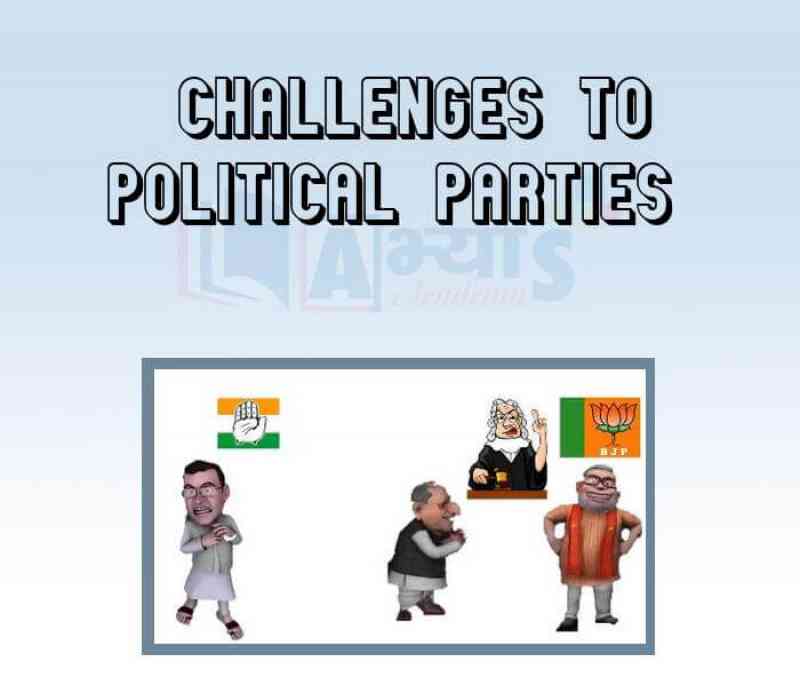
CHALLENGES OF POLITICAL PARTIES
 Shreya
The challenges faced by political parties are:
(i)The first challenge is lack of internal democracy within the parties. Parties do not keep membership registers, do not hold organisational meetings, and do not conduct internal elections regularly.
(ii) The second challenge of dynastic succession related to the first one. Those who happen to be the leaders are in a position to unfair advantage to favour people close to them even their family members.
(iii)The third challenge is about the growing role of money and muscle power in politics. Parties tend to nominate those candidate who have or can raise lots of money.
(iv)The fourth challenge is that very often parties do not seems to offer a meaningful choice to the voters. In order to offer meaningful choice, parties must be significantly different.
There are thousands of leaders and millions of members in a Political Party, but decisions are taken by one or two leaders. Son of cm will be the next cm, and next president of the political party will be the daughter of the current president. Parties fail to offer a meaningful choice to the voters. These are some of the major problem areas, where all the Political Parties are criticised.
All over the world, not only in India, people express their dissatisfaction with the failure of the Political Parties. Political Parties fail to Perform their functions due to four major problems or challenges faced by the political parties.
I) Lack of internal democracy
Political Parties are the most visible face of Democracy, but there is a lack of internal democracy within parties. Sometimes, parties do not follow the principals of democracy.
Power is concentrated in one or a few leaders at the top. Only Top leaders make the decision or choose the candidates; they do not consult with other members.
Every member of the party does not have a chance to take part in the decision-making process. As decisions are taken by the top leaders, other members don't get a chance in the decision-making process. They are only for name shake in the party.
Parties do not keep a membership register or hold the organizational meeting. There are thousands of members who work for the party, but there is no proper organization or registration of members. Sometimes Members work hard for the party but don’t get recognised.
Parties do not conduct internal elections regularly. In each party, there are internal elections for a different post like a secretary or president, but sometimes elections never take place and posts are given to the members directly by top leaders of the party,
Most of the members don’t get proper information about the inner working of the party. They find it difficult to continue with the party.
II) Dynastic Succession
The second challenge related to the first one, Lack of Internal democracy
In many parties, top positions are controlled by the members of one family. Top positions (like the president, general secretary state president) are given to relatives of the top leaders. This is unfair for the other members of the Party.
This is also bad for democracy since people do not have adequate experience or popular support come to occupy positions of pow. Without the ability to hold the positions some time these relatives become part of the government, which is very dangerous for the country. We can find this tendency in most parties, either regional or national.
III) Money and Muscle Power:
Parties choose those candidates who can raise money for the party and win elections with their money. All the parties need money, especially during elections, and that is why parties choose those candidates who can raise money for the party and use the money to win elections.
2. Rich Businessmen and companies who give funds to the party tend to influence the policies and decisions of the parties. As parties get the money during elections from the rich business houses, after winning they work for them and make policies to promote their businesses.
3. Sometimes parties also support criminals candidates because they can win elections.
IV) The meaningful choice to the voters
Political Parties do not seem to offer a meaningful choice to the voters. All political parties in India are similar to each other in actions and policies. The people who want different policies have no option available to them.
Most of the political parties have the same fundamental and ideological issues.
Sometimes people can not elect very different leaders either because leaders keep shifting from one party to another. People vote for one leader, as their policies are different from other parties. Still, after winning this leader join the same party he was against earlier. Thus voters get confused and lose belief in the political parties.
Source:
Click for the: Full Story
You might like









You Might Like this