


 Close Menu
 World
 Biography
 Health
 Education
 Business
 Lifestyle
 Sports
 Technology
 Animals
 History
 Food
 Religious
 Startups
 Movies
 Politics
 Fashion
 Covid
 Diet
 Fitness
 Marketing
 Travel
 Science
 Reviews
 Social media
 Stories
 Facts
 Art
 Entertainment
Ai agent
Business
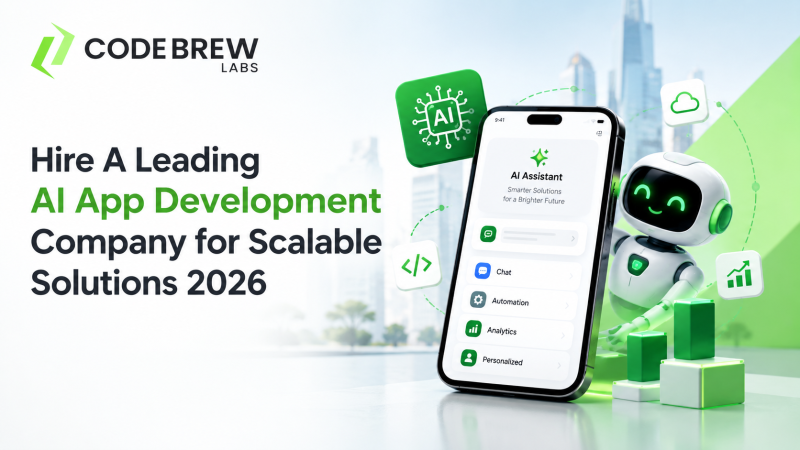
Hire a Leading AI App Development Company for Scalable Solutions
 Ai agent
Artificial intelligence has evolved from being a mere experiment to becoming a fundamental part of everyday infrastructure. By 2026, customers will expect applications that not only understand their needs but also provide answers within seconds and improve with each interaction. Creating such a product requires more than just a great idea; it necessitates the right partner.
Hiring a leading AI app development company is one of the quickest ways to transform this ambition into a reliable, scalable product, without the lengthy process of building an in-house team.
This guide will explain what an AI app development company does, which AI app development services are most important, how to evaluate potential vendors, and how to plan for artificial intelligence app development that continues to operate effectively as your user base expands.
Why Businesses Are Investing in Artificial Intelligence App Development in 2026
Three significant shifts are making 2026 a turning point for AI development. First, foundation models and APIs have become more capable and affordable, enabling even mid-sized companies to implement features like natural language search, document understanding, and AI assistants. Second, users are now comparing every app to the best AI tools they use daily, which raises expectations for personalization and speed. Third, leadership teams are increasingly demanding measurable returns from AI investments rather than just impressive demos.
As a result, there is a noticeable gap between prototypes and production systems. Many teams can create a proof of concept in a weekend, but far fewer can deliver an AI product that is accurate, secure, cost-effective, and able to handle ten times the traffic. This gap is precisely where an experienced partner provides significant value.
What Is an AI App Development Company?
An AI app development company consists of engineers, data scientists, product designers, and cloud specialists who collaboratively plan, build, deploy, and maintain software powered by artificial intelligence. Unlike a general web or mobile agency, this type of company is proficient in handling data pipelines, machine learning models, large language models (LLMs), evaluation methods, and the infrastructure necessary for their reliable operation.
A strong partnership covers the entire lifecycle of the project, including discovery, data preparation, model selection, app development, integration, testing, launch, and ongoing monitoring. This structure provides you with one accountable team, eliminating the confusion of dealing with multiple vendors who may blame each other when issues arise.
Core AI App Development Services to Look For
Not every provider offers the same range. When comparing AI app development services, check whether the company can deliver these capabilities:
- AI strategy and consulting: identifying high-value use cases, estimating return on investment and defining a realistic roadmap before any code is written.
- Custom machine learning development: training, fine-tuning and validating models on your own data for tasks such as forecasting, classification and anomaly detection.
- Generative AI and LLM apps: chatbots, copilots, content tools and retrieval-augmented generation (RAG) systems that answer questions from your private knowledge base.
- AI agents and workflow automation: software that can plan steps, call tools and complete tasks such as processing invoices or triaging support tickets.
- Computer vision: image and video analysis for quality inspection, identity checks, retail analytics and medical imaging support.
- Natural language processing and voice: sentiment analysis, speech recognition, translation and multilingual assistants.
- Recommendation and personalization engines: systems that suggest the next best product, article or action for each user.
- MLOps and cloud deployment: automated pipelines, monitoring, versioning and cost control so models stay healthy after launch.
- System integration: connecting AI features to your CRM, ERP, payment, analytics and legacy systems.
- Maintenance and optimization: regular retraining, prompt and model updates, security patches and performance tuning.
Benefits of Hiring a Leading AI App Development Company
Faster time to market. An experienced team reuses proven architectures, testing frameworks and deployment pipelines, which shortens the path from idea to launch.
Lower risk. Experts know where AI projects fail: poor data quality, unclear success metrics, hallucinated answers, runaway cloud bills and weak security. They plan for these problems early.
Access to specialized talent. Machine learning engineers, prompt engineers, data engineers and MLOps specialists are expensive and hard to hire. A partner gives you access to the whole bench on demand.
Built-in scalability. Scalable design is a habit, not an afterthought. A good company plans for growth in users, data volume and model complexity from the first sprint.
Responsible AI practices. Mature vendors build in privacy, bias testing, human review and audit trails, which matters more each year as regulation around AI tightens worldwide.
How to Choose the Right AI App Development Company
Use this checklist to separate genuine experts from vendors who simply added AI to their website.
- Look for proven production work. Ask for case studies of AI apps that are live with real users, not only prototypes. Request measurable outcomes such as reduced handling time, higher conversion or improved accuracy.
- Check technical depth. The team should be comfortable with modern frameworks, cloud platforms, vector databases, LLM providers and open-source models, and should explain trade-offs in plain language.
- Evaluate their data approach. Ask how they clean, label, secure and govern data. Strong artificial intelligence app development begins with strong data practices.
- Confirm security and compliance. Depending on your industry, you may need alignment with GDPR, HIPAA, SOC 2, ISO 27001 or local data-protection laws. Ask where data is stored and whether it is used to train third-party models.
- Insist on clear evaluation methods. A trustworthy partner defines accuracy, latency and cost targets up front and tests against them continuously.
- Review communication and process. Look for transparent sprints, regular demos, shared dashboards and a single point of contact.
- Understand ownership. Make sure you own the code, trained models, prompts and data pipelines created for you.
- Ask about post-launch support. AI systems drift as data and user behavior change. Ongoing monitoring and retraining should be part of the agreement.
Questions to Ask Before You Sign
- Which of our use cases are realistic for AI today, and which are not?
- How will you measure whether the app is working?
- What happens to our data, and who can access it?
- How will costs change when usage grows tenfold?
- Who owns the models, code and documentation at the end?
- Can you show a similar project that is still running in production?
Honest answers, including the admission that an idea may not need AI at all, are a good sign.
The Artificial Intelligence App Development Process, Step by Step
- Discovery and goal setting. Define the business problem, target users, success metrics and constraints. Decide whether AI is the right tool.
- Data assessment. Review the data you have, its quality, its sensitivity and what is missing.
- Prototype and validation. Build a small working version to test feasibility, accuracy and user reaction before major investment.
- Model selection and training. Choose between a hosted LLM, an open-source model or a custom-trained model, balancing quality, cost, speed and privacy.
- App development and integration. Build the user interface, back end, APIs and connections to your existing systems.
- Testing and evaluation. Test for accuracy, bias, safety, load and security, including red-team style checks on generative features.
- Deployment. Launch gradually, often to a small group first, with monitoring in place from day one.
- Monitoring and improvement. Track quality, cost and user feedback, then retrain and refine on a regular schedule.
What Scalable AI Architecture Looks Like
Scalability means the app keeps performing well and stays affordable as demand grows. A capable AI app development company typically designs for the following:
- Modular design. Separate services for the interface, business logic, data and models, so any part can be upgraded or scaled independently.
- Cloud-native infrastructure. Containers, auto-scaling and managed services that add capacity during peaks and release it afterward.
- Smart model routing. Using smaller, cheaper models for simple requests and larger models only when needed to control cost.
- Caching and efficient retrieval. Reusing results and using well-tuned vector search to cut latency and spending.
- Observability. Dashboards that track response quality, speed, errors and cost per request.
- Guardrails and fallbacks. Safety filters, confidence thresholds and human escalation paths for sensitive situations.
Industry Use Cases for AI Apps
Healthcare: appointment assistants, clinical documentation support and imaging analysis tools that assist, rather than replace, professionals.
Retail and e-commerce: personalized recommendations, visual search, demand forecasting and conversational shopping assistants.
Finance and insurance: fraud detection, document processing, risk scoring and customer service automation.
Logistics and manufacturing: route optimization, predictive maintenance and automated quality inspection.
Education: adaptive learning paths, tutoring assistants and automated feedback.
Customer support and operations: AI agents that resolve routine requests, summarize conversations and hand complex cases to people.
How Much Does AI App Development Cost?
Cost varies based on several factors, including the project's scope, data readiness, model selection, integrations, and compliance requirements. A focused pilot project, like a document question-answering assistant, can often be completed within a few weeks. In contrast, developing a multi-feature platform with custom models, complex integrations, and stringent security requirements will take longer and incur significantly higher costs.
It's also important to budget for ongoing expenses, such as cloud infrastructure, model usage fees, monitoring, and maintenance.
A practical strategy is to begin with a small, well-defined pilot project to demonstrate its value before expanding further. When approaching vendors, request a phased estimate that includes clear deliverables, rather than a single, vague cost figure.
Final Thoughts
The companies thriving with AI in 2026 will not necessarily be the ones showcasing the most impressive demos. Instead, they will be those that focus on providing reliable, secure, and measurable AI solutions to real users, continually improving these solutions over time.
To maximize the chances of your project becoming a success story, it’s essential to choose a leading AI app development company that has a proven track record, strong data practices, and a mindset geared toward scalable architecture.
Start by clearly identifying the business problem you want to address. Then, use the following checklist to shortlist potential partners. Conduct a small pilot project to test their capabilities, and when you find what works, scale it up. With the right team dedicated to your artificial intelligence app development, you can confidently transition from an idea to a dependable, growth-oriented product.
Frequently Asked Questions
What does an AI app development company do?
It designs, builds, deploys and maintains software that uses artificial intelligence, including machine learning models, generative AI features, automation and analytics, and connects them to your existing systems.
How do I choose the best AI app development company?
Review production case studies, technical depth, data security practices, evaluation methods, communication style and post-launch support. Start with a small paid pilot to test the working relationship.
How long does artificial intelligence app development take?
A focused prototype can take a few weeks, while a production-ready, multi-feature application commonly takes several months. Timelines depend on data readiness, integrations and compliance requirements.
Are AI app development services only for large enterprises?
No. Startups and mid-sized businesses benefit as well, especially now that pre-trained models and cloud tools lower the barrier to entry. A phased approach keeps budgets manageable.
Will my data be safe?
It can be, if the company follows strong security practices, uses encryption and access controls, and is clear about where data is stored and whether it is used for model training. Always confirm this in writing.
Source:
Click for the: Full Story
You might like









You Might Like this