Close Menu
 World
World
 Biography
 Health
 Education
 Business
 Lifestyle
 Sports
 Technology
 Animals
 History
 Food
Food
 Religious
 Startups
 Movies
 Politics
 Fashion
 Covid
Covid
 Diet
Diet
 Fitness
 Marketing
 Travel
 Science
 Reviews
 Social media
 Stories
 Facts
Facts
 Art
Art
 Entertainment
samiksha

Business
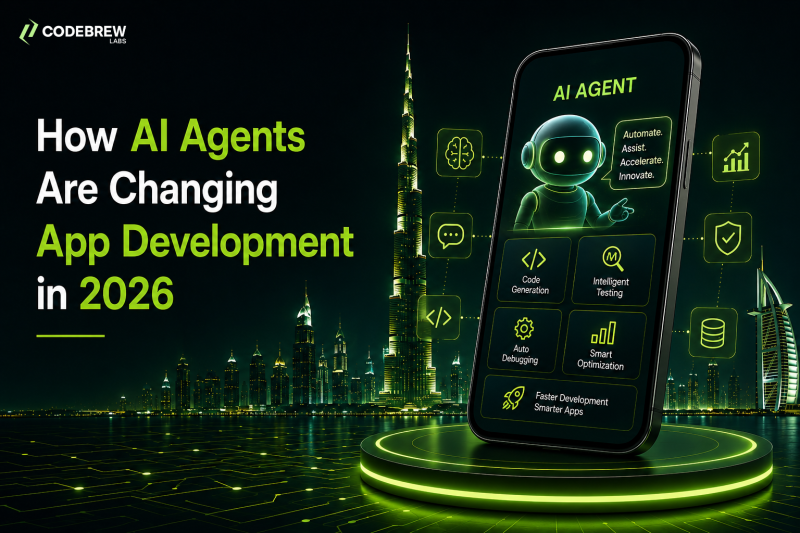
How AI Agents Are Changing App Development in 2026
 samiksha
Mobile app development is entering a new phase in 2026. Traditionally, applications were designed around screens, menus, buttons, and predefined workflows. Users would open an app, search for a feature, complete a task, and then move on.
However, AI agents are starting to change that model. Instead of merely responding to commands, AI agents can interpret user intent, reason through tasks, interact with software tools, and complete multi-step workflows. This evolution is pushing app development away from traditional feature-based experiences toward more intelligent and task-oriented applications. Current discussions in the industry increasingly suggest that AI agents will become a core component of both enterprise and mobile software experiences.
For businesses, this shift means that the question is no longer simply whether an app should incorporate AI. The more significant question is how AI agents can be integrated into the application's core functionality.
What Are AI Agents?
An AI agent is an intelligent software system designed to understand a goal, determine the steps required to achieve it, use available tools, and take action with limited human intervention.
A traditional chatbot might answer:
"What properties are available in Dubai Marina?"
An AI agent could go further. It could understand the user's budget and preferences, search a property database, compare available listings, shortlist suitable options, and potentially initiate the next step in the booking or inquiry process.
This difference is important.
Traditional AI often focuses on generating a response. Agentic AI focuses more on achieving an objective.
That shift is influencing how developers design mobile applications in 2026.
From Feature-Based Apps to Intent-Based Experiences
Traditional applications require users to understand how the application works.
If someone wants to order a service, they may need to open an app, select a category, choose a provider, enter information, confirm details, and complete payment.
An AI-powered agent can simplify this experience.
A user could simply say:
"Book me the fastest available cleaning service for tomorrow afternoon."
The agent can interpret the request, check availability, compare options, and guide or execute the required steps.
This creates a more intent-driven application experience, where users communicate what they want instead of manually navigating through every feature.
The broader mobile ecosystem is increasingly exploring this shift from app-centric interactions toward intent-driven experiences.
How AI Agents Are Changing App Development
1. Developers Are Designing Around AI From the Beginning
Previously, businesses could build an application first and add a chatbot or recommendation engine later.
In 2026, developers increasingly need to consider AI architecture during the initial planning stage.
This includes deciding:
- What tasks the agent should perform
- Which tools it can access
- What information it can retrieve
- What actions require user approval
- How the agent should maintain context
- How errors should be detected and handled
This changes the role of app architecture. AI is no longer necessarily an isolated feature; it can become part of the application's core workflow.
2. AI Agents Are Automating Multi-Step Tasks
One of the biggest advantages of agentic applications is workflow automation.
Consider a business travel application. Instead of making users search flights, compare hotels, check schedules, and organize travel details independently, an AI agent could coordinate these tasks based on the user's requirements.
Similarly, an enterprise application could allow an employee to request:
"Prepare this month's sales report and highlight the regions where revenue declined."
The agent could retrieve relevant data, analyze it, generate a report, and present the findings.
This type of automation can reduce repetitive work and improve productivity.
3. Mobile Apps Are Becoming More Conversational
AI agents are also changing how users interact with mobile applications.
Instead of navigating through multiple screens, users can communicate naturally through text, voice, or increasingly multimodal interfaces.
For example, an eCommerce customer might upload an image and ask:
"Find me a similar jacket under $150."
The application can combine image understanding, product search, personalization, and conversational AI to respond.
This creates a more natural interaction between the user and the application.
4. Personalization Is Becoming More Intelligent
Traditional personalization often relies on predefined rules.
AI agents can analyze broader context, including previous interactions, preferences, current requests, and available data.
For example, a financial application could recognize that a user is planning a major purchase and provide relevant budgeting insights. A fitness application could adjust recommendations based on previous activity. A travel application could suggest experiences based on a user's itinerary and preferences.
The objective is to move from "recommended for you" toward experiences that dynamically adapt to what the user is trying to accomplish.
5. Developers Are Building Tool-Connected Agents
An AI agent becomes considerably more useful when it can interact with external systems.
Modern agent architectures can connect AI models with APIs, databases, search systems, payment services, CRM platforms, calendars, enterprise software, and other tools.
For example, a restaurant application could use an AI agent to:
- Understand a customer's request.
- Search available restaurants.
- Check relevant information.
- Recommend options.
- Confirm the customer's selection.
- Complete an approved booking workflow.
The AI model provides reasoning and language capabilities, while connected tools allow the agent to perform useful actions.
This is why agent development requires careful planning around permissions, tool boundaries, authentication, and data access.
6. On-Device AI Is Becoming More Important
Another development influencing mobile applications is the growth of on-device AI.
Instead of sending every request to a remote server, certain AI tasks can be processed directly on smartphones and other edge devices. This can improve responsiveness and reduce the amount of sensitive information that needs to leave the device. Industry coverage of 2026 mobile development increasingly highlights on-device AI and edge intelligence as important trends.
For businesses, this can be particularly valuable for applications that require fast responses or handle sensitive information.
However, developers must balance model size, device capabilities, battery consumption, privacy requirements, and performance.
AI Agents Across Different Industries
The impact of AI agents is not limited to technology companies.
Healthcare
AI agents can assist with appointment scheduling, patient communication, reminders, administrative workflows, and information retrieval.
Human professionals should remain involved where decisions require clinical judgment.
Real Estate
Real estate applications can use agents to understand buyer requirements, search listings, compare properties, answer questions, and assist with lead qualification.
eCommerce
AI agents can become shopping assistants that help users discover products, compare options, answer questions, and personalize recommendations.
Fintech
Financial applications can use agents for customer support, transaction analysis, financial insights, and workflow automation while maintaining strong security and authorization controls.
Logistics
AI agents can coordinate delivery information, route-related workflows, customer communication, and operational tasks.
AI Agents Are Also Changing the Developer's Role
AI is not only changing the applications developers build. It is also changing how developers build them.
AI-assisted development tools can help generate code, create tests, identify potential issues, and accelerate repetitive development tasks. This allows developers to spend more time on architecture, product logic, security, user experience, and quality assurance.
However, AI-generated code still requires human review. Recent developer experiences highlight that AI can significantly increase coding speed while also creating risks such as incorrect implementations, security vulnerabilities, or nonexistent libraries.
The future therefore looks less like AI replacing developers and more like developers working with AI to build applications faster and differently.
Security Becomes More Important
As AI agents gain the ability to perform actions, security becomes a much bigger concern.
A chatbot that provides incorrect information is problematic. An agent that can access accounts, modify records, make purchases, or send messages can create much greater risks if it is poorly designed.
Developers therefore need strong controls around:
- User authentication
- Permission management
- Data access
- Tool authorization
- Prompt and input validation
- Human approval for sensitive actions
- Activity monitoring
- Audit trails
- Error handling
Recent research has also identified security risks in mobile AI agents that interact with applications, highlighting the importance of context isolation and trustworthy input handling.
What This Means for Businesses
Businesses planning a new application in 2026 should consider AI agents as part of their long-term product strategy.
However, adding an agent simply because it is popular is unlikely to create meaningful value.
The better approach is to identify repetitive, complex, or time-consuming workflows where an intelligent agent can make a measurable difference.
A business might begin with one focused use case, validate its performance, and gradually expand the agent's capabilities.
This approach can make AI adoption more manageable while providing real-world feedback before significant investment.
Building AI Agent-Powered Apps With Code Brew Labs
Developing an agent-powered mobile application requires more than integrating an AI model. It requires mobile engineering, backend development, AI integration, API connectivity, security architecture, UX design, and ongoing optimization.
Code Brew Labs helps businesses explore and develop digital products across mobile app development, AI, IoT, blockchain, and other emerging technologies. With 13+ years of industry experience, 2,500+ successfully delivered digital solutions, and 250+ technology professionals, the company focuses on building scalable technology solutions for businesses across different markets.
For companies planning AI-first applications, the right development partner can help identify practical agent use cases and turn them into secure, scalable products.
Conclusion
AI agents are changing app development in 2026 by moving applications from passive tools toward intelligent systems capable of understanding intent, personalizing experiences, automating workflows, and interacting with external services.
The biggest change is not simply the addition of AI features. It is the shift in how applications are designed.
Instead of asking users to navigate an application step by step, businesses can increasingly build experiences where users communicate their goals and the application helps accomplish them.
For companies investing in mobile technology today, this creates a significant opportunity. The next generation of successful applications may not just be apps with AI—they may be applications designed around intelligent agents from the ground up.
Source:
Click for the: Full Story
You might like