



 Close Menu
 World
World
 Biography
 Health
 Education
 Business
 Lifestyle
 Sports
 Technology
 Animals
 History
 Food
Food
 Religious
 Startups
 Movies
 Politics
 Fashion
 Covid
Covid
 Diet
Diet
 Fitness
 Marketing
 Travel
 Science
 Reviews
 Social media
 Stories
 Facts
Facts
 Art
Art
 Entertainment
Mamta Devi

Business
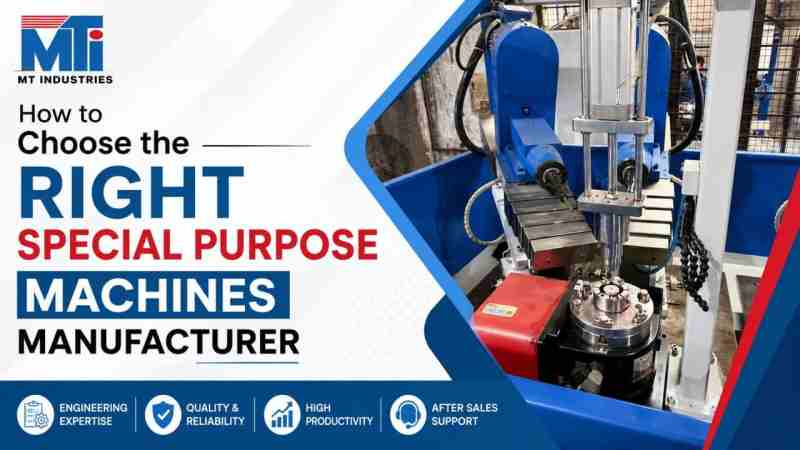
How to Choose the Right Special Purpose Machines Manufacturer
 Mamta Devi
Choosing the right Special Purpose Machines Manufacturer is an important decision for any manufacturing business investing in automation. An SPM is not simply another machine purchase. It is usually designed around a specific production process, component, cycle time, tooling requirement, and quality target. A poorly matched machine can create problems with downtime, maintenance, production consistency, and future scalability.
The right manufacturer, on the other hand, can help convert a repetitive production process into a more reliable and efficient operation.
Whether you need a drilling machine, tapping machine, assembly system, multi-operation SPM, or another customized solution, the selection process should go beyond price. You need to evaluate engineering capability, customization, machine quality, controls, after-sales support, and the manufacturer's understanding of your application.
This guide explains the key factors to consider when selecting a Special Purpose Machines Manufacturer for your production requirements.
What Is a Special Purpose Machine?
A Special Purpose Machine (SPM) is an industrial machine designed to perform a specific manufacturing operation or a defined combination of operations. Unlike general-purpose equipment, an SPM is developed around the requirements of a particular component or production process.
For example, an SPM may be designed for:
- Multi-spindle drilling
- Multi-point tapping
- Drilling and tapping in a single cycle
- Component assembly
- Pressing and insertion
- Facing, boring, or machining
- Automated inspection
- Material handling and production integration
The objective is generally to achieve a controlled production cycle with improved productivity, repeatability, accuracy, and process consistency.
Because these machines are application-specific, the capabilities of the manufacturer become particularly important.
Why Choosing the Right SPM Manufacturer Matters
An SPM directly interacts with your production process. Its design affects cycle time, operator involvement, tooling life, maintenance requirements, and product quality.
An experienced SPM Machines Manufacturer should therefore understand more than machine construction. The manufacturer needs to understand the relationship between the component, tooling, fixtures, cutting parameters, machine controls, and production targets.
For instance, reducing cycle time is not useful if the change results in excessive tool wear or poor component accuracy. Similarly, adding automation does not necessarily improve productivity if the machine becomes difficult to maintain.
A good manufacturer looks at the complete production requirement rather than focusing on one specification.
1. Start With Your Production Requirements
Before approaching any Special Purpose Machines Manufacturer in India, clearly define what you expect the machine to accomplish.
Important requirements include:
- Component dimensions and material
- Number of operations
- Required production quantity
- Target cycle time
- Required accuracy and repeatability
- Existing tooling
- Fixture requirements
- Operator involvement
- Available floor space
- Loading and unloading method
- Inspection requirements
- Future production requirements
A detailed application requirement gives the manufacturer a better foundation for machine design.
Instead of simply asking for a “high-speed SPM,” explain the actual production problem you need to solve.
2. Check the Manufacturer's Engineering Capability
The engineering capability of an SPM Machines Manufacturer is one of the most important selection criteria.
Ask how the manufacturer approaches machine design. A capable engineering team should be able to evaluate:
- Machine structure
- Spindle arrangement
- Drive selection
- Tooling requirements
- Fixture design
- Hydraulic or pneumatic systems
- Electrical controls
- Safety systems
- Automation requirements
- Component accessibility
- Maintenance considerations
For a complex application, the manufacturer may need to develop a customized machine rather than modify an existing standard model.
This is where engineering experience can make a significant difference.
3. Look for Application-Specific Customization
One of the biggest advantages of an SPM is customization.
A reliable Special Purpose Machines Manufacturer should be able to adapt the machine according to the application instead of forcing the production process to fit a fixed machine configuration.
Customization can involve:
- Number and position of spindles
- Tool arrangement
- Fixture design
- Component loading
- Automatic part transfer
- Number of machining stations
- Hydraulic or pneumatic clamping
- Sensors and interlocks
- PLC-based controls
- Automatic lubrication
- Inspection integration
The level of customization required depends on the component and production volume.
4. Evaluate Machine Accuracy and Repeatability
Production speed should never be considered separately from quality.
When comparing an SPM Machines Manufacturer in India, ask how machine accuracy and repeatability are maintained during continuous operation.
Important areas include:
- Machine rigidity
- Spindle quality
- Fixture accuracy
- Tool positioning
- Guide systems
- Clamping consistency
- Thermal considerations
- Alignment procedures
- Quality-control practices
A machine that produces the first few components accurately but loses consistency during long production runs is not an effective solution.
The goal should be stable and repeatable production, not just a good trial run.
5. Consider Cycle Time and Overall Productivity
Cycle time is often one of the primary reasons manufacturers invest in SPM technology.
However, don't evaluate cycle time using a single number supplied during a sales discussion. Understand what the cycle includes.
Ask whether the quoted cycle time covers:
- Component loading
- Clamping
- Machining
- Tool retraction
- Part unloading
- Transfer time
- Inspection
- Any required manual intervention
A realistic production cycle provides a much better basis for calculating output.
The right Special Purpose Machines Manufacturer should be able to explain how the proposed machine configuration achieves the required cycle time.
6. Examine Tooling and Fixture Design
Tooling and fixtures can significantly influence the performance of an SPM.
A good fixture should provide reliable component positioning and clamping while allowing efficient loading and unloading. Tooling should be selected according to the material, operation, required surface finish, production volume, and cutting conditions.
Ask the manufacturer:
- Who designs the fixtures?
- How is component positioning controlled?
- How are tools changed?
- What happens when tooling wears?
- Can tooling be adjusted or replaced easily?
- How is tool life monitored?
A machine may have excellent mechanical specifications, but poor fixture or tooling design can still limit its production performance.
7. Check Automation and Control Systems
Modern SPMs may incorporate PLC controls, sensors, safety interlocks, automatic lubrication, part detection, and material-handling systems.
When evaluating an SPM Machines Manufacturer, understand how these systems are integrated.
The control system should be practical for your operators and maintenance team. Important considerations include:
- User-friendly HMI
- Fault diagnostics
- Cycle monitoring
- Sensor feedback
- Safety interlocks
- Parameter management
- Emergency-stop systems
- Maintenance access
Automation should make the process more controlled—not unnecessarily complicated.
8. Assess Maintenance and Service Support
Even a well-designed machine requires maintenance.
Before choosing a Special Purpose Machines Manufacturer, ask about the manufacturer's approach to service and support.
Consider:
- Availability of critical spare parts
- Service response
- Preventive maintenance guidance
- Troubleshooting support
- Operator training
- Maintenance documentation
- Electrical and mechanical drawings
- Recommended consumables
A machine that is easy to maintain can reduce avoidable downtime over its operating life.
MT Industries, for example, approaches SPM development around application requirements, with experience across multi-drilling, multi-tapping, and multi-operation machines. Such experience can be useful when the production process involves several coordinated operations.
9. Review Previous Machine-Building Experience
Experience should be evaluated based on relevance, not just the number of years a company has existed.
When assessing a Special Purpose Machines Manufacturer in India, ask whether the manufacturer has worked on applications similar to yours.
Look for evidence of experience with:
- Similar components
- Similar materials
- Comparable production volumes
- Similar machining operations
- Comparable automation levels
- Similar accuracy requirements
A manufacturer with relevant application experience is generally better positioned to identify potential design issues before machine commissioning.
10. Compare Total Cost, Not Just Purchase Price
Price is important, but the lowest initial quotation may not provide the lowest overall cost.
Evaluate the machine using total cost of ownership (TCO).
This can include:
Purchase cost + tooling + installation + energy + maintenance + spare parts + downtime + operator requirements
A slightly higher initial investment may make financial sense if the machine delivers better uptime, longer tool life, easier maintenance, and consistent production.
Ask every manufacturer to clearly define what is included in the quotation so that comparisons are made on an equivalent basis.
11. Consider Future Production Needs
Your current production requirement may not remain unchanged.
Before selecting an SPM Machines Manufacturer, consider whether the machine can accommodate reasonable future changes.
Questions worth asking include:
- Can tooling be modified?
- Can additional automation be integrated?
- Can production parameters be adjusted?
- Can the machine handle product variants?
- Are critical components readily replaceable?
- Can the machine be upgraded later?
Thinking about future requirements during the design stage can prevent expensive modifications later.
12. Verify Installation and Commissioning Process
Machine delivery is not the end of the project.
Installation, commissioning, trial production, operator training, and process validation are all important stages.
A professional manufacturer should clearly explain:
- Machine design and approval
- Manufacturing
- Internal testing
- Factory acceptance or trial
- Transportation
- Installation
- Commissioning
- Production trials
- Operator training
- Handover documentation
MT Industries considers the application and production process while developing SPM solutions, which is particularly important when the machine involves multiple synchronized operations.
13. Ask the Right Questions Before Finalizing
Before placing an order, ask the shortlisted SPM Machines Manufacturer these questions:
- What production cycle can the machine realistically achieve?
- What accuracy and repeatability can be expected?
- Which operations are included?
- What tooling and fixtures are included?
- What automation is included?
- What utilities are required?
- What maintenance schedule is recommended?
- Which spare parts should be kept in stock?
- What training is provided?
- What documentation will be supplied?
- How will the machine be tested before dispatch?
- What happens if production requirements change?
The answers can reveal the manufacturer's technical understanding and level of project planning.
Why MT Industries Can Be Considered During Manufacturer Evaluation
When evaluating potential manufacturers, companies such as MT Industries can be assessed based on their experience with application-focused SPM solutions.
Its work around multi-drilling, multi-tapping, and multi-operation SPMs reflects the type of engineering capability manufacturers should examine when comparing suppliers.
The important point is not simply the manufacturer name. It is whether the supplier can understand the application, develop an appropriate machine configuration, validate the process, and provide practical support throughout the machine's operating life.
Final Checklist for Choosing an SPM Manufacturer
Before making your final decision, use this checklist:
✓ Understand your production requirement
✓ Compare relevant engineering experience
✓ Evaluate customization capability
✓ Check machine accuracy and repeatability
✓ Validate realistic cycle time
✓ Review tooling and fixture design
✓ Examine automation and controls
✓ Assess maintenance and service support
✓ Compare total cost of ownership
✓ Check installation and commissioning support
✓ Consider future production requirements
✓ Request clear technical documentation
Conclusion
Choosing the right Special Purpose Machines Manufacturer is ultimately an engineering decision rather than simply a purchasing decision. The best choice depends on how well the manufacturer understands your component, production process, quality requirements, cycle-time target, automation needs, and long-term operating conditions.
A capable SPM Machines Manufacturer in India should provide more than a machine. The manufacturer should contribute to application engineering, machine design, tooling, automation, commissioning, training, and ongoing support.
MT Industries is one example of a manufacturer operating in the SPM segment, with its focus on specialized drilling, tapping, and multi-operation applications.
Before making a final investment, compare suppliers on technical capability, application experience, machine reliability, customization, maintainability, support, and total operating value. This approach can help manufacturers choose an SPM solution that supports consistent production today while remaining practical for future requirements.
Frequently Asked Questions
1. How do I choose the right Special Purpose Machines Manufacturer?
Start by evaluating the manufacturer's engineering experience, customization capability, machine accuracy, cycle-time performance, tooling expertise, automation capabilities, service support, and relevant application experience. Request technical details and compare the complete solution rather than only the machine price.
2. What should I ask an SPM Machines Manufacturer before buying?
Ask about expected cycle time, machine accuracy, fixture and tooling design, automation, controls, utilities, maintenance, spare parts, installation, commissioning, training, documentation, and after-sales support. Also ask whether the manufacturer has handled applications similar to yours.
3. Why choose a Special Purpose Machines Manufacturer in India?
A Special Purpose Machines Manufacturer in India can provide locally accessible engineering, installation, commissioning, service, and spare-parts support. For Indian manufacturing facilities, local technical support can also simplify communication and maintenance coordination.
4. Are SPM machines suitable for high-volume production?
Yes. SPM machines are particularly useful for repetitive, high-volume manufacturing where consistent cycle times, repeatability, and reduced manual intervention are important. The machine should be designed according to the component, production volume, and required operations.
5. What makes a reliable SPM Machines Manufacturer in India?
A reliable SPM Machines Manufacturer in India should demonstrate relevant engineering experience, transparent technical specifications, robust machine construction, customization capability, quality control, proper commissioning, documentation, and dependable after-sales support. MT Industries can also be included in a supplier comparison when evaluating manufacturers for drilling, tapping, and multi-operation SPM requirements.
For More Information Click Here:- https://mtindustries.in/service-spm
Source:
Click for the: Full Story
You might like






You Might Like this