Close Menu
 World
World
 Biography
 Health
 Education
 Business
 Lifestyle
 Sports
 Technology
 Animals
 History
 Food
Food
 Religious
 Startups
 Movies
 Politics
 Fashion
 Covid
Covid
 Diet
Diet
 Fitness
 Marketing
 Travel
 Science
 Reviews
 Social media
 Stories
 Facts
Facts
 Art
Art
 Entertainment
Priyanshu codebrew
Business
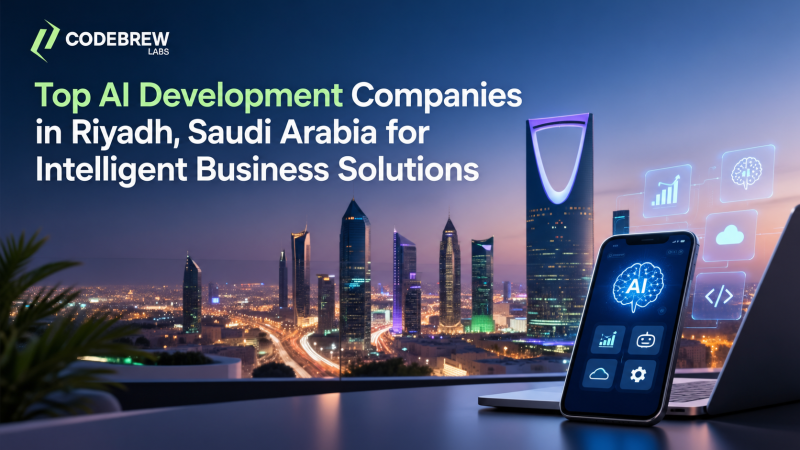
Top AI Development Companies in Riyadh, Saudi Arabia for Intelligent Business Solutions
 Priyanshu codebrew
What happens when an AI project moves beyond a prototype and has to work with real customers, real business data, Arabic-language users, existing enterprise systems, and the operational demands of a growing Saudi business?
That is where the choice of an AI App Development Company in Riyadh becomes more complicated than simply finding a team that can connect an application to an AI model.
Saudi Arabia's AI ecosystem is expanding around a much broader set of requirements. The Saudi Data & AI Authority (SDAIA) identifies AI adoption, data governance, cybersecurity, digital infrastructure, Arabic-language technologies, smart cities, research, and national AI capabilities among its strategic objectives. SDAIA also states that the National Strategy for Data & AI is intended to support Saudi Vision 2030 and build a data-driven economy.
The momentum is particularly visible in 2026. Saudi Arabia designated 2026 as the Year of Artificial Intelligence, with SDAIA coordinating initiatives intended to expand responsible AI adoption, innovation, infrastructure, and investment.
For companies building intelligent mobile products, that creates an interesting market: Riyadh now has access to broad software engineering firms, AI specialists, mobile development companies, agentic-AI teams, and regional technology providers.
We have therefore focused this list on companies that publicly describe capabilities relevant to AI, mobile applications, software engineering, automation, or intelligent business systems, while keeping the distinction between enterprise-oriented and startup-oriented requirements clear.
What Businesses Should Expect From an AI Development Partner in Riyadh
An AI application is rarely just an AI model wrapped inside a mobile interface.
A useful business product may need authentication, payment processing, CRM or ERP integration, analytics, cloud infrastructure, APIs, notifications, role-based access, multilingual UX, monitoring, and human review. The AI component may be a recommendation engine, conversational assistant, document-processing workflow, predictive model, computer-vision system, or agent that performs actions across business software.
For Saudi businesses, there can also be regional considerations around Arabic and English experiences, right-to-left interfaces, data handling, security, identity services, local payments, and regulatory requirements.
That means we would evaluate an AI development partner across three connected areas: AI engineering, product engineering, and local implementation capability.
The companies below offer different combinations of those capabilities.
1. Code Brew Labs
Code Brew Labs is a leading AI Development Company in Saudi Arabia specializing in AI-powered mobile applications, enterprise software, and custom digital solutions for startups, SMEs, enterprises, and government organizations. With over 13 years of experience, 2,000+ successful projects, and a team of 650+ technology professionals, the company delivers scalable Android, iOS, and cross-platform applications that help businesses across the Kingdom accelerate their Vision 2030-aligned digital transformation. By integrating technologies such as Artificial Intelligence, Machine Learning, Generative AI, Cloud Computing, and IoT, Code Brew Labs builds secure, innovative, and future-ready solutions across industries including fintech, healthcare, retail, logistics, education, travel, and real estate.
Key Services
- Custom Mobile App Development
- AI App Development
- Android App Development
- iOS App Development
- Flutter & React Native Development
- Enterprise Software Development
- UI/UX Design
- Product Discovery & Strategy
- Cloud & Backend Development
- Quality Assurance & Maintenance
Why Choose Code Brew Labs
Code Brew Labs combines AI expertise with modern mobile technologies to build secure, scalable, and high-performing applications tailored to the Saudi market. Its end-to-end development approach, experienced team, and deep focus on innovation make it a trusted technology partner for businesses in Riyadh, Jeddah, and beyond — helping them launch AI-powered digital products that comply with Saudi regulations and support long-term growth.
2. Dubai App Developers
Dubai App Developers is a premier AI Development Company in Saudi Arabia, specializing in enterprise-grade digital solutions for startups, enterprises, and government organizations across the Kingdom. With a strong focus on innovation, scalability, and business automation, the company develops production-ready applications designed to help Saudi businesses improve operational efficiency, enhance customer experiences, and drive Vision 2030-aligned digital transformation.
The company offers deep expertise in AI-powered mobile applications, AI automation, AI agents and RAG, custom AI development, AI consulting, computer vision, NLP, cloud AI, and data engineering. Its solutions are purpose-built to integrate with enterprise platforms while fully supporting Saudi compliance requirements, Arabic language capabilities, and RTL interface design.
Core Services
- AI App Development
- Mobile App Development
- iOS App Development
- Android App Development
- AI Automation & RPA
- AI Agents & RAG
- Custom AI Development
- AI Consulting & Strategy
- Computer Vision & NLP
- Cloud AI & Data Engineering
- Enterprise Software Development
- Enterprise System Integration
- UI/UX Design
- AI Validation & Prototyping
- Deployment & Continuous Support
Industries Served
Fintech, Real Estate, Retail, Logistics, Government, Healthcare, Automotive, Travel, IoT, Entertainment, Telecom, Security, and Sports.
3. Royo Apps
Royo Apps is a trusted AI Development Company in Saudi Arabia specializing in on-demand applications, SaaS platforms, and AI-powered digital solutions for startups, SMEs, and enterprises across the Kingdom. The company develops scalable Android, iOS, and cross-platform applications that help Saudi businesses launch branded marketplaces and digital platforms across industries such as healthcare, logistics, food delivery, eCommerce, transportation, and home services. With a strong focus on customization, Arabic language support, and rapid deployment, Royo Apps enables organizations throughout Riyadh, Jeddah, and Dammam to accelerate their digital transformation with flexible, business-ready solutions.
Key Services
- Custom Mobile App Development
- Android App Development
- iOS App Development
- Cross-Platform App Development
- On-Demand App Development
- SaaS Development
- Marketplace App Development
- UI/UX Design
- Cloud Solutions
- Maintenance & Support
Why Choose Royo Apps
Royo Apps combines AI capabilities with scalable mobile technologies to build customizable, user-friendly applications for the Saudi market. Its expertise in on-demand platforms, SaaS solutions, and end-to-end development makes it a reliable choice for organizations across the Kingdom looking to launch and grow digital products efficiently — with full support for Arabic interfaces and local business requirements.
4. Blocktech Brew
Blocktech Brew is an innovative AI Development Company in Saudi Arabia specializing in AI-powered mobile applications, blockchain, Web3, and custom software solutions. The company helps startups, SMEs, and enterprises across the Kingdom build scalable Android, iOS, and cross-platform applications by combining Artificial Intelligence, blockchain, and cloud technologies. Its end-to-end development services empower Saudi businesses to launch secure, innovative, and future-ready digital products that align with the Kingdom's National Technology Strategy and Vision 2030 objectives.
Key Services
- Custom Mobile App Development
- AI App Development
- Blockchain Development
- Web3 Development
- dApp Development
- Smart Contract Development
- Game Development
- UI/UX Design
- Enterprise Software Development
- Cloud Solutions
Why Choose Blocktech Brew
Blocktech Brew combines AI, blockchain, and mobile technologies to build secure, scalable, and high-performance applications for the Saudi market. Its expertise in emerging technologies, Arabic-ready interfaces, and end-to-end development makes it a trusted technology partner for businesses in Saudi Arabia seeking bold, innovative digital solutions.
5. Darb Productions
Darb Productions is a Riyadh-based software and mobile app development company that describes its work across Saudi startups, SMEs, enterprises, and government-adjacent organizations. Its public offering includes iOS and Android development, React Native, backend engineering, AI integration, API integration, Saudi-specific services, and bilingual Arabic-English applications.
For a business building an AI-enabled mobile product in Saudi Arabia, the local implementation details can matter as much as the model itself. Darb publicly highlights Arabic RTL interfaces and integrations involving services such as Nafath, ZATCA, mada, payment providers, and logistics platforms.
We would consider Darb particularly relevant for Saudi startups, SMEs, and enterprises that need a Riyadh-based product engineering team with local integration experience.
Its distinguishing quality is the emphasis on Saudi-specific mobile implementation, including Arabic RTL, local payment systems, backend engineering, and AI features within a broader product-development workflow.
6. VGA Softwares
VGA Softwares is a Riyadh-based software development company offering mobile and web applications, agentic AI, CRM and ERP systems, SaaS products, UI/UX, automation, and related engineering services. Its website describes work across Saudi Arabia and the GCC and positions mobile engineering as a core capability.
The company's agentic-AI offering is particularly relevant for organizations exploring systems that can perform multi-step tasks rather than simply respond to individual prompts. VGA describes agents that can interact with existing CRM, ERP, and inbox systems and escalate decisions to human teams when required.
We would consider VGA suitable for Saudi enterprises, growing GCC businesses, and startups building SaaS or operational software where AI needs to interact with business processes.
Its distinguishing quality is the connection between agentic AI and enterprise workflow software, rather than treating AI as only a chatbot or content-generation feature.
7. anabb.tech
anabb. tech is a Riyadh software company serving Saudi startups, SMEs, and enterprises with web applications, mobile apps, AI agents, MVP development, UI/UX, and product engineering. Its public offering specifically includes Arabic and English AI agents, chatbots, and workflow automation connected to business tools.
This profile makes it particularly relevant for organizations that are still validating an idea or turning an early concept into a working product.
We would consider anabb.tech a natural fit for startups, SMEs, and product teams seeking MVP development alongside AI automation. A company that needs to test product-market fit before committing to a large enterprise architecture may benefit from that broader product-building approach.
Its distinguishing quality is the combination of MVP development, product design, mobile/web engineering, and Arabic-English AI automation under one offering.
8. Digixvalley
Digixvalley describes itself as an AI, mobile app, and web development company serving Saudi startups, SMEs, enterprises, and digital transformation teams. Its Saudi offering covers AI applications, AI agents, RAG assistants, workflow automation, mobile applications, SaaS, fintech systems, cloud architecture, and dedicated development teams.
The company's Saudi mobile development material also emphasizes Arabic-first experiences, RTL support, local payment integrations, and architecture designed with Saudi operating requirements in mind.
We would consider Digixvalley relevant for startups and enterprises that need AI and mobile engineering together, particularly where the product will operate across several Saudi cities or eventually expand throughout the GCC.
Its distinguishing quality is the combination of AI engineering, mobile development, Arabic-first product design, and compliance-aware architecture.
How We Would Select an AI App Development Company in Riyadh
The first question should not be, "Which company has the most AI services?"
The better question is: What does the AI actually need to accomplish?
Suppose we are building an e-commerce application. A recommendation engine may be more useful than a general-purpose chatbot. If we are building a field-service platform, an AI assistant that summarizes work orders and creates follow-up tasks could provide more practical value. A financial organization may need document intelligence, anomaly detection, or predictive analytics, while a healthcare product may require highly controlled access to sensitive information and stronger human oversight.
The development partner should understand that distinction before development begins.
Define the AI Use Case Before the Technology Stack
A clear product brief should describe the users, workflow, data sources, business rules, integrations, mobile platforms, expected AI behavior, and measurable outcome.
For an AI assistant, that could mean defining the approved knowledge sources, retrieval architecture, escalation process, response boundaries, and audit requirements.
For predictive analytics, it could mean identifying historical datasets, target variables, data quality issues, retraining requirements, and the business decision the prediction is supposed to support.
For an AI agent, we should define exactly which systems the agent can access and which actions require human approval.
This prevents the common mistake of starting with a model and searching for a business problem afterward.
Arabic UX and Saudi Market Requirements Matter
A mobile application designed for Saudi Arabia should not treat Arabic as an afterthought.
Arabic UX, RTL layout, bilingual content, local payment methods, identity services, and regional integrations can affect product architecture from the beginning.
The same applies to AI. Arabic language performance can vary considerably depending on the model, data, prompting approach, retrieval layer, and evaluation methodology.
We should therefore ask prospective vendors to demonstrate how they will test Arabic and English responses, handle ambiguous user requests, manage sensitive information, and keep AI outputs within the application's intended scope.
SDAIA's strategic objectives explicitly include advancing Arabic-language technologies alongside responsible AI adoption, cybersecurity, digital infrastructure, and data governance.
Enterprise AI Requires More Than a Successful Demo
A prototype that works in a presentation is not necessarily a production system.
Before approving an enterprise AI project, we should examine authentication, authorization, logging, monitoring, data retention, model access, API security, fallback behavior, human review, performance, and ongoing maintenance.
The same principle applies to AI agents.
An agent that can read information is one thing. An agent that can modify customer records, issue refunds, send messages, create transactions, or change operational data requires much stronger controls.
The development partner should therefore explain what the AI can do, what it cannot do, how its actions are logged, and where human approval remains mandatory.
AI Development Cost Should Be Viewed as an Operating Requirement
The initial development budget is only one part of the calculation.
AI applications can generate ongoing expenses through model usage, cloud infrastructure, vector databases, monitoring, data processing, third-party APIs, security controls, retraining, evaluation, and maintenance.
We should therefore compare proposals based on the complete operating model rather than only the initial quotation.
A lower development price may not remain lower if the architecture creates excessive inference costs or requires extensive rebuilding after launch.
At the same time, a more sophisticated architecture is not automatically better. A simple workflow using established APIs can sometimes solve the business requirement without the cost and complexity of training or hosting a custom model.
What to Ask Before Signing an AI Development Contract
Before selecting a development partner, we would ask for clear answers to several practical questions:
- Which AI use cases has the team actually implemented?
- Who owns the source code and application architecture?
- Which external AI models and APIs will be used?
- Can the application switch models if business requirements change?
- How will Arabic and English outputs be evaluated?
- What happens when the AI produces an incorrect answer?
- Which data will be sent to external model providers?
- How will sensitive business information be protected?
- What integrations are included in the scope?
- Who monitors the application after launch?
- How are AI usage and infrastructure costs expected to scale?
- What happens when the model provider changes its API or pricing?
- Which parts of the system require human approval?
These questions expose the difference between a company that can demonstrate AI functionality and a technology partner capable of supporting an AI product over time.
Why Mobile Engineering and AI Engineering Need to Work Together
For many Saudi businesses, AI is not the final product.
The final product is a mobile banking experience, retail platform, logistics application, healthcare service, marketplace, employee application, customer portal, or enterprise workflow that happens to use AI.
That distinction matters.
A technically impressive AI model can still fail if the mobile experience is slow, the onboarding flow is confusing, the backend cannot scale, or the AI cannot access the right business data.
The strongest project architecture connects the AI layer with the rest of the product: mobile UX, backend APIs, databases, authentication, analytics, cloud infrastructure, integrations, and operational monitoring.
Final Takeaway
Riyadh's AI development market gives businesses several different paths.
A large enterprise may need an end-to-end AI and mobile engineering partner. A startup may need rapid MVP development with carefully selected AI capabilities. A business automating internal operations may need agentic AI connected to CRM or ERP systems. Another company may require Arabic-first mobile experiences, Saudi payment integrations, or a combination of AI and Web3 infrastructure.
There is no single technical architecture that fits all of these situations.
We would start with the business workflow, define the AI's specific responsibility, identify the required data and integrations, establish security and governance requirements, and then evaluate development companies against those requirements.
For businesses searching for an AI App Development Company in Riyadh, that approach produces a much more useful shortlist than simply comparing the number of services listed on each company's website.
And as Saudi Arabia continues implementing its National Strategy for Data & AI, the opportunity is moving beyond experimentation toward practical applications across government, healthcare, education, energy, mobility, enterprise operations, and consumer services. SDAIA identifies these areas among its national AI priorities.
The practical next step is straightforward: define the product users, the workflow AI should improve, the systems it must connect to, the required Arabic/English experience, the data involved, and the expected business outcome. Then use that brief to evaluate development partners on engineering capability, AI experience, Saudi-market implementation, security, scalability, and long-term support.
Source:
Click for the: Full Story
You might like