



 Close Menu
 World
World
 Biography
 Health
 Education
 Business
 Lifestyle
 Sports
 Technology
 Animals
 History
 Food
Food
 Religious
 Startups
 Movies
 Politics
 Fashion
 Covid
Covid
 Diet
Diet
 Fitness
 Marketing
 Travel
 Science
 Reviews
 Social media
 Stories
 Facts
Facts
 Art
Art
 Entertainment
samiksha

Technology
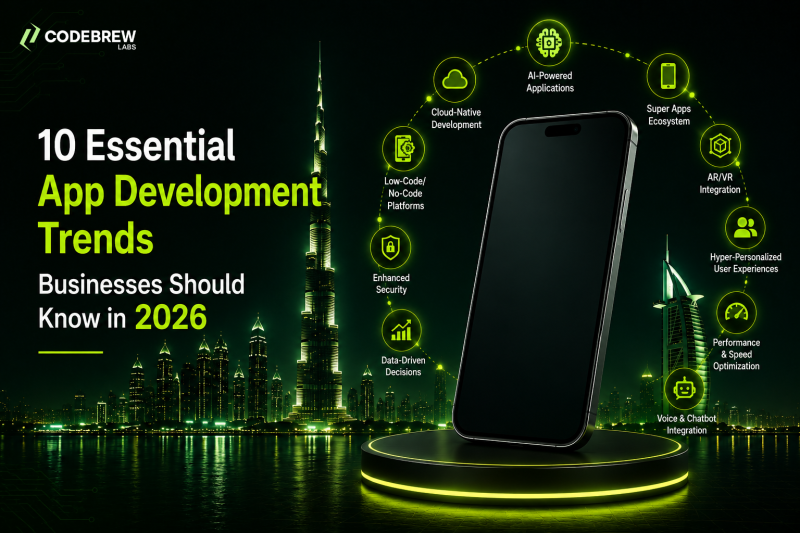
10 Essential App Development Trends Businesses Should Know in 2026
 samiksha
The app development industry is evolving faster than ever. Businesses are no longer building mobile applications simply to establish a digital presence. Modern apps are becoming intelligent platforms that combine artificial intelligence, automation, cloud technology, personalization, and real-time connectivity to deliver better customer and business experiences.
In 2026, companies planning a new application need to understand where the industry is heading before deciding which features and technologies to invest in. Following the right app development trends can help businesses create products that remain competitive, scalable, and relevant as user expectations continue to change.
From AI-powered experiences to stronger security and cross-platform development, here are 10 essential app development trends businesses should know in 2026.
1. AI-Powered App Development Is Becoming Mainstream
Artificial intelligence is one of the biggest forces shaping app development in 2026.
AI is being integrated into applications to make them more intelligent, personalized, and automated. Instead of simply responding to predefined commands, modern apps can analyze user behavior, understand natural language, identify patterns, and provide relevant recommendations.
Businesses are using AI for:
- Intelligent chatbots
- Personalized recommendations
- Predictive analytics
- Smart search
- Automated customer support
- Fraud detection
- Voice recognition
- Content generation
For example, an eCommerce application can use AI to recommend products based on customer behavior, while a real estate app can help users discover properties based on preferences.
The key trend is moving from apps that simply provide functionality to apps that actively assist users.
2. Generative AI Is Changing Mobile Experiences
Generative AI is taking AI-powered app development a step further.
Applications can now provide conversational experiences where users interact with services using natural language rather than navigating through multiple screens.
Generative AI can support:
- AI assistants
- Content creation
- Document summarization
- Intelligent search
- Personalized recommendations
- Automated responses
- Data analysis
For businesses, the opportunity lies in identifying practical use cases rather than adding AI as a marketing feature.
An application that uses AI to solve a genuine customer problem can provide significantly more value than one that simply includes a basic chatbot.
3. Cross-Platform App Development Continues to Grow
Businesses increasingly want applications available across both iOS and Android without maintaining entirely separate development projects.
Cross-platform frameworks such as Flutter and React Native allow development teams to share substantial portions of application code across platforms.
This approach can provide advantages such as:
- Faster development
- Shared code
- Easier maintenance
- Consistent user experiences
- Potentially lower development effort
However, cross-platform development is not automatically the best option for every application. Projects requiring deep platform-specific capabilities or specialized performance may still benefit from native development.
The important trend is the growing flexibility businesses have when choosing their development approach.
4. Hyper-Personalization Is Becoming a Competitive Advantage
Users increasingly expect applications to understand their needs.
Modern app development is moving toward personalized experiences based on user behavior, preferences, location, purchase history, and interactions.
For example:
An entertainment app can recommend content based on viewing behavior.
An eCommerce app can display personalized products and offers.
A fitness application can create recommendations based on individual goals and activity.
AI and analytics make it possible to provide this personalization at scale.
However, businesses must balance personalization with privacy and transparency. Users should understand how their data is being used and have appropriate controls.
5. Cloud-Native App Development Is Expanding
Cloud infrastructure has become a critical part of modern application architecture.
Cloud-native development allows applications to use scalable infrastructure, managed databases, APIs, storage, authentication, analytics, and other services without relying entirely on traditional physical infrastructure.
Cloud technology can help businesses:
- Scale applications more efficiently
- Support growing user bases
- Improve availability
- Manage large datasets
- Deploy updates faster
- Integrate external services
- Support distributed teams
For applications expected to grow quickly, designing the backend with scalability in mind from the beginning can prevent major technical challenges later.
6. IoT and Mobile Apps Are Becoming More Connected
The Internet of Things is creating new opportunities for mobile applications.
Smartphones can act as control centers for connected devices, sensors, vehicles, wearables, and industrial systems.
Businesses are using mobile apps to:
- Monitor connected devices
- Control smart equipment
- Track vehicles
- Analyze sensor data
- Monitor health and fitness
- Manage industrial systems
For example, a logistics company can use a mobile application connected to IoT devices to monitor fleet information in real time.
As connected devices continue to expand, mobile applications will increasingly become part of larger digital ecosystems rather than operating as standalone products.
7. Voice and Conversational Interfaces Are Growing
Typing and tapping are no longer the only ways users interact with applications.
Voice technology and conversational interfaces are becoming more useful as AI systems become better at understanding natural language.
Businesses can use voice functionality for:
- Search
- Customer support
- Navigation
- Accessibility
- Productivity
- Hands-free controls
AI-powered conversational interfaces can also allow users to describe what they need instead of navigating through complex menus.
For example, instead of manually applying multiple filters in a shopping application, a user could ask for products matching a particular budget, category, and preference.
8. Mobile App Security Is Receiving Greater Attention
As applications handle more personal, financial, and business information, security has become a core component of app development.
Businesses can no longer treat security as something to address after an application has been built.
Modern development should consider:
- Secure authentication
- Data encryption
- API security
- Secure payment processing
- Access controls
- Threat monitoring
- Regular security testing
- Privacy protection
Applications in sectors such as healthcare, finance, real estate, and enterprise services may require particularly strong security and compliance practices.
A secure application protects not only users but also the reputation and long-term credibility of the business.
9. Super Apps and Integrated Digital Ecosystems Are Expanding
Another notable trend is the growth of applications that combine multiple services within a single platform.
Instead of requiring separate apps for payments, shopping, transportation, communication, and other services, businesses can create ecosystems where multiple functions are available from one application.
This approach can increase user engagement because customers have more reasons to return to the same platform.
However, businesses should avoid adding features simply to create a larger application. Every additional service should support a clear user need and fit the overall product strategy.
10. Continuous Development and App Optimization Are Becoming Standard
Launching an application is no longer the final stage of app development.
Successful applications are continuously improved based on analytics, customer feedback, performance data, market changes, and emerging technologies.
Post-launch optimization may involve:
- Fixing bugs
- Improving performance
- Adding features
- Updating UI/UX
- Supporting new operating systems
- Strengthening security
- Improving conversion rates
- Integrating new technologies
Businesses can use analytics to determine which features are being used, where users leave the application, and what areas need improvement.
This creates a continuous development cycle:
Launch → Measure → Learn → Improve → Scale
Rather than trying to predict everything before launch, businesses can use real-world data to make informed product decisions.
Other App Development Trends to Watch
While the ten trends above are among the most important, several other technologies are also influencing the industry.
Augmented Reality
AR can create interactive experiences for retail, real estate, education, entertainment, and other industries.
Blockchain
Blockchain can support specific use cases involving digital assets, decentralized applications, identity, and transaction management.
Edge Computing
Processing data closer to users and connected devices can help reduce latency in applications requiring real-time responses.
Low-Code and AI-Assisted Development
Low-code platforms and AI coding tools can help development teams accelerate repetitive tasks and build certain application components faster.
Wearable App Development
Smartwatches and other wearable devices are creating additional opportunities for healthcare, fitness, productivity, and lifestyle applications.
How Businesses Should Respond to These Trends
Following every technology trend is not necessarily a good strategy.
Instead, businesses should identify which trends directly support their product and customers.
Before investing in a new technology, consider:
Does it solve a real customer problem?
Technology should improve the user experience or business process rather than simply make the application appear more advanced.
Does it support the business model?
A feature should contribute to customer acquisition, retention, revenue, efficiency, or another measurable business objective.
Can the technology scale?
The selected architecture should support future growth in users, data, integrations, and functionality.
Is it secure?
Security and privacy should be considered before integrating new technologies, particularly AI and third-party services.
Can the team maintain it?
A technology may look impressive but become difficult to maintain if the development team does not have the necessary expertise.
How These Trends Are Changing App Development
The biggest change is that mobile applications are becoming more intelligent and interconnected.
Traditional apps primarily respond to user input. Modern applications can increasingly anticipate needs, automate processes, personalize content, communicate with connected devices, and use AI to make interactions more natural.
This means businesses need to think beyond individual features and consider the entire digital ecosystem surrounding their application.
The development process is also becoming more iterative. Instead of building a large application and waiting months to launch, businesses can develop an MVP, gather user feedback, analyze performance, and continuously improve the product.
Conclusion
The app development landscape in 2026 is being shaped by AI, generative AI, cross-platform frameworks, cloud computing, IoT, personalization, voice interfaces, stronger security, and continuous product optimization.
Businesses that understand these trends can make better decisions about which technologies to adopt and where to invest their development budget.
However, technology should always serve the product—not the other way around. The most successful applications will be those that combine the right technology with a clear business objective, excellent user experience, strong security, and continuous improvement.
Code Brew Labs helps businesses build modern digital products using technologies such as mobile app development, AI, cloud, IoT, blockchain, and emerging technologies. With 13+ years of industry experience, 2,500+ successfully delivered digital solutions, and 250+ technology professionals, the team works with businesses to transform ideas into scalable and market-ready applications.
Source:
Click for the: Full Story
You might like








You Might Like this