


 Close Menu
 World
 Biography
 Health
 Education
 Business
 Lifestyle
 Sports
 Technology
 Animals
 History
 Food
 Religious
 Startups
 Movies
 Politics
 Fashion
 Covid
 Diet
 Fitness
 Marketing
 Travel
 Science
 Reviews
 Social media
 Stories
 Facts
 Art
 Entertainment
Kajal Singh

Technology
A Procurement Checklist for Specifying Military Antennas
 Kajal Singh
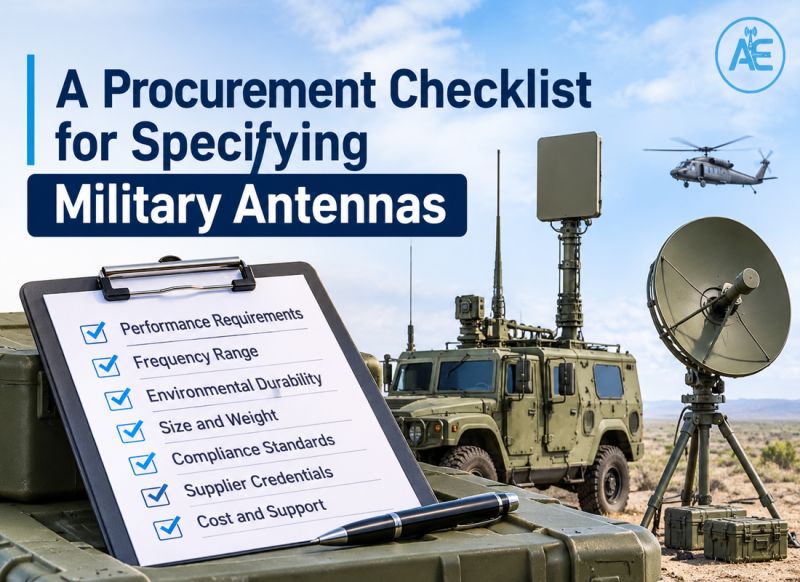
A military antenna is specified correctly when its operating band, RF performance, platform fit, environmental tolerance and test evidence all match the complete system it will serve. Checking frequency and gain alone leaves gaps that surface late. The way RFQs are written and the way replies are judged are changed when military antennas are considered as part of the total radio installation. What to define first, what items in the datasheet to compare, what evidence to ask for, and how to hold every supplier to the same acceptance criteria is discussed in this article.
Define the Operational Requirement Before Requesting Quotes
Start with the radio, not the antenna. Log the terminal, communication mode, operating frequency and bandwidth and the interfaces it expects. Note down where the antenna will be located and the space you have. Ask the supplier to state which antenna specifications and test results apply to the proposed model. Tactical radio, ground communications and UHF satellite links have different requirements. That split is reflected in designs grouped under Military Tactical Antenna and UHF Military SATCOM Antenna. For example, a whip that covers the band of a vehicle radio can still be disappointing if roof clearance demands it be mounted adjacent to a mast.
Which RF Specifications Should Buyers Compare?
Frequency range tells you at which frequencies an antenna can operate. Ask what the VSWR limit is if you want to know the usable bandwidth. The range may be less than the full operating range, but it indicates the area where the antenna can still perform well .
Gain alone is not enough to tell you how well an antenna will cover an area. Also you will have to check its radiation pattern. More gain may mean less coverage in some directions. This works well for a fixed link but not necessarily for a moving platform . Make sure you compare gain on the same reference such as dBi or dBd. See if the value is a peak gain or an average and what the conditions were under which it was measured.
The antenna polarization should match that of the receiving antenna. Otherwise the signal can be weaker. The radio, antenna and feedline also need to be impedance matched, typically at 50 ohms. VSWR or return loss is a measure of how much signal power is reflected instead of being transferred. Ask what frequencies were used, and under what conditions. Finally, ensure that the antenna can handle the power levels of the intended operating mode and duty cycle. The connector and cable also need to be able to handle that power.
Does the Antenna Fit the Platform and Installation?
Bench results are different from performance when installed. Verify mounting pattern, dimensions, weight, clearance, structural limits, cable routing, connector access, feedline loss and for many monopoles, the ground plane.
Military antennas have installation-specific constraints. Check the antenna’s resistance to shock and vibration. Nearby metal parts can also affect its radiation pattern. Portables have weight and handling. Fixed sites are out in the wind and lightning. Salt and crowded superstructures mean naval installations. Airborne ones provide airflow and close space. If an antenna has been demonstrated on one platform, it should not be assumed to fit another without modification or re-validation.
What Environmental and EMC Evidence Should Buyers Request?
Think vibration, mechanical shock, temperature variations, moisture, dust and corrosion. Environmental and electromagnetic compatibility are discrete issues with discrete evidence.
MIL-STD-810 is a tailoring-driven environmental test framework so applicable methods depend on service. MIL-STD-461 defines the EMC requirements and test methods for emissions and susceptibility. MIL-STD-461H was released in April of 2026 and replaces 461G. Contracts do not automatically move to the latest revision, so specify which one you want. Not every antenna will need every method. Military radio antennas suffer from co-site interference near other transmitters.
Supplier declaration is a statement. A test report documents what was done. Qualification evidence demonstrates performance to agreed criteria for intended use. The formal approval is a decision taken by the competent authority. Demand test methods, configuration, acceptance criteria and proof that the tested unit is identical to the proposed one.
Military Antennas Procurement Checklist for an RFQ
Agree acceptance criteria before quotations arrive so all suppliers are answering the same question.
- Operating frequency and required bandwidth.
- Gain, radiation pattern, polarisation and impedance, with measurement basis.
- VSWR or return-loss limits and measurement conditions.
- Power-handling limits and connector interfaces.
- Mounting dimensions, weight, orientation and installation constraints.
- Environmental and EMC requirements for the platform
- Applicable standards, their revisions and supporting test evidence.
- Datasheets, technical drawings and configuration details.
- Inspection, acceptance, documentation and delivery requirements.
- Customisation needs, deviations and supplier clarifications.
How Should Buyers Compare Military Antenna Suppliers?
Assess military antenna vendors against evidence a reviewer can verify. First, a complete consistent datasheet, gain, pattern and VSWR should agree and state their conditions. Ask if documentation is traceable, if the supplier has identified gaps in the specifications, what testing and evidence there is, how inspection and configuration control are performed and if delivery commitments, limitations and deviations are documented.
When comparing a military antenna supplier in India, check its technical documents, test evidence and support services. Use the same criteria for every supplier. Location, catalogue size, marketing language do not indicate an antenna fits your requirement. And require each bidder to provide the same proof for army antennas or any other platform.
When Does a Custom Military Antenna Make Sense?
Existing designs may not meet requirements for frequency coverage, bandwidth, space, mounting, platform integration, environmental requirements or interfaces. Document operating requirements, mechanical and electrical interfaces, expected RF performance, environmental and EMC criteria. Prototype evaluation, acceptance criteria and documentation before commissioning one. Customisation does not necessarily mean better performance or less testing.
Why Choose Antenna Experts?
Antenna Experts is an antenna manufacturer for defence, aviation, SATCOM and RF communication applications. Our company supports antenna design, customisation, OEM projects, testing and repairs. This enables frequency, installation constraints, RF performance, customisation and documentation to be discussed before a specification is finalised that also includes Military Antennas requirements.
Frequently Asked Questions
1. What should a military antenna RFQ include?
List the operating frequency, bandwidth, RF performance, power handling, interfaces and mounting needs. Include environmental conditions, applicable standards, required documents, inspections and acceptance criteria. This helps every supplier respond to the same requirements.
2. Which test standards should buyers ask for?
The right standards depend on the application, platform, environment and contract. MIL-STD-810 may apply to environmental testing, while MIL-STD-461 covers EMC requirements. Simply naming a standard does not prove compliance. Ask for supporting test evidence.
3. How do buyers compare antenna datasheets?
Compare all datasheets using the same criteria. Check frequency range, gain, radiation pattern, polarisation, VSWR or return loss, power handling, dimensions and connectors. Review the measurement conditions behind each figure. Request evidence for any value that matters to the application.
4. When does a custom antenna make sense?
A custom antenna may be needed when existing designs do not meet the required frequency coverage, installation space, mounting or environmental needs. Integration needs may also call for a custom design. This helps buyers assess the design against agreed requirements before prototyping.
Author Bio
Kajal Singh is the Marketing Manager at Antenna Experts. Covering antenna solutions, RF communications and defence and aviation applications, with a focus on practical technical requirements.
Source:
Click for the: Full Story
You might like









You Might Like this