



 Close Menu
 World
World
 Biography
 Health
 Education
 Business
 Lifestyle
 Sports
 Technology
 Animals
 History
 Food
Food
 Religious
 Startups
 Movies
 Politics
 Fashion
 Covid
Covid
 Diet
Diet
 Fitness
 Marketing
 Travel
 Science
 Reviews
 Social media
 Stories
 Facts
Facts
 Art
Art
 Entertainment
Ai agent
Technology
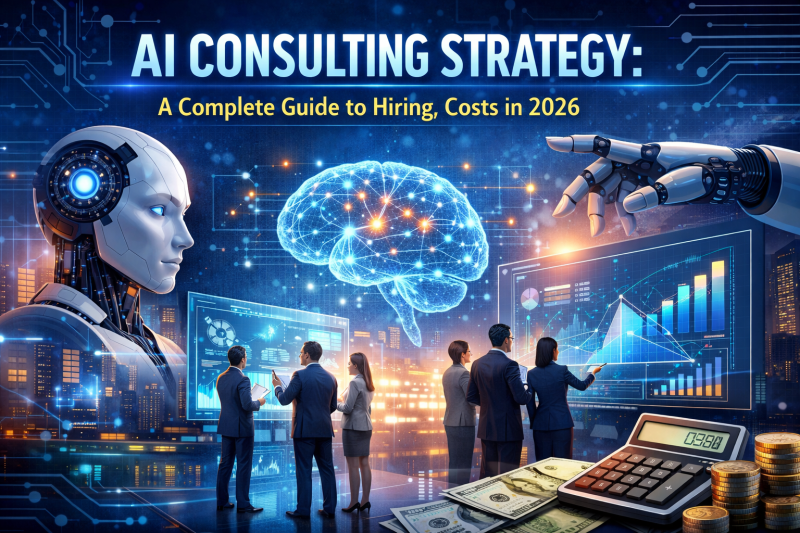
AI Consulting Strategy: A Complete Guide to Hiring, Costs In 2026
 Ai agent
Introduction:
By 2026, artificial intelligence has moved from experimentation to execution. Organizations across industries are no longer asking whether to adopt AI, but how fast and how responsibly they can scale it. This shift has made AI consulting strategy a critical business function rather than a technical afterthought.
AI systems today influence pricing decisions, customer experiences, operational efficiency, and even regulatory compliance. Without the right guidance, companies risk wasted investments, biased models, or solutions that never move beyond pilot stages. AI consulting firms help bridge this gap by aligning AI capabilities with real business outcomes, regulatory requirements, and long-term growth strategies.
This guide explains what AI consulting strategy looks like in 2026, how to hire the right partner, and what costs businesses should realistically expect.
What Is AI Consulting Strategy?
AI consulting strategy is the structured, end-to-end approach organizations use to plan, design, deploy, govern, and scale artificial intelligence initiatives in a way that delivers real business value. It goes far beyond simply building machine learning models or deploying AI tools. At its core, AI consulting strategy answers three critical questions: why AI is needed, where it should be applied, and how it can be implemented responsibly and sustainably.
In 2026, AI has become deeply embedded in everyday business operations. As a result, AI consulting strategy now sits at the intersection of business strategy, technology architecture, data management, and governance. The role of AI consultants is to ensure that AI investments are intentional, measurable, and aligned with long-term organizational goals rather than reactive or trend-driven.
A well-defined AI consulting strategy acts as a roadmap, helping organizations move from isolated AI experiments to enterprise-wide adoption. It provides structure, prioritization, and accountability at every stage of the AI lifecycle.
Core Components of a Strong AI Consulting Strategy
A mature AI consulting strategy typically includes the following interconnected pillars:
Business goal alignment
Every AI initiative must tie directly to business outcomes such as revenue growth, cost reduction, productivity improvement, risk mitigation, or customer experience enhancement. Consultants help translate strategic objectives into AI-ready initiatives.
Data readiness and architecture
AI is only as good as the data behind it. This step involves assessing data quality, availability, security, and integration across systems. In 2026, this also includes cloud readiness, real-time data pipelines, and MLOps infrastructure.
AI use-case prioritization
Not all AI ideas are worth pursuing. A strong strategy evaluates feasibility, impact, cost, and risk to identify high-value use cases. This prevents wasted investment and accelerates time to value.
Technology and vendor selection
AI consulting strategy helps organizations choose the right platforms, tools, cloud providers, and vendors based on scalability, security, and long-term flexibility rather than short-term convenience.
Risk management and governance
Ethical AI, data privacy, bias mitigation, explainability, and regulatory compliance are no longer optional. A robust strategy defines governance frameworks, approval processes, and accountability models.
Scaling and long-term optimization
AI strategy does not end at deployment. It includes performance monitoring, model retraining, user adoption, change management, and continuous improvement to ensure AI systems evolve with the business.
How AI Consulting Strategy Has Evolved by 2026
In earlier years, AI consulting often focused on proof-of-concept projects or isolated automation tasks. By 2026, this approach is no longer sufficient. AI consulting strategy is now deeply integrated with digital transformation, automation, and decision intelligence.
Modern AI strategies emphasize:
- Embedding AI into core business workflows
- Supporting real-time, data-driven decision-making
- Combining AI with automation and analytics platforms
- Designing AI systems that are secure, explainable, and compliant from day one
AI is no longer treated as a standalone innovation initiative. Instead, it is a foundational capability that influences how organizations operate, compete, and grow.
Why AI Consulting Strategy Matters More Than Ever
Without a clear AI consulting strategy, organizations face common risks such as fragmented systems, low adoption, regulatory exposure, and poor ROI. Many AI projects fail not because of technology limitations, but due to lack of alignment, governance, and execution planning.
A strong AI consulting strategy ensures that:
- AI investments are prioritized based on value, not hype
- Stakeholders understand and trust AI systems
- Solutions can scale across teams and regions
- AI remains adaptable as technology and regulations evolve
In 2026, organizations that treat AI strategically rather than tactically are the ones gaining sustainable competitive advantage.
When Does a Business Need AI Consulting?
Organizations usually seek AI consulting when they face one or more of the following situations:
- Lack of internal AI expertise or leadership
- Data is available but underutilized
- AI pilots fail to scale into production
- Pressure to adopt generative AI or automation
- Regulatory or compliance concerns
- Need for faster, data-driven decision-making
AI consultants bring both experience and objectivity, helping organizations avoid common pitfalls while accelerating adoption.
Types of AI Consulting Services
Strategy & RoadmappingThis includes AI vision setting, use-case identification, maturity assessments, and multi-year roadmaps. It is often the starting point for organizations new to AI or looking to scale responsibly.
Data & AI EngineeringThese services focus on data pipelines, machine learning models, cloud integration, MLOps, and system architecture. Execution-focused firms specialize here.
Generative AI & LLM ConsultingIn 2026, a major share of AI consulting demand revolves around generative AI. Services include:
- Custom LLM development
- Enterprise copilots
- AI-powered knowledge management
- Secure, private model deployment
This covers ethical AI frameworks, bias mitigation, explainability, auditability, and alignment with local and global regulations. It is especially critical in regulated industries.
How to Hire the Right AI Consulting Partner
Define Business Objectives FirstBefore hiring any consultant, organizations must clearly define what success looks like. Is the goal cost reduction, revenue growth, automation, or innovation? Consultants should align AI initiatives directly with measurable KPIs.
Evaluate Technical & Industry ExpertiseNot all AI consultants are equal. Some excel at strategy, others at engineering. Look for firms with proven experience in your industry and hands-on expertise in modern AI technologies, including generative AI.
Assess Local Compliance KnowledgeIn regions with strict data and AI regulations, such as the UAE and EU, local compliance expertise is non-negotiable. A strong AI partner understands data residency, privacy laws, and sector-specific regulations.
Check Delivery Model & ScalabilityThe right partner should support you beyond initial deployment. Ask about long-term support, model monitoring, retraining, and scaling across departments or regions.
AI Consulting Costs in 2026
AI consulting costs vary widely depending on scope, complexity, and provider type.
Pricing ModelsCommon pricing structures include:
- Fixed-price projects
- Time & material (hourly/daily rates)
- Retainer-based engagements
- Outcome-based or value-based pricing
Hidden Costs to Watch For
When organizations budget for AI consulting, they often focus only on consulting fees and development costs. However, many AI initiatives exceed expectations due to hidden or underestimated expenses. Identifying these early is critical to avoiding budget overruns and delayed timelines.
Data Preparation and Cleaning
Data preparation remains one of the most time-consuming and expensive aspects of AI projects. Many organizations discover that their data is incomplete, inconsistent, or scattered across legacy systems. Cleaning, labeling, and structuring data for AI models often requires significant effort, specialized tools, and ongoing resources. In 2026, data readiness is still the single biggest cost driver in most AI initiatives.
Cloud Infrastructure and Compute
AI models especially generative AI and large language models require substantial computing power. Cloud costs can increase rapidly due to model training, inference, storage, and data transfers. Without proper cost optimization and monitoring, cloud spending can exceed initial projections. A reliable AI consulting partner should design architectures that balance performance with cost efficiency.
Model Maintenance and Retraining
AI is not a “build once and forget” solution. Models degrade over time due to data drift, changing user behavior, and evolving business conditions. Ongoing monitoring, retraining, and optimization are necessary to maintain accuracy and relevance. These recurring costs are often overlooked during initial planning.
Change Management and Training
Even the best AI development solutions fail if users do not adopt them. Training employees, redesigning workflows, and managing organizational change require time and investment. This includes documentation, workshops, internal communication, and leadership alignment. In 2026, successful AI consulting engagements allocate budget specifically for human adoption.
Security and Compliance Audits
AI systems introduce new security and regulatory risks. Regular audits, penetration testing, bias assessments, and compliance reviews are essential especially in regulated industries. These efforts add cost but are necessary to protect data, maintain trust, and meet legal requirements.
A transparent AI consulting partner will surface these hidden costs early, helping organizations plan realistically and avoid unpleasant surprises later.
ROI Expectations from AI Consulting
Return on investment from AI consulting should be measured across multiple dimensions, not just short-term financial gains. In 2026, organizations evaluate AI success using both quantitative and qualitative metrics.
Operational Efficiency Gains
AI-driven automation reduces manual work, improves accuracy, and speeds up processes. This can lead to measurable productivity improvements across operations, customer support, finance, and supply chain functions.
Cost Savings Through Automation
By automating repetitive and resource-intensive tasks, AI helps organizations reduce labor costs, minimize errors, and optimize resource allocation. These savings often compound over time.
Revenue Uplift from Personalization or Optimization
AI enables smarter pricing, targeted marketing, personalized customer experiences, and improved demand forecasting. These capabilities directly contribute to revenue growth and higher customer lifetime value.
Risk Reduction and Compliance Assurance
AI consulting also delivers ROI by reducing operational, financial, and regulatory risk. Better monitoring, predictive insights, and compliance frameworks help prevent costly failures and penalties.
Faster Decision-Making
Decision intelligence powered by AI enables leaders to act faster with greater confidence. Real-time insights and predictive analytics shorten decision cycles and improve strategic agility.
By 2026, organizations increasingly expect AI initiatives to demonstrate tangible value within 6 to 12 months, shifting focus away from long, experimental projects toward outcome-driven execution.
Common Mistakes to Avoid When Hiring AI Consultants
Despite growing awareness, many organizations still repeat the same mistakes when engaging AI consultants. Avoiding these pitfalls dramatically increases the likelihood of success.
Hiring Based on Brand Name Alone
Well-known consulting brands do not automatically guarantee the best fit. Some excel at strategy but lack execution depth, while others focus on delivery without strategic alignment. Fit matters more than reputation.
Starting with Technology Instead of Business Goals
Leading with tools or platforms rather than business outcomes often results in misaligned solutions. Successful AI projects start with clear problems and measurable objectives.
Ignoring Data Readiness
Without clean, accessible, and well-governed data, even the most advanced AI models will fail. Data readiness should be assessed before any major AI investment.
Underestimating Change Management
AI changes how people work. Ignoring user adoption, training, and communication leads to resistance and underutilized systems.
Treating AI as a One-Time Project
AI is an ongoing capability, not a single deployment. Organizations must plan for continuous improvement, governance, and scaling.
Avoiding these mistakes significantly improves AI project success rates and long-term value creation.
AI Consulting Trends Shaping 2026
AI consulting continues to evolve rapidly, shaped by technological advances, regulatory pressure, and changing business expectations. Several trends are defining the consulting landscape in 2026.
Explosion of Generative AI Use Cases
Generative AI has become mainstream, driving demand for custom copilots, content automation, coding assistants, and knowledge management systems. Consulting firms are increasingly focused on secure, enterprise-grade generative AI deployments.
Shift Toward Ethical and Explainable AI
Transparency, fairness, and accountability are now core requirements. AI consultants are expected to design systems that can explain decisions, detect bias, and meet regulatory standards.
Industry-Specific AI Accelerators
Generic AI solutions are being replaced by domain-trained models and industry accelerators. These reduce time-to-value and improve accuracy by addressing sector-specific challenges.
Integration of AI with Automation and Analytics
AI is no longer deployed in isolation. Consulting strategies increasingly combine AI, robotic process automation, and advanced analytics into unified intelligent systems.
Demand for Sovereign and Secure AI Solutions
Data sovereignty and national security concerns are driving demand for locally hosted, secure AI platforms especially in government and critical industries.
Consulting firms that adapt to these trends, invest in responsible innovation, and deliver measurable outcomes will lead the AI consulting market in 2026 and beyond.
Conclusion
AI consulting strategy in 2026 is about making smarter, faster, and safer decisions with artificial intelligence. Hiring the right AI consulting partner requires clarity, due diligence, and a long-term mindset. While costs can be significant, the right strategy delivers measurable ROI, competitive advantage, and future readiness. Organizations that invest wisely in AI consulting today will define their industries tomorrow.
FAQs
1. Is AI consulting worth the cost in 2026?
Yes, when aligned with business goals, AI consulting delivers strong ROI through efficiency, automation, and innovation.
2. How long does an AI consulting engagement usually last?
It can range from a few weeks for strategy to several months or years for enterprise-scale deployment.
3. Can SMEs afford AI consulting?
Yes. Many firms now offer modular, scalable AI consulting tailored for startups and SMEs.
4. What industries benefit most from AI consulting?
Healthcare, finance, retail, logistics, energy, and government sectors see the highest impact.
5. Should AI consulting include governance and ethics?
Absolutely. Responsible AI is essential for compliance, trust, and long-term sustainability.
Source:
Click for the: Full Story
You might like









You Might Like this