Close Menu
 World
World
 Biography
 Health
 Education
 Business
 Lifestyle
 Sports
 Technology
 Animals
 History
 Food
Food
 Religious
 Startups
 Movies
 Politics
 Fashion
 Covid
Covid
 Diet
Diet
 Fitness
 Marketing
 Travel
 Science
 Reviews
 Social media
 Stories
 Facts
Facts
 Art
Art
 Entertainment
99 exchapp

Business
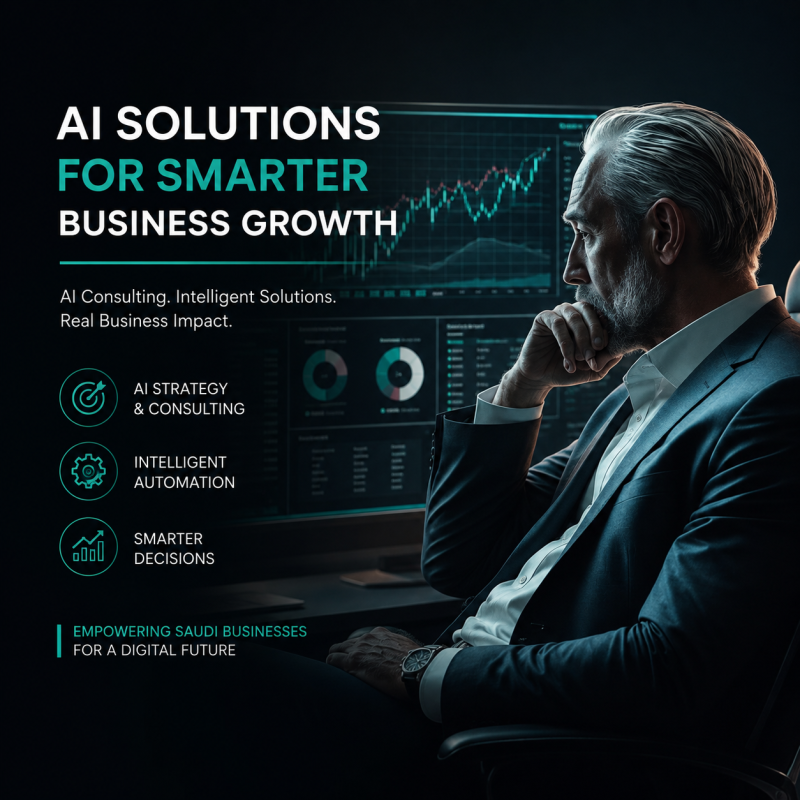
AI-Powered Business Transformation and Intelligent Automation Solutions in Saudi Arabia
 99 exchapp
Artificial intelligence is moving beyond experimentation. For businesses in Saudi Arabia, the bigger question is no longer whether AI can be useful, but where it can create measurable business value and how it should be implemented.
From automating repetitive workflows to improving forecasting, customer experiences, decision-making, and operational efficiency, AI can influence almost every part of an organisation. However, successful adoption requires more than purchasing software or launching a chatbot. Businesses need a practical strategy, leadership alignment, suitable technology, reliable data, and a clear implementation path.
This is where AI consulting and intelligent business solutions become valuable. Saudi organisations can use structured AI guidance to identify worthwhile opportunities, prioritise investments, and turn promising ideas into practical initiatives aligned with their business objectives and the Kingdom's broader digital transformation ambitions.
1. CodeZal AI: Connecting AI Strategy With Business Outcomes
CodeZal AI is positioned around helping Saudi businesses understand, plan, and implement AI rather than simply adopting technology for its own sake.
Its services include AI readiness assessments, AI strategy development, roadmap planning, implementation advisory, data dashboards, machine-learning models, data engineering, and ongoing insights and reporting. The consultancy also provides custom AI development, integration, deployment, and automation solutions.
One practical strength of this approach is starting with the business problem.
- Which processes consume the most employee time?
- Where are decisions being made with incomplete information?
- Which customer interactions could be personalised?
- Where could predictive analytics reduce costs?
- Which manual workflows are suitable for automation?
Answering these questions first can prevent organisations from investing in AI projects that look impressive but produce limited commercial value.
2. Start With an AI Readiness Assessment
Before developing an AI roadmap, businesses need to understand their current position.
An AI readiness assessment can examine data quality, existing technology, internal capabilities, workflows, and organisational priorities. This creates a clearer picture of what can realistically be implemented.
For instance, a retailer may want demand forecasting but discover that its sales and inventory data is fragmented across different systems. In that situation, improving data infrastructure may need to happen before deploying a sophisticated prediction model.
This kind of assessment helps organisations sequence their investments rather than attempting everything simultaneously.
3. Build an AI Strategy Around Business Priorities
AI strategy should connect directly to measurable business goals.
A logistics company might prioritise route optimisation and predictive maintenance. A retailer could focus on recommendations, demand forecasting, and customer personalisation. A property business might explore valuation models, lead qualification, or market analytics.
The technology changes by industry, but the principle remains the same: start with the desired business outcome and then identify the appropriate AI capability.
A well-defined roadmap can also help leadership teams decide which projects should be piloted first, what resources are required, and how success will be measured.
4. Give Executives Practical AI Knowledge
Technology adoption becomes difficult when leadership teams lack confidence in evaluating AI opportunities.
Executive workshops can help decision-makers understand practical applications, limitations, investment considerations, and implementation choices. CodeZal AI's executive workshop, for example, is designed around hands-on exercises, industry-specific use cases, and a personalised 90-day action plan.
This is particularly useful for organisations deciding between building an internal solution, purchasing an existing platform, or working with an external development partner.
Executives do not need to become engineers. They need enough understanding to ask the right questions and make informed decisions.
5. Turn Repetitive Work Into Intelligent Automation
Automation is one of the most practical starting points for AI adoption.
Consider a business where employees spend hours reviewing documents, processing customer requests, preparing reports, updating records, or sorting large volumes of information.
An intelligent workflow could automate parts of these processes while keeping human oversight where judgement is important.
For example:
Manual process: Employee receives a request → reads information → categorises it → enters data → sends it to another department.
AI-assisted process: System reads the request → extracts relevant information → categorises it → updates the appropriate system → alerts an employee when human review is needed.
The objective is not to remove people from every process. It is to reduce unnecessary manual effort so employees can focus on higher-value work.
6. Use Data to Improve Decision-Making
AI becomes much more useful when businesses have reliable data.
Dashboards can provide leadership teams with a clearer view of performance, while machine-learning models can help identify patterns and predict potential outcomes.
A sales organisation, for example, could combine historical sales data, customer behaviour, product information, and seasonal trends to improve forecasting.
Similarly, a supply-chain operation could use predictive analytics to anticipate demand, identify potential disruptions, or improve inventory planning.
The key is making insights actionable. A dashboard that simply displays numbers is less valuable than one that helps a manager determine what needs attention and what action should happen next.
7. Develop Custom AI Solutions When Off-the-Shelf Tools Fall Short
Generic AI tools can solve many common problems, but they may not fit specialised workflows.
Custom AI development can connect intelligence to an organisation's existing systems, processes, and data.
Potential applications include:
- Intelligent document processing
- Internal knowledge assistants
- Predictive analytics
- Customer-service automation
- Recommendation systems
- Machine-learning models
- Workflow automation
- AI-powered business dashboards
Customisation is particularly relevant when an organisation has unique operational requirements or needs deeper integration with existing enterprise systems. CodeZal AI lists custom AI development, AI integration and deployment, machine-learning models, automation solutions, and ongoing support among its capabilities.
8. Focus on Saudi-Specific Business Requirements
AI strategies should reflect the environment in which a business operates.
Saudi organisations may need to consider local regulations, data governance, Arabic-language requirements, existing enterprise infrastructure, industry-specific compliance, and organisational readiness.
Local understanding can also help businesses identify use cases that make sense within their specific market rather than copying strategies developed for completely different environments.
CodeZal AI highlights its Saudi registration, Jeddah presence, PDPL compliance, and focus on aligning engagements with Saudi Arabia's digital transformation direction.
9. Measure AI Projects With Clear KPIs
A successful AI initiative needs measurable objectives.
Instead of saying, "We want to use AI to improve operations," establish specific targets such as:
- Reduce processing time by 30%
- Lower operational costs by 15%
- Increase conversion rates
- Improve forecast accuracy
- Reduce customer response times
- Increase employee productivity
These metrics allow leadership teams to determine whether an AI project deserves further investment.
Start small where possible. A focused pilot with measurable results can provide stronger evidence than a large technology rollout without clear success criteria.
10. Move From Experimentation to Long-Term AI Capability
A single successful AI project is only the beginning.
Businesses that want sustainable results should think about governance, employee training, data quality, system maintenance, security, and continuous optimisation.
The strongest AI strategies create a cycle:
Assess → Prioritise → Pilot → Measure → Improve → Scale
This approach reduces unnecessary spending while allowing successful initiatives to expand across departments.
Takeaway
AI offers Saudi businesses an opportunity to improve productivity, automate workflows, strengthen decision-making, and create new digital capabilities. But technology alone does not guarantee results.
The practical path starts with understanding business needs, assessing readiness, educating leadership, prioritising high-value opportunities, and implementing solutions that can be measured and improved over time.
For organisations pursuing digital growth, AI consulting is most valuable when it connects technology with clear commercial outcomes. With the right strategy and execution, artificial intelligence can become a practical business capability rather than another technology experiment.
Source:
Click for the: Full Story
You might like