Close Menu
 World
 Biography
 Health
 Education
 Business
 Lifestyle
 Sports
 Technology
 Animals
 History
 Food
 Religious
 Startups
 Movies
 Politics
 Fashion
 Covid
 Diet
 Fitness
 Marketing
 Travel
 Science
 Reviews
 Social media
 Stories
 Facts
 Art
 Entertainment
visioninfo

Technology
Are Your AI Training Datasets Ready? Choosing Annotation Services in USA
 visioninfo
Building a successful AI model requires more than advanced technology and skilled developers. The quality of the training data plays an equally important role. Even a well-designed machine learning model can produce inaccurate results if it learns from incomplete, inconsistent, or poorly labeled datasets.
This is a common challenge for businesses developing computer vision applications, machine learning solutions, autonomous systems, and other AI-powered technologies. Collecting large amounts of data is not enough. That data must be properly organized, reviewed, labeled, and prepared before it can be used for model training.
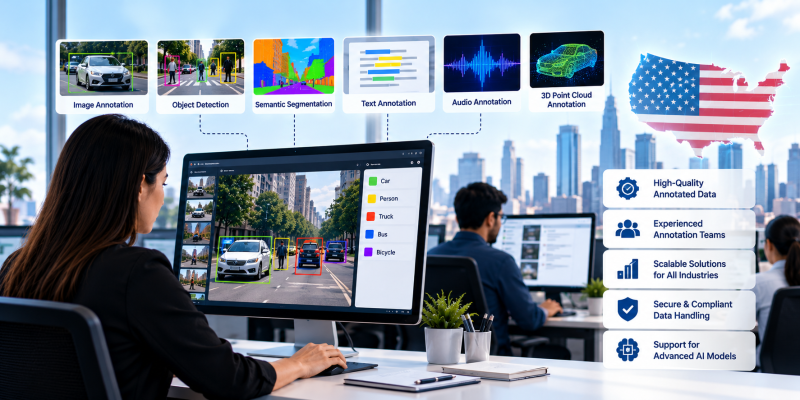
This is where AI Annotation Services in USA become valuable. Professional annotation teams help businesses transform raw images, videos, text, and other data into structured datasets that AI models can understand. However, choosing the right service provider requires more than comparing prices. You need to consider annotation accuracy, quality control, data security, scalability, and industry experience.
In this guide, we will explore the important factors that help businesses prepare reliable training datasets and choose the right annotation services for their AI projects.
What Makes an AI Training Dataset Ready?
An AI training dataset is a collection of information used to teach machine learning models how to identify patterns, recognize objects, understand information, and make predictions.
However, not every dataset is suitable for training. Before using collected data, businesses should check whether it meets certain quality requirements.
A well-prepared dataset should have the following characteristics.
1. Accurate and Consistent Labels
Data labeling tells an AI model what it is looking at or how it should interpret specific information.
For example, if you are developing an object detection system for road safety, your dataset may contain images of cars, bicycles, pedestrians, traffic signals, and road signs.
Each object must be labeled correctly. If a pedestrian is mistakenly labeled as a vehicle, the model may learn incorrect patterns.
Consistent labeling is equally important. Different annotators should follow the same guidelines when working on similar data.
Professional AI Annotation Services in USA can help businesses establish annotation guidelines and review procedures to maintain consistency across large datasets.
2. Sufficient Data Diversity
A dataset should represent the different situations in which an AI model will operate.
For example, a facial recognition system should not be trained using images captured under only one lighting condition. It should include different lighting environments, camera angles, backgrounds, and image qualities.
Similarly, a traffic monitoring model should include:
- Daytime and nighttime road conditions.
- Different weather situations.
- Heavy and light traffic.
- Different vehicle types.
- Urban and rural environments.
A diverse dataset helps reduce the chances of a model performing well during training but struggling in real-world situations.
3. Properly Organized Data
Raw data can become difficult to manage when businesses collect thousands or millions of files.
Images, videos, text documents, and other information should be organized into clearly defined categories. File naming, metadata, annotation formats, and dataset versions should also be managed properly.
A well-organized dataset makes it easier for development teams to review, update, and use information during model training.
4. Complete and Relevant Information
More data does not always mean better data.
A dataset containing unrelated, duplicated, or incomplete information can affect model performance. Businesses should identify missing records, remove unnecessary duplicates, and make sure the collected information matches the project's objectives.
The goal is to build a dataset that represents the actual problem the AI model is expected to solve.
Why Businesses Need Professional AI Annotation Services in USA
Preparing training datasets internally may seem like a cost-saving approach. However, managing large annotation projects requires time, trained professionals, proper tools, and quality management.
As projects become more complex, businesses often need external expertise.
Here are some reasons why professional annotation services can make a difference.
1. Better Data Accuracy
Annotation accuracy directly affects what an AI model learns.
For instance, a healthcare imaging application may need specialists to identify and label specific areas in medical images. Even small labeling errors can affect the usefulness of the training data.
Professional annotation teams follow defined instructions and quality-checking procedures to reduce labeling mistakes.
2. Faster Dataset Preparation
Large AI projects often involve thousands of images, lengthy videos, or extensive text collections.
Completing all annotation work internally can slow down development, particularly when the business does not have an established annotation team.
Working with an experienced service provider gives businesses access to additional resources and structured workflows.
3. Access to Skilled Annotators
Different AI projects require different annotation knowledge.
For example, image classification, object detection, semantic segmentation, video tracking, and text annotation all involve different processes.
Professional annotation teams can help businesses select suitable annotation methods based on their project requirements.
4. Flexible Project Scaling
Annotation requirements may change as an AI project develops.
A business might initially need 10,000 labeled images but later require 100,000 additional images for a larger model.
A reliable annotation partner should be able to adjust team capacity, project timelines, and quality procedures according to changing requirements.
5. Reduced Internal Workload
Managing annotation operations requires continuous supervision, employee training, and quality reviews.
Outsourcing suitable tasks allows internal AI engineers and developers to focus on model development, testing, integration, and deployment.
For many businesses, AI Annotation Services in USA offer a practical way to manage these responsibilities without building a large internal annotation department.
Types of Annotation Services Your AI Project May Need
Before choosing an annotation company, it is important to understand which type of annotation your project requires.
Different data formats need different labeling techniques.
1. AI Image Annotation Services
Best suited for computer vision, image recognition, object detection, and visual inspection projects.
Images are widely used to train AI models that recognize objects, understand scenes, and identify visual patterns.
AI Image Annotation Services involve adding labels, boundaries, or other information to images so that machine learning models can understand their contents.
Common image annotation methods include:
Image Classification: Assigning a category to an entire image. For example, identifying whether an image contains a dog, cat, car, or building.
Bounding Box Annotation: Drawing rectangular boxes around objects to identify their location within an image.
Polygon Annotation: Creating detailed boundaries around objects with irregular shapes.
Semantic Segmentation: Assigning labels to individual pixels based on the objects or regions they represent.
Keypoint Annotation: Identifying important points on objects, human bodies, or faces.
Example: A retail company developing an automated inventory management system may need thousands of product images labeled by product category, size, and position. Accurate image annotation helps the model recognize products more reliably.
2. AI Video Annotation Services
Best suited for surveillance, autonomous vehicles, sports analytics, and human activity recognition.
Video annotation is more complex than image annotation because videos contain multiple frames and continuous movement.
AI Video Annotation Services help businesses label objects, activities, movements, and events across video sequences.
Common video annotation techniques include:
- Object tracking across multiple frames.
- Frame-by-frame labeling.
- Human activity recognition.
- Vehicle and pedestrian tracking.
- Action recognition.
- Temporal event annotation.
Example: Consider a company developing an intelligent traffic monitoring system. Its AI model needs to identify vehicles, track their movement, recognize pedestrians, and detect traffic violations.
Annotators must label objects consistently across video frames so that the model can understand not only what an object looks like but also how it moves.
3. Text Annotation
Text annotation helps AI systems understand written information.
It is commonly used in natural language processing, chatbots, sentiment analysis, document processing, and language models.
Some common text annotation activities include:
- Named entity recognition.
- Sentiment labeling.
- Intent classification.
- Text categorization.
- Entity identification.
- Language-based data classification.
For example, a customer support company may label customer messages according to their intent, such as refund requests, product complaints, or technical questions.
These labels help train systems to identify customer needs and respond appropriately.
4. Audio Annotation
Audio annotation involves labeling speech, sounds, and other audio information.
It is useful for voice assistants, speech recognition applications, transcription platforms, and audio-based machine learning systems.
Common tasks include:
- Speech transcription.
- Speaker identification.
- Audio classification.
- Sound event detection.
- Timestamp annotation.
- Emotion and tone labeling, where appropriate.
For example, a company developing a voice-controlled application may need recorded conversations transcribed and labeled to improve speech recognition.
How to Choose the Right AI Annotation Services in USA
Selecting an annotation provider is an important decision because the quality of its work can influence your entire AI development process.
Instead of choosing a company based only on cost, evaluate its capabilities and working methods.
1. Check Industry and Project Experience
Start by understanding whether the provider has experience with projects similar to yours.
A company working on autonomous vehicle datasets may require experience in object detection, lane marking, and vehicle tracking. A business developing retail AI applications may need product classification and image segmentation expertise.
Ask potential providers:
- Have you handled similar annotation projects?
- Which annotation techniques do you support?
- Can you share relevant case studies?
- What tools and platforms do you use?
- How do you manage complex annotation requirements?
Relevant experience can help reduce communication gaps and project delays.
2. Understand Their Quality Assurance Process
Quality assurance should be one of your main selection criteria.
A provider should have a clear process for checking annotation accuracy before delivering the completed dataset.
Ask whether the company offers:
Sample Annotation: A small sample project to evaluate quality before starting large-scale work.
Multi-Level Review: Additional checks by quality reviewers or senior annotators.
Annotation Guidelines: Written instructions that explain how different data types should be labeled.
Error Tracking: A process for identifying recurring mistakes and correcting them.
Client Feedback: Opportunities to review completed work and request necessary changes.
A good provider should be comfortable explaining its quality management process rather than simply promising high accuracy.
3. Evaluate Data Security and Privacy
AI training datasets may contain confidential business information, customer records, product images, or other sensitive material.
Before sharing data with an external provider, understand how it will be handled.
Important questions include:
- How is client data stored?
- Who can access the project files?
- Are secure file transfer methods available?
- Does the provider follow appropriate confidentiality agreements?
- How long is project data retained?
- What happens to the data after project completion?
Businesses handling personal information should also consider applicable privacy requirements, including relevant US state privacy laws and contractual obligations.
Data security should be discussed before the project begins, not after files have been shared.
4. Compare Pricing and Project Transparency
Annotation pricing depends on several factors, including data type, task complexity, dataset size, annotation guidelines, and quality requirements.
For example, drawing basic bounding boxes around common objects is generally different from performing detailed medical image segmentation or tracking multiple objects across video frames.
Request a detailed quotation that explains:
- Pricing structure.
- Estimated delivery time.
- Included quality checks.
- Revision policies.
- Project milestones.
- Additional service charges.
The lowest quotation may not offer the best value if the delivered dataset requires extensive corrections.
5. Check Scalability and Communication
Your annotation requirements may increase as your AI model develops.
Choose a provider that can manage changing workloads without compromising consistency.
Regular communication is also important. Your team should be able to discuss annotation guidelines, review sample outputs, share feedback, and resolve project issues.
A reliable partner should provide clear updates throughout the project.
6. Request a Pilot Project
Before assigning a large dataset, start with a small paid or agreed-upon pilot project.
A pilot allows you to evaluate:
- Annotation accuracy.
- Understanding of project instructions.
- Delivery quality.
- Communication.
- Turnaround time.
- Ability to handle difficult examples.
For instance, if your project contains 50,000 images, you can begin with a representative sample of 500 images.
Review the results with your AI development team. If the output meets your requirements, you can move forward with the remaining dataset.
This approach helps identify problems before they affect the entire project.
Common Mistakes to Avoid When Selecting an Annotation Partner
Even businesses with well-defined AI goals sometimes make mistakes when outsourcing annotation work.
Here are some common issues to watch out for.
Choosing the Cheapest Provider
Low pricing can be attractive, but annotation quality should never be ignored. Poorly labeled datasets may create additional review costs and delay model development.
Ignoring Annotation Guidelines
Without clear instructions, different annotators may interpret the same task differently.
Always prepare detailed guidelines with examples, labeling rules, and instructions for handling difficult cases.
Not Checking Sample Results
Starting a large project without reviewing sample annotations increases the risk of receiving inconsistent or incorrect output.
A pilot project helps establish expectations before scaling.
Overlooking Data Diversity
A large dataset may still be unsuitable if it does not represent real-world conditions.
Review the distribution of data and identify missing scenarios before beginning model training.
Ignoring Data Security
Sharing confidential information without understanding the provider's security practices can create unnecessary business risks.
Establish access controls, confidentiality terms, and data handling expectations in advance.
How to Prepare Your Dataset Before Outsourcing Annotation
Businesses can make annotation projects more efficient by completing some preparation work before contacting a service provider.
Follow these practical steps.
Step 1: Define Your AI Project Objective
Explain what you want your AI model to achieve.
For example, are you building an object detection system, a video surveillance application, a product recognition tool, or a machine learning model for document processing?
Your objective will determine the annotation requirements.
Step 2: Identify the Required Data Types
Decide whether your project needs images, videos, audio, text, or a combination of different formats.
Also identify the expected file formats and approximate dataset size.
Step 3: Create Annotation Guidelines
Prepare clear instructions explaining:
- What needs to be labeled.
- Which annotation method should be used.
- How categories should be defined.
- How overlapping objects should be handled.
- What to do with unclear or incomplete data.
Detailed guidelines reduce confusion and improve consistency.
Step 4: Review and Clean Your Dataset
Remove unnecessary duplicate files, check data quality, identify missing information, and organize the remaining files.
Make sure the dataset contains relevant examples for your intended application.
Step 5: Establish Quality Expectations
Decide how annotation quality will be measured.
You may define acceptable error levels, review requirements, sampling procedures, and correction timelines.
For more complex projects, different quality measures may be required depending on the annotation task.
Step 6: Discuss Requirements With Your Provider
Share a representative sample, project guidelines, and expected delivery schedule.
Discuss technical requirements before the annotation work begins. This gives both teams a clearer understanding of the expected output.
Why Choose Vision Infotech for AI Annotation Services in USA?
Choosing the right annotation partner can make dataset preparation easier and help your development team maintain a consistent workflow.
Vision Infotech has been providing software outsourcing solutions since 2012. The company works with businesses that need technology services to support their digital projects and long-term development goals.
When preparing AI training datasets, businesses need a service partner that understands the importance of accuracy, clear communication, and project-specific requirements.
Here is why businesses can consider Vision Infotech for their annotation requirements.
1. Project-Focused Annotation Approach
Every AI project has different data requirements. Vision Infotech focuses on understanding the project objectives, dataset type, and expected output before determining the appropriate workflow.
This helps businesses establish clear expectations from the beginning.
2. Image and Video Annotation Support
AI projects involving computer vision require structured and consistent labeling.
Vision Infotech can support businesses looking for image and video annotation solutions based on their project requirements, including object identification, visual data labeling, and video-based annotation tasks.
3. Focus on Data Quality
A useful training dataset needs more than completed labels. It requires proper instructions, consistency, and review.
Vision Infotech emphasizes the importance of understanding annotation requirements and maintaining quality throughout the project.
4. Software Development Understanding
As a software outsourcing company, Vision Infotech understands how data preparation fits into broader technology development workflows.
This perspective is useful for businesses that need annotation support as part of their AI and machine learning development initiatives.
5. Long-Term Technology Partnership
AI development is not always a one-time project. Businesses may need additional datasets, updated labels, or new annotation categories as their applications evolve.
Vision Infotech aims to support businesses with technology services that align with their changing project requirements.
If your business is preparing a new AI project or improving an existing training dataset, you can discuss your requirements with Vision Infotech and identify a suitable approach.
Conclusion
Preparing a reliable AI training dataset is one of the most important steps in developing a successful machine learning application. Collecting data is only the beginning. Businesses must also focus on accurate labeling, data diversity, consistent annotation guidelines, proper organization, and quality checks.
Choosing the right AI Data Annotation Services in USA can make this process easier by providing access to suitable expertise, structured workflows, and scalable annotation support.
Before selecting a provider, evaluate its experience, quality assurance methods, security practices, communication, and ability to handle your specific data requirements. Starting with a pilot project is also a practical way to check whether the provider meets your expectations.
If you are planning to build an AI model or improve the quality of your existing training datasets, Vision Infotech can help you explore annotation solutions based on your business requirements. A well-prepared dataset creates a stronger foundation for AI development and helps your business move toward more reliable technology solutions.
FAQs
1. How Do I Know If My AI Training Dataset Is Ready?
Your dataset is ready when it contains relevant and diverse information, accurate labels, consistent annotation formats, and properly organized files. It should also meet the quality requirements of your intended AI application.
2. What Should I Look for in AI Annotation Services in USA?
Look for relevant project experience, annotation accuracy, quality assurance procedures, data security practices, transparent pricing, scalability, and reliable communication.
It is also useful to request sample work before assigning a large project.
3. What Is the Difference Between Image and Video Annotation?
Image annotation involves labeling objects, regions, or features within individual images. Video annotation involves labeling objects and activities across multiple video frames, often including movement tracking and event identification.
4. How Much Do AI Data Annotation Services Cost?
The cost depends on the dataset size, annotation complexity, data format, labeling method, quality requirements, and delivery timeline. Businesses should request project-specific quotations rather than relying on a general price estimate.
5. Can Annotation Services Improve AI Model Accuracy?
Yes. Accurate and consistent annotations provide better training examples, helping models learn relevant patterns. However, final model accuracy also depends on data diversity, model architecture, training methods, and evaluation procedures.
6. Should I Outsource AI Data Annotation?
Outsourcing can be useful when your business has large datasets, limited internal resources, specialized annotation requirements, or changing project workloads. The decision should depend on your budget, data security requirements, and internal capabilities.
Source:
Click for the: Full Story
You might like