Close Menu
 World
World
 Biography
 Health
 Education
 Business
 Lifestyle
 Sports
 Technology
 Animals
 History
 Food
Food
 Religious
 Startups
 Movies
 Politics
 Fashion
 Covid
Covid
 Diet
Diet
 Fitness
 Marketing
 Travel
 Science
 Reviews
 Social media
 Stories
 Facts
Facts
 Art
Art
 Entertainment
Priyanshu codebrew
Business
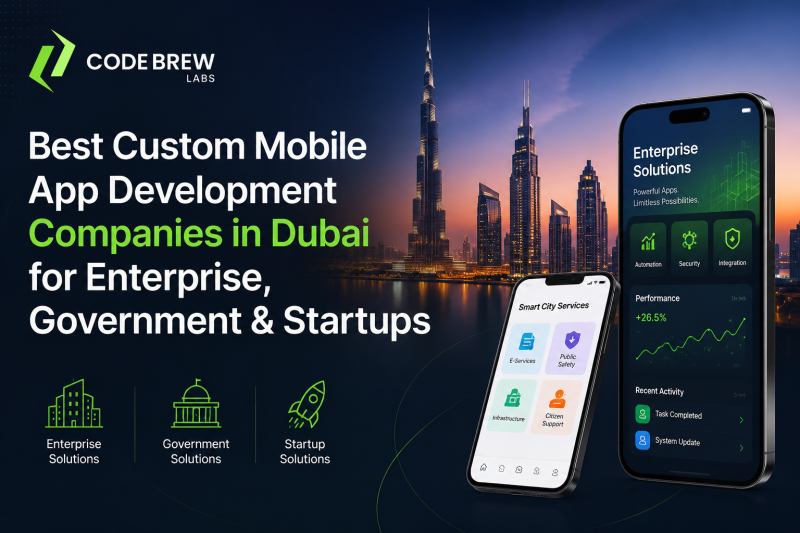
Best Custom Mobile App Development Companies in Dubai for Enterprise, Government & Startups
 Priyanshu codebrew
A mobile app can look impressive in a demo and still become a costly problem six months after launch. The real test comes later: Can it handle more users? Can your internal systems connect to it? Does it protect sensitive data? Can your team actually maintain it?
That’s why choosing a Mobile App Development Company in Dubai isn't simply about finding a team that can build an iOS or Android interface. For businesses, government departments, and startups, the better question is whether the development partner understands the product, integrations, security requirements, user experience, and long-term roadmap behind the app.
Dubai is home to a broad mix of software development firms, product studios, and technology companies. Some focus on enterprise platforms, while others are better suited to startups that need an MVP quickly. The following companies are worth considering when you're looking for custom mobile application development.
What to Look for in a Custom Mobile App Development Partner
Before you start comparing companies, take a moment to define what "custom" actually means for your project.
For one business, it could mean connecting the app to an ERP, CRM, payment gateway, government identity system, IoT platform, analytics tools, or a proprietary database. For a startup, it might mean something much simpler: an MVP with subscriptions, location services, social login, in-app chat, and a backend that can grow as the user base grows.
Enterprise and government projects usually bring another layer of requirements. Security and system integration may matter far more than having a flashy interface. You might need role-based permissions, audit logs, multilingual support, cloud infrastructure, API management, and specific compliance procedures built into the project from day one.
Startups, on the other hand, often need to move quickly without burning through their budget. Being able to test an idea, gather feedback, and change direction can matter more than building every planned feature in version one.
Here's the thing: a long list of services doesn't automatically make a development company the right choice. Look for evidence that the team has worked on projects similar to yours and understands the practical challenges that come with them.
1. Code Brew Labs
Code Brew Labs is a strong option for organizations looking for a custom mobile app development company that can handle more than the front-end development. Its service portfolio covers iOS and Android development, cross-platform applications, UI/UX design, backend engineering, AI solutions, enterprise software, and emerging technologies.
That broader capability can be useful when the app is only one part of a larger digital product. For example, an enterprise application might need a web-based administration system, APIs, analytics, cloud infrastructure, and third-party integrations alongside the mobile apps.
For startups, the same approach can be applied at a smaller scale. A team can begin with an MVP and then expand the architecture as the product gains users and new requirements emerge.
Key services offered
- Custom iOS and Android app development
- Flutter and React Native development
- AI-powered mobile applications
- UI/UX design and product development
- Enterprise application development
- Backend and API development
- Cloud-based application infrastructure
- On-demand and marketplace applications
- Blockchain and Web3 development
- AI chatbot and automation solutions
If your project needs a combination of mobile development, backend engineering, and intelligent features, Code Brew Labs is worth putting on your shortlist.
2. Dubai App Developers
Dubai App Developers focuses specifically on mobile and digital product development, making it an option for businesses that want a local Dubai-oriented development partner.
Its work can be relevant to companies building customer-facing applications where usability, mobile performance, and platform compatibility are central requirements. This can include applications for startups as well as established businesses looking to introduce a dedicated mobile channel.
When evaluating a provider like this, ask to see examples that resemble your intended application rather than simply reviewing its portfolio visually. A polished consumer app doesn't necessarily demonstrate experience with enterprise integrations or complex administrative workflows.
3. Royo Apps
Royo Apps is another established technology provider with experience across mobile application development and broader digital products.
The company works on applications for sectors such as food delivery, transportation, healthcare, e-commerce, logistics, and on-demand services. That industry exposure can be useful if your application depends on operational workflows rather than simply presenting information to users.
For example, a delivery application may require customer apps, driver applications, an admin panel, location tracking, order management, notifications, and payment processing. That's a very different engineering challenge from building a five-screen informational app.
For businesses considering Royo Apps, the key question is whether its existing technical approach matches the complexity and scale of your particular project.
4. Blocktech Brew
Blocktech Brew is a technology development company with a focus that extends beyond traditional mobile applications. Its capabilities include mobile development, blockchain, AI, Web3, and custom software solutions.
That makes it particularly interesting for projects where the mobile application needs to connect with newer technology layers. A fintech platform, digital asset application, tokenized marketplace, or AI-enabled application may require architecture that goes well beyond conventional mobile development.
However, specialized technology isn't automatically necessary. If your app is a conventional marketplace, booking platform, or enterprise workflow application, compare the company's capabilities against your actual requirements rather than adding complexity simply because the technology is available.
5. Innoveev
Best for: Startups, digital products, and businesses looking for a Dubai-based product development team
Innoveev is a Dubai-based software and app development company headquartered in Dubai Silicon Oasis. The company works across mobile, web, and AI products, with a particular focus on building digital products for the Gulf market. It also says it was involved in building Tamam, an on-demand services marketplace that is live across the UAE and has raised more than $10 million.
That product-building experience makes Innoveev an interesting option for startups that need more than someone to simply code an app. If you're developing a marketplace, consumer platform, or new digital service, having a team that's familiar with taking a product from an early idea to a live application can be useful.
The company also works with businesses under DIFC jurisdiction, which may be relevant for organizations that want a Dubai-based technology partner while keeping their commercial arrangements within a familiar regional framework.
If you're considering Innoveev, ask how the proposed team will approach product discovery, UX, architecture, testing, and post-launch improvements. For startups, those decisions can have just as much impact on the product as the technology stack itself.
6. Techugo
Techugo is a mobile and software development company that works across mobile applications, web solutions, UI/UX, and emerging technologies.
Its portfolio spans multiple industries, which can be helpful when you're looking for a development partner with experience across different product models.
For a startup, one area to examine closely is its approach to product discovery. A development team can build exactly what you specify, but the strongest product engagements often involve discussions about user flows, MVP scope, technical priorities, and future iterations before development begins.
7. Quytech
Quytech works across mobile applications, web development, AI, blockchain, and custom software. Its technology mix makes it a potential fit for companies that need specialized functionality inside a mobile product.
AI-enabled applications are a good example. A business might need a recommendation engine, conversational assistant, document processing, predictive functionality, or computer-vision features connected to a mobile interface.
The mobile application itself may be relatively straightforward. The difficult part can sit behind it in the data, APIs, machine-learning services, and cloud infrastructure.
That distinction is worth keeping in mind when comparing vendors.
8. RisingMax Inc.
RisingMax offers mobile app development and custom software development services across different business categories.
Companies considering this type of provider should pay attention to how the development team handles communication, project documentation, testing, and post-launch maintenance.
Those details aren't as exciting as the app's interface, but they have a direct effect on how easy the project is to manage. A technically capable team can still become difficult to work with if requirements, milestones, responsibilities, and change requests aren't clearly documented.
9. Appther
Best for: Startups and businesses building AI-powered mobile applications
Appther is a Dubai-focused technology company working across AI, mobile applications, and enterprise software. Its current offering includes iOS and Android development, AI engineering, LLMs, machine-learning models, chatbots, and custom software solutions for businesses across the UAE.
That combination makes it worth considering when AI is a meaningful part of the product rather than a feature added simply for marketing purposes.
For example, a startup might build a mobile application around an AI assistant, recommendation system, document-processing workflow, or intelligent search. In that situation, the development team needs to think about the mobile interface and the AI architecture behind it as one product.
Appther also positions its services around UAE requirements, including PDPL considerations and fixed-price AED contracts, which may be useful for local businesses that want clearer commercial and compliance expectations from the beginning.
10. Mobcoder
Mobcoder provides mobile application development alongside web development, UI/UX design, and software engineering services.
Its mobile-first capabilities can make it relevant for businesses building customer-facing apps across iOS and Android.
When reviewing a company such as Mobcoder, don't stop at the initial development estimate. Ask how it handles app-store releases, bug fixes, OS updates, monitoring, security patches, analytics, and technical support after launch.
A mobile app is an ongoing product, not a one-time software delivery.
How AI Can Add Value to a Custom Mobile App
AI can be useful when it solves a genuine product problem.
A retail application might use recommendations to personalize product discovery. A banking application could provide conversational assistance or categorize transactions. A logistics application might use predictive models to improve planning. A government service could use natural-language interfaces to help citizens find information more quickly.
But AI shouldn't be added just to make a proposal sound more advanced.
Before approving an AI feature, ask what data it needs, how its outputs will be evaluated, what happens when it makes a mistake, and whether users can understand or challenge important decisions.
For sensitive enterprise or government applications, privacy and human oversight become especially important.
How to Choose the Right Mobile App Development Company in Dubai
Start with your business requirement, not the vendor list.
Write down who will use the application, what problem it solves, which platforms you need, what systems it must connect to, and what the first release absolutely needs to accomplish.
Then ask shortlisted companies for a technical proposal.
A useful proposal should explain the suggested architecture, development phases, estimated timeline, team structure, testing strategy, third-party integrations, deployment process, and post-launch support. It should also clearly identify assumptions and items that could change the cost.
Pay attention to the questions a vendor asks you. If a company immediately gives you a price without understanding the product, integrations, users, and technical constraints, treat that as a warning sign.
The cheapest proposal isn't necessarily the least expensive project. Poor architecture, unclear requirements, weak testing, or inadequate support can create additional costs after launch.
Final Takeaway: Choose the Team That Fits the Product
The best Mobile App Development Company in Dubai for your organization isn't necessarily the largest company or the one with the longest list of technologies.
It's the team that understands what you're trying to achieve and can explain how the application should be designed, built, tested, launched, and maintained.
Shortlist three to five vendors. Give each the same product brief. Ask for their technical approach, team structure, delivery plan, relevant case studies, and post-launch support model. Then compare the answers, not just the prices.
That process will tell you far more than a generic portfolio ever could.
For an enterprise, government department, or startup, the goal isn't simply to launch an app. It's to build a product that remains useful when the first version is no longer new.
Source:
Click for the: Full Story
You might like