



 Close Menu
 World
World
 Biography
 Health
 Education
 Business
 Lifestyle
 Sports
 Technology
 Animals
 History
 Food
Food
 Religious
 Startups
 Movies
 Politics
 Fashion
 Covid
Covid
 Diet
Diet
 Fitness
 Marketing
 Travel
 Science
 Reviews
 Social media
 Stories
 Facts
Facts
 Art
Art
 Entertainment
Box Altitude

Sports
Can Altitude Training Support Recovery Between Hard Endurance Sessions?
 Box Altitude
For serious endurance athletes, the limit is not always fitness.
Sometimes it is recovery.
A cyclist may be capable of handling another hard session, but not yet recovered enough to produce the required power. A runner may have the fitness for another demanding block, but accumulated fatigue starts affecting pace. A triathlete can have the training plan, the motivation and the time, yet still struggle to absorb the workload.
This is where recovery becomes part of performance.
Altitude exposure is usually discussed in the context of endurance adaptation and race preparation. But there is another reason athletes and coaches are increasingly interested in it: using controlled altitude exposure as part of a recovery focused training strategy.
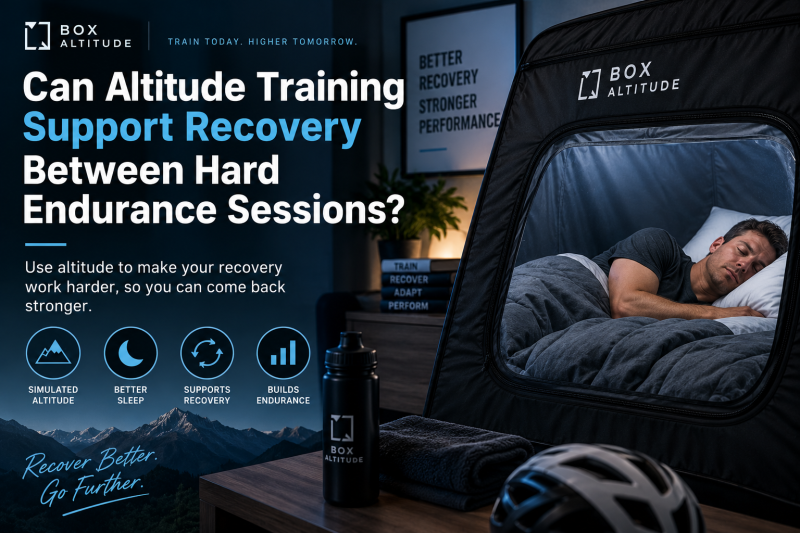
A system such as Box Altitude allows athletes to introduce simulated altitude during sleep and recovery while continuing to train at lower altitude during the day.
The distinction is important.
The goal is not to make recovery harder.
The goal is to use the recovery window more deliberately.
Recovery Sets the Ceiling for Training
Training creates the stimulus.
Recovery is when the body responds to it.
An athlete can add more intervals, longer rides or additional running volume, but if recovery does not keep pace, the quality of the next session begins to decline.
This is particularly relevant to endurance athletes training at higher weekly volumes.
The difference between completing a hard session and being able to complete another quality session two days later can determine whether a training block succeeds.
Sleep is central to that process.
It is also the longest uninterrupted recovery period most athletes have available each day.
That makes overnight altitude exposure an interesting option for athletes looking to incorporate a hypoxic stimulus without adding another physical workload.
How Altitude Exposure Fits Into Recovery
At altitude, reduced oxygen availability creates a physiological stimulus.
One of the body's responses involves increased erythropoietin signalling, which can contribute to changes in red blood cell production and oxygen carrying capacity over sustained exposure.
That is the traditional performance argument for altitude.
But from a training management perspective, the more interesting question is how the exposure fits between sessions.
An athlete can sleep in a controlled simulated altitude environment overnight and then return to normal oxygen conditions for the next day's training.
This allows the altitude stimulus to occur during a period that would otherwise be devoted to sleep and recovery.
Box Altitude describes this approach through the Live High, Train Low model. The athlete sleeps at simulated altitude while maintaining low altitude conditions for key training sessions, helping protect training intensity.
The result is a separation between the physiological altitude stimulus and the mechanical demands of training.
Why Training Quality Still Comes First
It is easy to assume that making a training session harder will automatically make it more effective.
That is not how endurance training works.
A threshold session has a purpose. A VO₂max interval session has a purpose. A long aerobic ride has a purpose.
If hypoxic conditions reduce the athlete's ability to hit the required intensity, the session may no longer achieve the original objective.
This is one reason sleeping at altitude can be attractive.
The athlete can accumulate exposure without moving their most important training sessions into hypoxic conditions.
For example, a cyclist might complete a structured interval session during the morning at normal oxygen availability. They can then recover through the day and use simulated altitude overnight.
The next session can be approached with the same training targets rather than having altitude dictate the workload.
The Recovery Question Is More Complicated Than It Looks
There is a temptation to describe altitude as a direct recovery intervention.
That claim needs more care.
Altitude exposure creates physiological adaptations. Those adaptations may support oxygen transport and endurance capacity over time.
But that does not mean that sleeping at altitude automatically makes muscle soreness disappear or guarantees faster recovery after every training session.
Recovery has several components.
Sleep quality.
Energy availability.
Training load.
Muscle damage.
Hydration.
Psychological stress.
Travel.
And the athlete's general health.
Altitude should be considered within that wider picture.
Box Altitude's own recovery focused material positions altitude as a way to support adaptation and training tolerance rather than as a replacement for basic recovery practices.
That is a more useful way to approach it.
Why Overnight Exposure Can Be Different From Another Training Session
An athlete only has so much physical capacity.
Adding another hypoxic workout means adding another stressor.
Using altitude during sleep is different because the exposure does not require the athlete to perform additional physical work.
The athlete is already resting.
This makes overnight exposure particularly relevant to athletes who are already training heavily.
The aim is to add a physiological stimulus without adding another session to the calendar.
That is also why the Live High, Train Low model remains attractive.
The athlete can protect the quality of the sessions that drive performance while using sleep as the main altitude exposure window.
Consistency Matters
Altitude exposure is not a one night solution.
The adaptations associated with altitude depend on sufficient exposure, and individual response varies.
This is where a controlled home system has a practical advantage.
An athlete can establish a routine rather than relying entirely on occasional altitude camps.
Box Altitude's recovery guidance describes overnight exposure in the range of 8 to 11 hours and identifies approximately 2,200 to 2,500 metres as a typical recovery focused set point.
Those figures should not be treated as a universal prescription.
The appropriate protocol depends on the individual athlete, their objectives, training load, acclimatisation and response.
The broader principle is more useful:
Altitude exposure needs to be consistent enough to form part of the programme.
Managing the First Few Nights
Athletes should also recognise that simulated altitude can affect sleep during the initial acclimatisation period.
That matters because recovery depends heavily on sleep quality.
If an athlete introduces altitude too aggressively and sleeps poorly, the cost may outweigh the intended benefit.
A gradual approach makes more sense.
Start at a manageable simulated altitude. Allow the body to adapt. Monitor sleep and other responses. Then adjust the exposure when appropriate.
Box Altitude's guidance recommends progressive acclimatisation rather than immediately starting at a high simulated altitude.
This is particularly relevant for athletes already carrying significant training fatigue.
The first objective should be to maintain good recovery.
Altitude exposure comes second.
Measuring the Response
A structured approach also benefits from monitoring.
Athletes already track training load, heart rate, sleep and other recovery indicators. Altitude exposure can be considered alongside those measures.
Box Altitude systems include app based control and monitoring, with current technology providing information such as altitude exposure, blood oxygen saturation and heart rate.
This can help athletes understand whether their exposure is consistent and how their body responds.
The data should not be overinterpreted.
A change in blood oxygen saturation during a hypoxic session does not, by itself, prove that an athlete has increased haemoglobin mass or improved performance.
Those outcomes require more specific assessment.
The value of monitoring is that it gives the athlete a clearer picture of the protocol.
Who Might Find This Approach Useful?
Recovery focused altitude exposure is most relevant to athletes already dealing with substantial training demands.
That includes:
- High volume cyclists
- Ironman and long course triathletes
- Competitive runners
- Rowers and endurance swimmers
- Masters endurance athletes
- Athletes managing multiple training disciplines
- Athletes preparing for demanding competition blocks
The common factor is training density.
If an athlete is training only a few hours per week, adding altitude may not be the first place to look for improvement.
Training structure, nutrition and sleep are likely to matter more.
Altitude becomes more interesting when the athlete is already doing the fundamentals well and recovery is becoming a limiting factor.
Altitude Should Complement Recovery, Not Replace It
There is no system that can compensate for consistently poor sleep, insufficient fuelling or excessive training load.
An athlete cannot train beyond their recovery capacity indefinitely.
The smarter approach is to identify where the programme is limited.
If the problem is inadequate sleep, fix sleep.
If the problem is insufficient energy intake, fix nutrition.
If the problem is excessive training load, adjust the programme.
If those foundations are already in place, altitude exposure may become a useful additional tool.
This is where Box Altitude fits into a broader performance strategy.
Its systems allow athletes to sleep in controlled simulated altitude while continuing normal training at lower altitude.
The system does not replace the programme.
It sits inside it.
The Bigger Picture
The most useful way to think about altitude is not as another workout.
It is an environmental variable.
An athlete can change the oxygen availability during sleep without changing the structure of their daytime training.
That distinction gives altitude a different role.
Instead of asking, "How can I make my training harder?" the athlete can ask, "Where can altitude fit without reducing the quality of the training I already need to do?"
For high level endurance athletes, that is often the better question.
An altitude box can provide a controlled environment for that exposure at home, allowing the athlete to build a repeatable routine around sleep rather than relying entirely on travel or altitude camps.
The benefit is not that altitude makes recovery effortless.
It is that the athlete gains another variable to manage.
A More Deliberate Approach to Recovery
Endurance performance is built through repeated high quality work.
The athlete trains.
The athlete recovers.
Then the athlete trains again.
If recovery cannot keep pace, the quality of the entire programme eventually suffers.
Altitude exposure may have a role in that equation, particularly when used during sleep alongside a well structured Live High, Train Low approach.
Box Altitude provides a practical way to introduce that exposure without moving key daytime training into hypoxic conditions.
The sensible approach is measured.
Start with a clear objective. Use an appropriate exposure. Protect sleep. Monitor the response. Keep training quality intact.
Altitude is not a substitute for recovery.
Used properly, it can become part of the system that makes recovery more manageable.
Source:
Click for the: Full Story
You might like










You Might Like this