Close Menu
 World
World
 Biography
 Health
 Education
 Business
 Lifestyle
 Sports
 Technology
 Animals
 History
 Food
Food
 Religious
 Startups
 Movies
 Politics
 Fashion
 Covid
Covid
 Diet
Diet
 Fitness
 Marketing
 Travel
 Science
 Reviews
 Social media
 Stories
 Facts
Facts
 Art
Art
 Entertainment
Yatin Samra

Technology
Development of Fintech Patform in the USA: Building Secure Financial Solutions in 2026
 Yatin Samra
USA’s financial services are getting more digitized, interconnected, and technologized. Customers expect quick transactions, mobile experiences, personalized financial services, and easy access to their finances. At the same time, businesses need platforms which will provide management of their finances with the ability of compliance, security, and scalability.
Such conditions are offering new opportunities for start-ups, financial organizations, and technology companies to develop fintech platform services that will include modern technologies like architecture, automation, APIs, analytics, and intelligent financial services.
Fintech platform is not just a digital solution that allows doing financial transactions. Fintech platform is the ecosystem of technologies that connect users, financial organizations, payment systems, data, compliance procedures, and business processes through secured infrastructure.
Understanding Modern Fintech Platforms
A fintech platform can support a wide range of financial activities depending on its business model. It may provide digital payments, personal finance management, lending, investment services, digital banking, insurance technology, cryptocurrency services, financial analytics, or business banking.
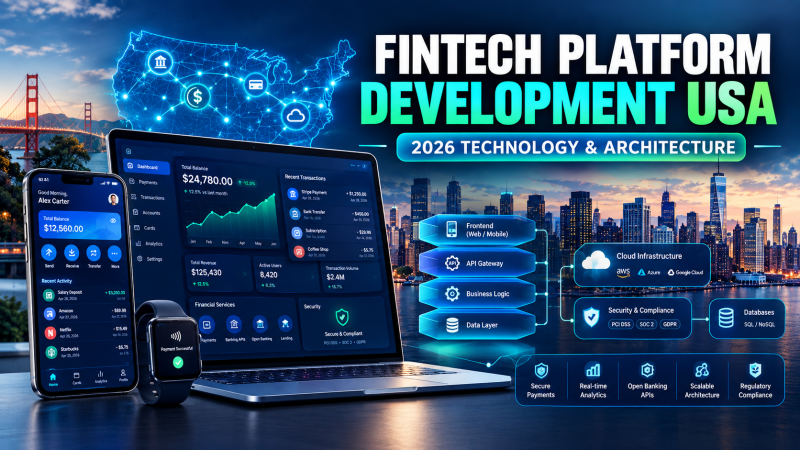
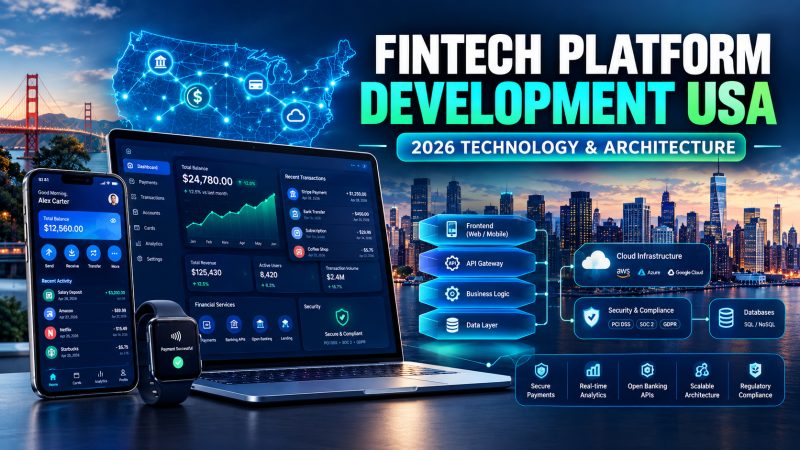
The underlying platform generally consists of several interconnected layers:
- User-facing web and mobile applications
- Backend services and APIs
- Payment and transaction infrastructure
- Customer and account management
- Data storage and analytics
- Security and identity systems
- Compliance workflows
- Administrative dashboards
- Third-party financial integrations
The architecture should be designed around the specific financial services being offered rather than relying on a generic technology stack.
Why the US Fintech Market Requires Strong Infrastructure
The USA has a large and diverse financial ecosystem involving banks, payment providers, investment companies, lenders, insurers, technology companies, and financial marketplaces.
This ecosystem creates both opportunities and technical challenges.
A fintech platform may need to connect with multiple external systems while maintaining consistent data and transaction records. It may also need to support different payment methods, identity verification processes, reporting requirements, and user permissions.
For this reason, scalability and interoperability should be considered from the beginning of development.
A platform designed only for a small initial user base can face significant limitations when transaction volumes, integrations, or product offerings expand.
Core Technologies Behind Fintech Platforms
Modern fintech platforms commonly combine several technologies rather than depending on one technology alone.
Cloud Computing
Cloud infrastructure allows fintech businesses to provision computing resources according to demand. Properly designed cloud environments can support high availability, automated deployment, monitoring, backups, and disaster recovery.
Cloud architecture can also make it easier to separate development, testing, and production environments.
Application Programming Interfaces
APIs are fundamental to modern financial platforms. They allow applications to communicate with banks, payment providers, identity services, accounting systems, analytics tools, and other third-party applications.
A well-designed API layer can make the platform easier to extend as new financial services and integrations are introduced.
Artificial Intelligence and Machine Learning
AI can support specific fintech functions such as:
- Fraud detection
- Transaction monitoring
- Customer support
- Financial recommendations
- Risk analysis
- Document processing
- Customer segmentation
- Anomaly detection
The most effective implementations focus on clearly defined business problems instead of adding AI simply as a technology feature.
Data Analytics
Financial platforms generate significant amounts of transactional and behavioral data. Analytics infrastructure can convert this information into useful operational and business insights.
For example, organizations can analyze transaction patterns, customer activity, payment behavior, product usage, and operational performance.
Security Should Be Built Into the Architecture
Security is one of the most important considerations in fintech development because platforms can handle sensitive financial and personal information.
A comprehensive security strategy can include:
- Encryption for data in transit and at rest
- Multi-factor authentication
- Role-based access control
- Secure API authentication
- Session management
- Continuous monitoring
- Audit logging
- Vulnerability testing
- Secure software development practices
- Backup and disaster recovery mechanisms
Security should not be treated as a final-stage feature. It needs to influence architecture, database design, authentication, API development, infrastructure, and operational processes from the beginning.
Identity Verification and Compliance Workflows
Financial technology platforms often need processes for customer identification, transaction monitoring, fraud prevention, and regulatory compliance.
Depending on the business model, a platform may integrate third-party services for identity verification, document verification, sanctions screening, transaction monitoring, or other compliance-related functions.
Instead of building every compliance capability from scratch, businesses can use specialized providers and connect them through APIs.
This approach can reduce development complexity while allowing the fintech platform to maintain a centralized workflow for onboarding and compliance operations.
Creating a Reliable Transaction Infrastructure
Financial transactions require a higher level of reliability than many standard software operations.
The system needs to handle transaction requests carefully and maintain accurate records of financial activity.
A robust transaction architecture should consider:
- Transaction validation
- Idempotency
- Authorization
- Balance management
- Error handling
- Transaction status tracking
- Reconciliation
- Audit trails
- Notification mechanisms
A clear transaction lifecycle also helps businesses investigate issues and maintain accurate financial records.
The Importance of a Strong Ledger System
For platforms involving financial balances, a reliable ledger is a fundamental component.
The ledger should provide a structured record of financial events and support accurate tracking of credits, debits, transfers, fees, adjustments, and other relevant activities.
Instead of relying only on displayed account balances, the system should maintain a traceable history of financial events.
This becomes particularly important when a platform grows and needs reconciliation, reporting, auditing, or integration with external financial systems.
Designing the User Experience
Technology alone does not determine whether users will adopt a fintech platform.
The interface should make financial activities understandable and accessible.
Important user experience areas include:
- Simple registration
- Clear account dashboards
- Easy navigation
- Transparent transaction information
- Straightforward payment flows
- Helpful notifications
- Accessible support
- Responsive mobile experiences
Financial applications should avoid unnecessary complexity, particularly during important actions such as payments, transfers, account verification, and withdrawals.
Integrating Third-Party Financial Services
Building every financial capability internally can increase development time and operational complexity.
Strategic integrations can provide access to services such as:
- Payment processing
- Banking connectivity
- Identity verification
- Credit information
- Accounting
- Fraud prevention
- Currency conversion
- Financial data aggregation
- Communication services
The integration architecture should include authentication, error handling, monitoring, rate-limit management, and fallback strategies where appropriate.
This creates a more resilient platform while allowing the business to focus on its core financial proposition.
Mobile and Web Platforms
Many fintech businesses need both web and mobile experiences.
A web application can provide detailed account management, reporting, administration, and business functionality. Mobile applications can focus on everyday activities such as payments, transfers, notifications, account monitoring, and authentication.
Cross-platform development can be considered when businesses want to maintain a consistent experience across multiple mobile operating systems while managing development resources efficiently.
The right approach depends on the platform's performance requirements, user base, feature complexity, and long-term roadmap.
Scalability for Growing Financial Platforms
Scalability should be considered before a platform experiences rapid growth.
A scalable fintech architecture may use:
- Modular services
- Load balancing
- Caching
- Message queues
- Database optimization
- Horizontal scaling
- Automated infrastructure
- Monitoring and observability
The objective is not simply to support more users. The platform should also handle increased transaction volumes, additional integrations, new financial products, and expanding operational requirements.
A Practical Development Approach
Fintech platform development can be divided into several stages.
1. Business and Market Analysis
The first stage involves identifying the target users, financial problem, business model, competitors, and regulatory considerations.
2. Product Definition
The core features and user journeys should be documented before development begins.
3. Architecture Planning
Developers and architects can then determine the backend structure, database strategy, APIs, cloud infrastructure, security model, and third-party integrations.
4. MVP Development
An initial version should focus on essential functionality rather than attempting to launch every planned feature simultaneously.
5. Testing and Security Validation
Functional, performance, security, integration, and usability testing should be performed before launch.
6. Deployment and Monitoring
Once the platform is deployed, monitoring systems can track performance, errors, transactions, infrastructure health, and user activity.
7. Continuous Improvement
After launch, businesses can use customer feedback and platform analytics to prioritize improvements and introduce new capabilities.
Factors That Influence Fintech Development Costs
The cost of developing a fintech platform in the USA depends on several factors.
These can include:
- Platform complexity
- Number of supported financial services
- Web and mobile requirements
- Third-party integrations
- Security requirements
- Compliance workflows
- AI and analytics features
- Infrastructure architecture
- Development team location and expertise
- Testing requirements
- Post-launch maintenance
A basic financial application and a multi-service financial ecosystem can have very different development requirements.
Therefore, businesses should estimate costs based on the actual product scope instead of relying on a single generic development figure.
Building for Long-Term Growth
A fintech platform should be designed with future expansion in mind.
For example, a business may initially launch a payment solution and later introduce expense management, financial analytics, lending, or business banking features.
A modular architecture makes these expansions easier because new capabilities can be added without completely rebuilding the underlying platform.
Documentation, automated testing, API versioning, monitoring, and clean service boundaries can also reduce technical debt as the platform grows.
Final Thoughts
The creation of fintech platform solutions in the USA involves the integration of knowledge and skills related to finance, software engineering, security, scalability, and user-focused development.
The best platforms are designed based on clear financial use cases that involve reliable transactional systems, secure APIs, smart automation, effective data architecture, and selective integrations.
Both startups and businesses can benefit from starting their development efforts with a business challenge and then transforming it step-by-step into technical solutions.
With the continuous evolution of digital finance in 2026, the companies that treat their fintech development as a technology ecosystem can build platforms for future challenges.
Source:
Click for the: Full Story
You might like