



 Close Menu
 World
World
 Biography
 Health
 Education
 Business
 Lifestyle
 Sports
 Technology
 Animals
 History
 Food
Food
 Religious
 Startups
 Movies
 Politics
 Fashion
 Covid
Covid
 Diet
Diet
 Fitness
 Marketing
 Travel
 Science
 Reviews
 Social media
 Stories
 Facts
Facts
 Art
Art
 Entertainment
Jesse Keyes

Lifestyle
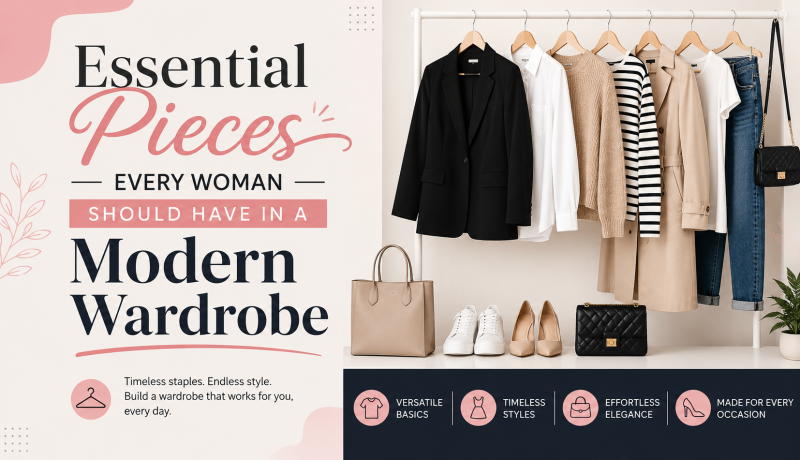
Essential Pieces Every Woman Should Have in a Modern Wardrobe
 Jesse Keyes
Quick Summary: A modern wardrobe doesn’t have to be enormous, it has to be smart. What every woman should have in her wardrobe: a white button-down shirt, a tailored blazer, dark jeans, a little black dress, neutral slacks, a trench coat, quality knitwear, an adaptable jacket, comfy flats or loafers, and a few striking accessories. They work for the weekend or high street moments and keep their value season after season instead of chasing every passing fad, they play well together.
Many of us have stood in front of a wardrobe full of clothing and still felt like we had nothing to wear. It is not a clothing deficit. It’s not having the appropriate clothes – things that genuinely go together instead of just sitting there as one-off impulse buys that never quite found a partner.
That’s the whole point of designing a modern wardrobe, not on trends, but on essentials. When you have a few good pieces that are adaptable, getting dressed is no longer a daily puzzle. You throw on a blazer, some jeans you already have, shoes you’ve worn a hundred times, and you’re out the door in ten minutes looking like you tried harder than you did.
This is the precise principle at the heart of labels like Jesse Keyes, whose collections are built around sophisticated, contemporary designs made to smoothly transition from casual everyday wear to high street fashion. The focus is on pieces that earn their position in a closet and keep earning it year after year, rather than chasing one-season trends.
What is really supposed to be in that closet? Here’s a no-nonsense, practical run-down of the components worth owning – and why each is important.
1. The White Button-Down Shirt
This one gets tagged as a cliché, but it’s a cliché for a reason: nothing else does its function quite as well. A fresh white shirt can be tucked into a pencil skirt for the workplace, tied at the waist over shorts for a weekend brunch, or layered beneath a sweater when the weather shifts. It feels like it’s been thrown together without too much effort, and it goes with just about everything else on this list.
Choose a fabric with a touch of structure so it retains its shape all day long. A shirt that creases the minute you sit down is not doing you any favours.
2. A Well-Fitted Blazer
A blazer is the kind of garment that instantly elevates everything you wear it with. It can be worn over a t-shirt and jeans to make a lazy outfit deliberate. Style it with tailored pants and it’s boardroom-ready in seconds.
Here, it means more than just about anything else in your closet. Shoulders should be clean, the length should be somewhere flattering to your frame—not whatever’s fashionable that season. Black, camel or navy are neutral colours that will outlive anything flamboyant and colourful.
3. Dark Wash Denim
Not all jeans are made equal, and not every pair deserves a permanent place in your closet. Those that do, are nearly always a dark clean wash with little or no significant distressing. Dark denim is easier to dress up than light or faded washes, so one good pair can take you from a casual coffee run to dinner with the proper top and shoes.
Fit is personal – straight leg, slender, wide leg, depending on your body and what you feel good in. But the wash and the quality of the denim itself have to be non-negotiable.
4. The Little Black Dress
No wonder this term became a fashion shorthand decades ago and never truly went away. A good black dress solves more "what do I wear" emergencies than anything else in your closet. Two hours notice on dinner invitation? Done . Last minute post-work event? Change your shoes and jewellery and it’s a whole different appearance.
The goal is to pick a silhouette that can work for several occasions, not something so particular it just works for one type of event. A simple cut, that fits nicely, will always beat anything highly decorated.
5. Tailored Trousers
The tailored trouser is somewhere between jeans and a formal suit and is undoubtedly one of the most undervalued pieces in a modern wardrobe. Black, navy or camel, a solid pair will last you through the office, travel days and meals that demand 'smart' but not 'formal'. They are comfy in a way jeans sometimes are not, and they photograph well, which is more important than people want to admit.
6. A Neutral Trench Coat
Outerwear is where so many outfits fall down and it's largely because people buy coats for one particular look, not for a coat that works across several. A trench coat fixes the problem. It works well over blazers, sweaters or dresses and its clean lines mean it never appears old as trend-driven coats do after a year or two.
Beige and black are the safest picks because they just go with everything else already existing in your closet.
7. Quality Knitwear
A superb sweater is doing silently more effort than people realise. Cashmere, merino wool or a decent cotton blend in a neutral tone will be worn on repeat – tossed over pants for work, teamed with jeans on weekends, layered under jackets in winter. This is one category where it pays to spend a bit extra – cheap knitwear pills, stretches out and loses shape after a few washes.
8. A Versatile Jacket
Every lady needs at least one more garment beyond the trench and it should be a little more casual...a leather jacket, a denim jacket or a structured bomber. This is the touch that polishes something that would otherwise be too rough or tones down something that feels too formal for the occasion. It’s also frequently the element that makes an outfit feel current and that’s exactly where high street fashion influence tends to make its biggest mark.
9. Comfortable Flats or Loafers
Heels have their place, but they're not a daily solution and anyone who says otherwise is likely nursing painful feet by lunchtime. A decent pair of leather flats or loafers can carry an ensemble just as well and are genuinely wearable for a full day of errands, work or vacation. Neutrals like black, brown or white will go with almost everything in your closet.
10. A Few Statement Accessories
Basic pieces are the foundation, but accessories are what make the wardrobe anything but monotonous. A structured purse, a dramatic pair of earrings, a silk scarf – these are the odds and ends that let you wear the same basic ensemble five times running without anybody realising you’ve replicated it. They’re also usually the cheapest method to remain on top of what’s hot in casual and high street fashion without having to revamp your entire wardrobe each season.
Why Fewer, Better Pieces Win
The way people shop is changing, and it’s not really about minimalism. It’s the disappointment of garments that don’t wear well, that don’t fit right after a couple washes, that look fun in a snapshot and then dismal in real life.
That issue is addressed head-on by building your wardrobe around necessities — truly well-made basics that mix and match. You spend less time determining what to wear and less money replacing things that went apart after one season. Brands like Jesse Keyes are leaning into this and producing collections that are supposed to flow between casual everyday wear and high street fashion, so the things you buy don’t get locked into one single event or trend cycle.
Frequently Asked Questions
What are the must-have wardrobe basics for women?
A white button-down shirt, tailored blazer, dark wash jeans, a little black dress, neutral trousers, a trench coat, quality knitwear, a versatile jacket, comfortable flats or loafers, and a few statement accessories cover nearly every occasion a modern woman needs to dress for.
How many pieces do I need for a capsule wardrobe?
Most capsule wardrobes work well with 25–35 pieces, including outerwear, tops, bottoms, dresses, and shoes. The goal isn't a specific number — it's making sure every piece can be paired with at least three others.
What's the difference between casual and high street fashion?
Casual wear typically means comfort-first pieces like jeans, tees, and flats meant for everyday life. High street fashion refers to accessible, trend-aware clothing that reflects current runway influences at a wearable, affordable level — it sits between casual basics and high fashion.
Is it worth spending more on wardrobe essentials?
Generally, yes. Essentials get worn far more often than trend pieces, so cost-per-wear drops significantly over time. A well-made blazer or coat worn for years often costs less in the long run than several cheaper versions replaced annually.
How do I build a wardrobe that doesn't feel outdated quickly?
Stick to neutral colors, classic silhouettes, and quality fabrics for your core pieces, then use accessories or one or two statement items per season to stay current. This keeps the foundation timeless while still feeling fresh.
A modern wardrobe isn't about having more. It’s about having the appropriate parts, the ones that work as hard as you do, can adjust to whatever the day throws at you, and don’t require replacing every few months. Build out from the essentials above and getting dressed ceases being a decision fatigue and starts being second nature.
Source:
Click for the: Full Story
You might like





You Might Like this