



 Close Menu
 World
World
 Biography
 Health
 Education
 Business
 Lifestyle
 Sports
 Technology
 Animals
 History
 Food
Food
 Religious
 Startups
 Movies
 Politics
 Fashion
 Covid
Covid
 Diet
Diet
 Fitness
 Marketing
 Travel
 Science
 Reviews
 Social media
 Stories
 Facts
Facts
 Art
Art
 Entertainment
seerah Manpower

Business
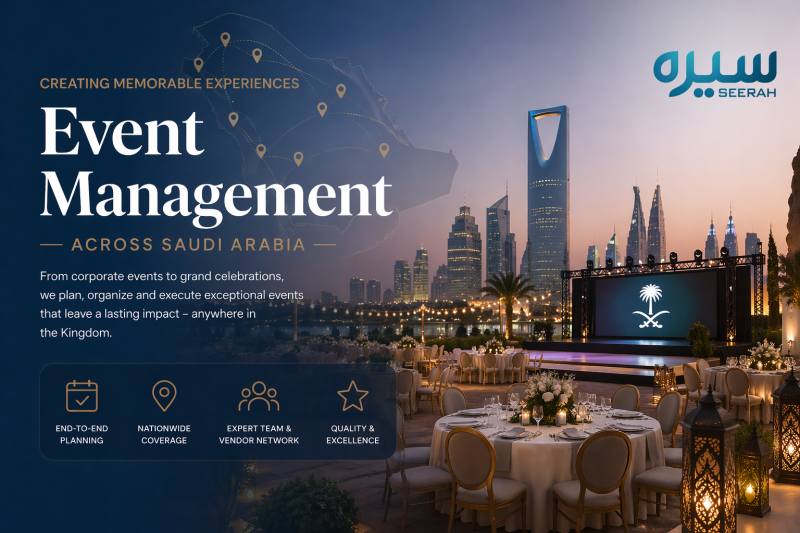
Event Management in Saudi Arabia: Trends Redefining the Industry
 seerah Manpower
Introduction: An Industry at a Turning Point
Stand inside any major event venue in Saudi Arabia today and you can feel something shifting. The conversations between event managers and their clients sound different than they did five years ago. Budgets are larger, expectations are higher, timelines are tighter, and the pressure to create something genuinely memorable — something that gets talked about for months — has never been more intense. The Saudi events industry is growing up fast, and the trends shaping its future are fascinating to watch.
This article is for anyone who wants to understand where event management in the Kingdom is heading — whether you are a professional in the industry, a business owner who commissions events, a student considering a career in events, or simply someone who is curious about one of Saudi Arabia's most dynamic and visible sectors.
Trend 1: Experiential Design Is Now the Standard, Not the Exception
There was a time when a successful corporate event meant a nice venue, good food, a keynote speech, and a photo opportunity. Those days are gone. Saudi clients — particularly younger decision-makers and consumers — have been to enough average events to know exactly what they do not want. They want to feel something. They want to be transported, surprised, challenged, or moved. They want to leave an event with a story to tell.
This has driven a profound shift in how event managers approach their work. Experiential design — the practice of creating immersive, emotionally resonant environments and experiences — has moved from being a luxury add-on to being the core brief. Leading Saudi event agencies are now hiring experience designers, set designers, sensory specialists, and creative technologists alongside their traditional planning and logistics teams.
The impact of this trend is visible everywhere. Product launches in Saudi Arabia now include elaborate theatrical reveals. Corporate conferences are designed as journeys, with each session, break, and meal contributing to an overarching narrative. Wedding receptions have become multi-sensory environments where scent, sound, light, and texture are all deliberately choreographed. The bar keeps rising, and event managers who embrace this trend are reaping the rewards.
Trend 2: Technology Integration Is Accelerating Rapidly
Saudi Arabia is one of the most connected countries in the world, with among the highest smartphone penetration and social media usage rates globally. This digital culture is reshaping event management in profound ways. Technology is no longer something that gets bolted onto events as an afterthought — it is increasingly woven into the very fabric of how events are conceived, delivered, and measured.
Artificial intelligence is beginning to change event planning workflows. AI tools can now analyze attendee preferences and generate personalized event experiences, predict catering quantities with impressive accuracy, optimize venue layouts for crowd flow, and even generate initial event concepts based on client briefs. Event managers who learn to work with these tools — rather than fearing them — are finding that they can serve clients better and manage more events simultaneously.
Augmented and virtual reality are opening up extraordinary creative possibilities. Clients in Saudi Arabia can now take virtual walkthroughs of event setups before a single table is moved. Guests at product launches can interact with AR overlays that reveal product features in real time. Hybrid events — where some guests attend in person and others participate digitally — have become a standard offering rather than a niche service.
Event data and analytics are also becoming seriously important. Major Saudi event clients — particularly government bodies and large corporations — increasingly want to see measurable outcomes from their investments. How many people attended? How long did they engage? What did they feel? What did they post? Event managers who can provide sophisticated post-event analysis are distinguishing themselves from competitors who can only report headcounts.
Trend 3: Sustainability Is Becoming a Real Priority
Saudi Arabia's Vision 2030 includes significant environmental commitments — including ambitious targets around renewable energy, waste reduction, and carbon neutrality. These national priorities are filtering down into the events industry, where clients are increasingly asking event managers to demonstrate environmental responsibility.
Sustainable event management in Saudi Arabia is still in its early stages compared to markets like the UK or Scandinavia, but it is gaining momentum quickly. Event managers are being asked to use locally sourced flowers and produce, minimize single-use plastics, optimize transportation logistics to reduce emissions, implement food waste reduction programs, and choose venues with strong environmental credentials.
There is also a growing movement toward sustainable event design — using materials that can be reused or recycled, designing installations that have multiple-use potential, and choosing fabrics and finishes that minimize environmental impact. For event managers who are ahead of this curve, sustainability is becoming a genuine differentiator in competitive pitches.
Trend 4: The Rise of Saudi Women in Event Management
One of the most significant shifts in Saudi Arabia's events industry over the past several years has been the rapid and remarkable rise of Saudi women as event management professionals and business owners. Prior to the social reforms introduced as part of Vision 2030, women's participation in mixed-gender professional settings was severely restricted. The changes that followed opened up an entire industry to half the population — and the impact has been transformative.
Today, women lead some of Saudi Arabia's most successful event management companies. They design weddings that are celebrated across social media, manage corporate events for major international companies, and hold senior roles at the agencies handling some of the Kingdom's largest national events. Young Saudi women studying event management, hospitality, and communication are entering the workforce with exceptional drive, creativity, and ambition.
The cultural insight that Saudi women bring to event management — particularly for social and family events — is genuinely invaluable. Understanding the nuances of Saudi family dynamics, the expectations of different tribal communities, the evolving standards of what constitutes a beautiful and meaningful celebration — this is knowledge that cannot easily be imported, and it is making Saudi women event professionals increasingly indispensable.
Trend 5: International Partnerships and Knowledge Transfer
Saudi Arabia's ambition to host world-class events has driven a surge in partnerships between local event companies and international specialists. Global event agencies, production companies, entertainment consultancies, and venue management firms have all entered the Saudi market — some through direct investment, others through joint ventures, and many through project-specific collaborations.
For Saudi event management professionals, these partnerships represent an extraordinary learning opportunity. Working alongside international specialists on mega-events like Riyadh Season, Formula E, or MDLBeast Soundstorm exposes Saudi professionals to global best practices, cutting-edge technologies, and sophisticated planning methodologies that would take years to develop independently.
At the same time, Saudi event companies bring something that international partners cannot easily replicate: deep cultural knowledge, established local vendor networks, strong relationships with government authorities, and an intuitive understanding of what Saudi audiences genuinely want. The best partnerships leverage both sides of this equation, creating something genuinely better than either party could produce alone.
Trend 6: The Professionalization of the Industry
For much of its history, Saudi Arabia's events industry operated on informal networks and personal relationships, with limited standardization of processes, pricing, or professional qualifications. That is changing rapidly. A new generation of event management professionals is demanding — and delivering — higher standards across the board.
Professional certifications, university-level event management programs, and industry associations are all growing in prominence. The Saudi Tourism Authority and General Entertainment Authority are increasingly requiring certain standards from event organizers who apply for permits. Large corporate and government clients are implementing formal vendor qualification processes that require evidence of professional competence, insurance, safety planning, and financial stability.
This professionalization is genuinely good for the industry. It raises the bar for everyone, protects clients from underqualified operators, and creates a more sustainable competitive environment where quality is rewarded rather than just price. For committed professionals, it is a welcome development — even if the transition period involves some growing pains.
Trend 7: Community and Cultural Events Are Finding New Energy
Perhaps the most heartwarming trend in Saudi event management is the renewed energy around community and cultural events. Saudi Arabia has a rich and diverse cultural heritage — in music, poetry, crafts, culinary traditions, and storytelling — that was not always visible in the public sphere. That is changing in exciting ways.
The Diriyah Arts Festival, the AlUla Arts Festival, the Jeddah Season's cultural programming, and dozens of smaller local initiatives are bringing Saudi culture to life in vibrant, accessible, beautifully managed events. These are not just tourism plays — they are genuine expressions of Saudi identity, and the event managers who produce them are doing some of the most meaningful work in the industry.
For young Saudis who grew up in a country with limited public entertainment options, these events represent something profound: a chance to celebrate their own culture in their own country, in ways that feel authentically Saudi and joyfully modern at the same time. The event managers who understand and honor this emotional dimension are the ones creating truly unforgettable experiences.
What This Means for Event Management Professionals
The trends reshaping Saudi Arabia's events industry point toward a future that demands more from event management professionals — more creativity, more technical skill, more cultural intelligence, more adaptability, and more genuine passion for the craft. The professionals who will thrive are those who stay curious, keep learning, embrace technology without losing the human touch, and approach every event — large or small — as an opportunity to create something genuinely extraordinary.
Saudi Arabia is not just hosting more events. It is becoming a global leader in how events are conceived and delivered. And the event management professionals who are driving that transformation deserve recognition, investment, and pride — because they are quite literally shaping the experiences that will define a generation.
Conclusion: A Bright Future, Earned Through Excellence
The future of event management in Saudi Arabia belongs to those who are willing to grow alongside this extraordinary market. The trends are clear, the opportunities are real, and the Kingdom's appetite for meaningful, well-crafted experiences shows no signs of slowing. For event professionals who are ready to rise to the challenge, there has never been a better time to be part of this industry. The stage is set. The audience is waiting. Now it is time to deliver something unforgettable.
Source:
Click for the: Full Story
You might like




You Might Like this