Close Menu
 World
World
 Biography
 Health
 Education
 Business
 Lifestyle
 Sports
 Technology
 Animals
 History
 Food
Food
 Religious
 Startups
 Movies
 Politics
 Fashion
 Covid
Covid
 Diet
Diet
 Fitness
 Marketing
 Travel
 Science
 Reviews
 Social media
 Stories
 Facts
Facts
 Art
Art
 Entertainment
Deepak

Health
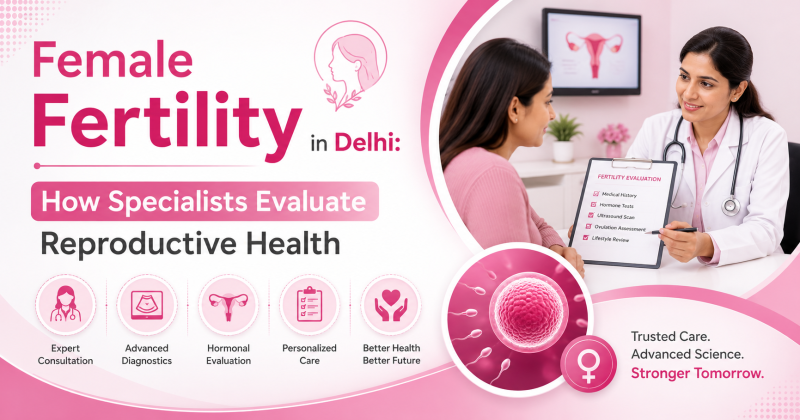
Female Fertility in Delhi: How Specialists Evaluate Reproductive Health
 Deepak
For many women, the decision to see a fertility specialist comes after months, sometimes years, of uncertainty. Irregular cycles, unexplained delays in conceiving, or simply wanting to understand reproductive health can all lead someone to seek a proper fertility checkup.
If you're exploring female fertility in Delhi, understanding how a specialist actually evaluates reproductive health can make the process feel far less intimidating. This article walks through what a typical fertility evaluation involves, so you know what to expect at each step.
Why Female Fertility Evaluation Matters
Fertility isn't a single, fixed trait. It's influenced by a combination of hormonal balance, ovarian function, uterine health, and overall wellbeing. A comprehensive evaluation helps identify what, if anything, may be affecting conception, rather than leaving couples to guess.
Female infertility in Delhi, as elsewhere, can stem from various causes, including:
- Ovulation disorders (such as PCOS)
- Blocked or damaged fallopian tubes
- Endometriosis
- Uterine abnormalities, including fibroids or polyps
- Age-related decline in egg quantity and quality
- Thyroid or other hormonal imbalances
- Unexplained infertility, where no clear cause is identified despite testing
Because the causes vary widely, a structured evaluation process is essential before recommending any treatment.
When Should You See a Fertility Specialist?
Many women wait too long before seeking help, often due to uncertainty about when it's "necessary." As a general guideline, it's worth scheduling a fertility consultation in Delhi if:
- You're under 35 and haven't conceived after 12 months of trying
- You're 35 or older and haven't conceived after 6 months of trying
- You have irregular or absent menstrual cycles
- You've experienced recurrent miscarriages
- You have a diagnosed condition like PCOS or endometriosis
- You simply want to understand your reproductive health before planning a pregnancy
Early evaluation doesn't necessarily mean immediate treatment. Often, it simply provides clarity.
How a Fertility Specialist Evaluates Reproductive Health
1. Detailed Medical HistoryThe evaluation typically begins with a thorough discussion covering:
- Menstrual cycle history (regularity, flow, pain)
- Previous pregnancies or miscarriages
- Past surgeries or medical conditions
- Family history of fertility issues or hormonal disorders
- Lifestyle factors such as weight, stress, smoking, or alcohol use
This conversation helps the doctor identify patterns that guide further testing.
2. Physical and Pelvic ExaminationA physical examination, including a pelvic exam, helps assess reproductive organ health and identify any visible abnormalities that may require further investigation.
3. Hormonal Fertility TestingFertility testing in Delhi typically involves blood tests to evaluate key hormones, including:
- AMH (Anti-Müllerian Hormone): Indicates ovarian reserve, or the estimated number of remaining eggs
- FSH and LH: Reflect ovarian function and the timing of ovulation
- TSH: Assesses thyroid function, which directly affects fertility
- Prolactin: Elevated levels can interfere with ovulation
- Estradiol and Progesterone: Help evaluate hormonal balance across the cycle
These tests offer a clearer picture of ovarian function and hormonal regulation.
4. Ultrasound EvaluationA transvaginal ultrasound is commonly used to assess:
- Antral follicle count (an indicator of ovarian reserve)
- Ovarian cysts or structural abnormalities
- Uterine lining thickness
- Presence of fibroids, polyps, or other uterine irregularities
This non-invasive imaging provides valuable insight into both ovarian and uterine health.
5. Tubal Patency TestsIf fallopian tube blockage is suspected, a doctor may recommend a hysterosalpingography (HSG) or similar test to check whether the tubes are open and functioning properly. Blocked tubes can prevent the egg and sperm from meeting naturally.
6. Ovulation TrackingFor women with irregular cycles, tracking ovulation through hormone testing or ultrasound monitoring over a cycle can help confirm whether and when ovulation is occurring.
7. Additional Testing, If NeededDepending on initial findings, further evaluation may include:
- Hysteroscopy (to examine the uterine cavity more closely)
- Genetic testing, in cases of recurrent miscarriage
- Screening for autoimmune or clotting disorders
Not every patient requires every test. The evaluation is tailored based on individual history and initial findings.
What Happens After the Evaluation?
Once test results are available, the fertility specialist reviews findings with the patient and, where relevant, her partner. Depending on the diagnosis, next steps might include:
- Lifestyle and dietary guidance
- Medication to regulate ovulation
- Treatment for underlying conditions like thyroid imbalance or PCOS
- Minimally invasive procedures, if structural issues are identified
- Assisted reproductive options such as IUI or IVF, if appropriate
The right path depends entirely on individual diagnosis. There is no universal treatment plan, and outcomes vary based on each woman's specific reproductive health profile.
The Emotional Side of Fertility Evaluation
It's worth acknowledging that undergoing fertility testing can bring up anxiety, frustration, or even grief, especially after a long journey trying to conceive. A good fertility consultation in Delhi should address not just the physical evaluation but also provide space for questions, honest discussion, and realistic expectations.
Patients are encouraged to ask questions freely, request explanations of test results, and take time to process information rather than feeling rushed into decisions.
Choosing the Right Fertility Specialist
When selecting a female fertility specialist in Delhi, consider factors such as:
- Clear communication and willingness to explain findings
- A structured, evidence-based diagnostic approach
- Experience managing diverse fertility conditions
- Comfort level and trust during consultations
Dr. Poonam Goyal, Gynaecologist and Fertility Specialist, brings a thorough, individualised approach to female fertility evaluation, recognising that each woman's reproductive health history requires careful, personalised assessment rather than a one-size-fits-all process.
Final Thoughts
Understanding your reproductive health doesn't have to be overwhelming. A structured fertility evaluation, covering medical history, hormonal testing, and imaging, helps identify what's really going on and what options may be appropriate. If you've been wondering about your fertility or facing difficulty conceiving, a proper consultation is often the most useful first step toward clarity.
FAQs
1. What is the first step in a female fertility evaluation?
The process typically begins with a detailed medical history discussion, followed by a physical examination and initial hormonal blood tests.
2. What does AMH testing tell you about fertility?
AMH (Anti-Müllerian Hormone) levels help estimate ovarian reserve, or the approximate number of eggs remaining. It does not predict pregnancy outcomes on its own.
3. Can irregular periods indicate a fertility problem?
Irregular periods can sometimes indicate ovulation issues, such as those seen in PCOS, but they don't always mean infertility. A proper evaluation helps determine the underlying cause.
4. Is a fertility checkup necessary before trying to conceive?
It's not mandatory, but a preconception fertility checkup can help identify potential issues early, especially for women with irregular cycles or known health conditions.
5. How long does a complete fertility evaluation take?
Timelines vary, but initial testing, including bloodwork and ultrasound, can often be completed within one menstrual cycle, depending on the tests required.
6. When should someone consider seeing a fertility specialist?
If conception hasn't occurred after 12 months of trying (6 months if above 35), or if there are underlying health concerns like PCOS or irregular cycles, it's advisable to consult a specialist.
Source:
Click for the: Full Story
You might like