



 Close Menu
 World
World
 Biography
 Health
 Education
 Business
 Lifestyle
 Sports
 Technology
 Animals
 History
 Food
Food
 Religious
 Startups
 Movies
 Politics
 Fashion
 Covid
Covid
 Diet
Diet
 Fitness
 Marketing
 Travel
 Science
 Reviews
 Social media
 Stories
 Facts
Facts
 Art
Art
 Entertainment
Skoma Digital

Marketing
First-Party Data Marketing: Why It Matters for Businesses
 Skoma Digital
Why First-Party Data Is Becoming Every Business's Most Valuable Marketing Asset
Introduction
Businesses have more access to customer information than ever, but having more data does not automatically mean having better marketing.
The important question is where the data comes from, how reliable it is, and whether a business can use it responsibly. This is why first-party data marketing has become increasingly important.
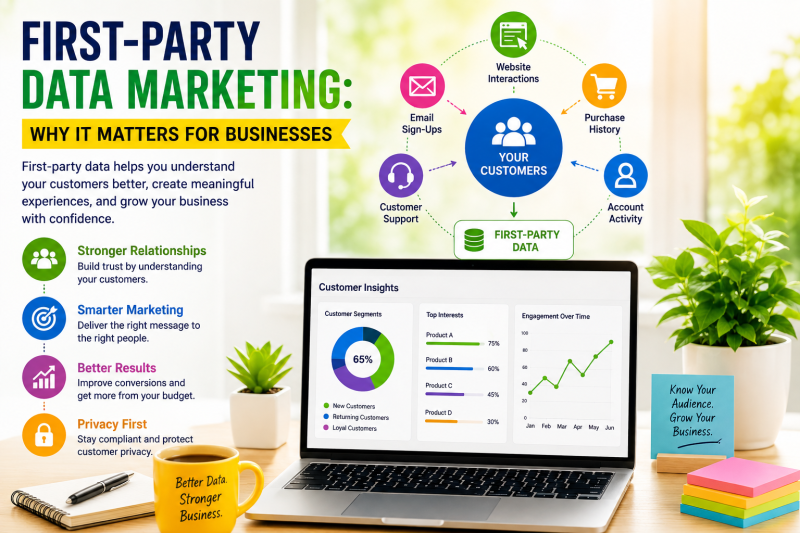
First-party data is information a business collects directly through its own customer interactions. Website activity, purchases, subscriptions, CRM records, customer enquiries, and account preferences can all provide useful insights.
When managed properly, this information can help businesses understand customers more clearly, create more relevant experiences, improve marketing decisions, and build stronger long-term relationships.
Why First-Party Data Has Become a Strategic Marketing Asset
The Shift Away From Dependence on Third-Party Data
Businesses have traditionally relied on external platforms and audience data to reach potential customers.
That approach can provide useful targeting opportunities, but businesses have less control over how external data is collected, updated, or made available.
First-party data gives businesses a more direct relationship with the information they use for marketing.
Why Direct Customer Relationships Produce More Valuable Insights
Information collected directly from customers has context.
A purchase tells a business what someone bought. A website interaction can show what they considered. A customer service conversation may reveal a specific problem.
When these signals are connected appropriately, businesses can develop a much clearer understanding of customer needs.
What Makes First-Party Data More Valuable Than External Audience Data?
Data Comes Directly From Real Customer Interactions
First-party customer data comes from interactions between a business and its audience.
This can include:
- Website visits
- Purchases
- Email interactions
- Account activity
- Customer enquiries
- Product usage
- Subscriptions
Because the business collects the information directly, it can understand the context behind many of these interactions.
Greater Context Around Customer Intent and Behaviour
A generic audience segment may tell a business that someone fits a particular demographic.
First-party data can provide more useful behavioural context, such as which products a customer viewed, what they purchased, or which content they engaged with.
Stronger Control Over Data Quality and Usage
Businesses can establish their own processes for collecting, organising, updating, and using customer information.
This creates an opportunity to improve data quality while establishing appropriate governance.
Where Businesses Generate First-Party Data
Website and Product Interactions
Websites can provide valuable information about customer journeys.
Businesses may learn which pages customers visit, which products they explore, and where users stop progressing through a journey.
CRM and Customer Service Records
CRM systems can bring together information from sales and customer interactions.
Customer service records can also reveal recurring questions, concerns, and preferences.
Purchases, Subscriptions, and Transactions
Transaction data provides direct evidence of customer behaviour.
Purchase frequency, product preferences, subscription activity, and customer value can help marketers develop more relevant segments.
Forms, Surveys, and Account Preferences
Forms and surveys allow businesses to collect information directly from customers.
However, businesses should only collect information that has a clear purpose and should communicate how it will be used.
How First-Party Data Improves Marketing Performance
More Accurate Customer Segmentation
Instead of treating every customer as part of one broad audience, businesses can create segments based on actual behaviour and customer relationships.
This can make campaigns more relevant and reduce unnecessary messaging.
More Relevant Personalisation
First-party data can support personalised content, recommendations, offers, and communications.
For example, a business may adapt messaging based on previous purchases or a customer's stage in the buying journey.
Better Lead Nurturing and Customer Retention
Customer data can help businesses understand where prospects are in the buying process.
Existing customers can also receive more relevant communications based on their previous interactions.
Stronger Marketing Attribution
First-party data can help businesses connect marketing interactions with customer activity.
This can make it easier to understand which channels and campaigns contribute to conversions, although attribution remains a complex measurement challenge.
The Hidden Problems Businesses Face Without First-Party Data
Incomplete Customer Understanding
When customer information is scattered across different platforms, marketers may only see part of the customer journey.
This can result in less relevant campaigns and weaker decision-making.
Increasing Dependence on External Platforms
Relying heavily on external platforms can leave businesses vulnerable to changes in policies, targeting capabilities, algorithms, or data availability.
Weak Audience Targeting and Personalisation
Without reliable customer information, businesses may rely on broad assumptions.
This can lead to generic messaging that fails to reflect individual customer needs.
Difficulty Measuring the Real Customer Journey
If sales, CRM, website, and marketing data remain disconnected, understanding the complete customer journey becomes much harder.
How to Build a First-Party Data Strategy Without Creating Data Silos
Identify the Customer Data the Business Actually Needs
Start with business objectives.
Ask what information is genuinely needed to improve customer experiences, marketing decisions, or business performance.
Collecting data simply because it is available can create unnecessary complexity.
Connect CRM, Website, Sales, and Marketing Data
Data becomes more useful when relevant systems can work together.
Connecting appropriate sources can help teams create a more complete view of customer interactions.
Establish Clear Consent and Data Governance
Businesses need clear rules around data collection, access, storage, retention, and usage.
Consent requirements depend on the type of data and the processing activity, so businesses should ensure their practices comply with applicable privacy laws.
Turn Collected Data Into Actionable Customer Insights
Data has little value if it simply sits inside a database.
Marketing teams should turn relevant information into practical actions, such as better segmentation, improved customer journeys, and more useful content.
Why Privacy and Trust Determine the Long-Term Value of First-Party Data
Transparent Data Collection
Customers should understand what information a business collects and why it is needed.
Meaningful Customer Consent
Where consent is required, it should be obtained appropriately and managed according to applicable data protection requirements.
Responsible Data Storage and Usage
Businesses should limit access to sensitive information and establish suitable security and governance controls.
Trust is an important part of long-term customer relationships. Poor data practices can damage that trust even when the underlying marketing strategy is strong.
How Businesses Can Turn First-Party Data Into a Competitive Advantage
The real value of first-party data comes from connecting information with useful business action.
A company that understands its customers can make better decisions about messaging, products, customer service, retention, and marketing investment.
Businesses looking to improve how they collect, organise, and activate customer information can also consider specialist support such as Skoma Digital Marketing, particularly when building a more connected data-driven marketing approach.
Conclusion
First-party data is becoming a valuable marketing asset because it gives businesses information based on direct customer relationships.
Unlike relying entirely on external audience data, businesses can build their own understanding of customer behaviour through websites, CRM systems, transactions, customer service, surveys, and other direct interactions.
The strongest approach is not to collect as much information as possible. It is to collect useful information responsibly, connect relevant data sources, protect customer privacy, and turn insights into better experiences.
When businesses combine customer data, sound governance, effective technology, and thoughtful marketing, first-party data can become a long-term competitive advantage.
FAQs
What is first-party data in marketing?
First-party data is information a business collects directly from its customers or audience through interactions such as purchases, website activity, subscriptions, forms, CRM records, and customer service.
Why is first-party data becoming more important for businesses?
It gives businesses greater control over customer information and can provide valuable insights based on direct interactions rather than relying entirely on external audience data.
How can businesses collect first-party customer data?
Businesses can collect it through websites, purchases, account registrations, CRM systems, customer service interactions, surveys, subscriptions, and other direct customer relationships.
How does first-party data improve marketing personalisation?
It provides information about customer behaviour and preferences, allowing businesses to create more relevant content, offers, recommendations, and communications.
What is the difference between first-party and third-party data?
First-party data is collected directly by the business from its own audience. Third-party data is obtained from external organisations rather than directly from the customer's relationship with the business.
How can businesses use first-party data while protecting customer privacy?
Businesses should be transparent about collection and usage, obtain appropriate consent where required, minimise unnecessary data collection, restrict access, and maintain suitable security and governance processes.
How does first-party data improve marketing performance and attribution?
It can connect customer interactions across relevant touchpoints, helping marketers understand audiences, improve segmentation, personalise campaigns, and assess how marketing activity contributes to business outcomes.
Source:
Click for the: Full Story
You might like








You Might Like this