Close Menu
 World
World
 Biography
 Health
 Education
 Business
 Lifestyle
 Sports
 Technology
 Animals
 History
 Food
Food
 Religious
 Startups
 Movies
 Politics
 Fashion
 Covid
Covid
 Diet
Diet
 Fitness
 Marketing
 Travel
 Science
 Reviews
 Social media
 Stories
 Facts
Facts
 Art
Art
 Entertainment
Secuodsoft technologies

Technology
Frontend vs Backend Development: Differences, Skills & Salary in 2025
 Secuodsoft technologies
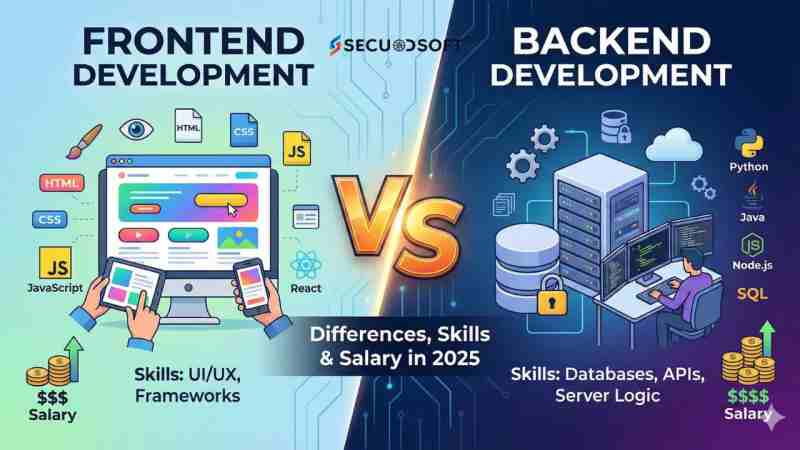
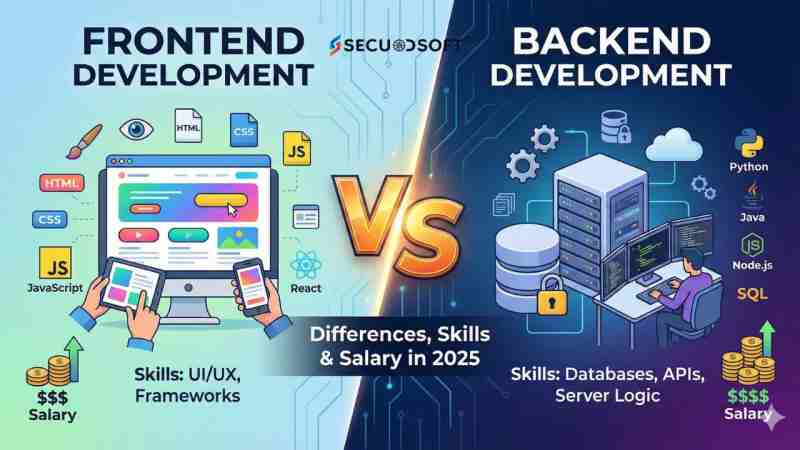
Frontend vs Backend Development are two pillars of modern web and software engineering, and understanding their differences, skills, tools, and salary trends in 2025 is critical for anyone planning a tech career or hiring a development team. This blog explains what frontend and backend development are, how they differ, which tech stacks they use, what skills they demand, how much developers earn today, and which trends are shaping both roles in 2025.
Choosing between frontend vs backend development is one of the most important decisions for aspiring developers and tech professionals in 2025. Both roles are in high demand, but they require different mindsets, tools, and career paths. Frontend focuses on the visual and interactive part of applications, while backend powers the logic, data, and performance behind the scenes.
For businesses building modern digital products, understanding the distinction between frontend and backend development helps in planning hiring, tech stacks, and project structure effectively. This guide explores definitions, differences, skills, salary data, and upcoming trends that can shape smart decisions for both individuals and organizations.
What are Frontend and Backend Development?
What Is Frontend Development?
Frontend development (also called client-side development) focuses on everything users see and interact with directly in a browser or application interface. It covers layout, colors, typography, animations, forms, navigation, and overall user experience.
Core frontend technologies in 2025 include HTML for structure, CSS for styling, and JavaScript for interactivity, along with frameworks like React, Angular, and Vue for building complex user interfaces. Frontend developers ensure applications are responsive, accessible, and optimized for performance on different devices and screen sizes.
What Is Backend Development?
Backend development (server-side development) focuses on logic, database operations, APIs, and server configuration that enable frontend interfaces to function correctly. Backend code handles data processing, business rules, authentication, and communication with databases and external services.
Common backend languages in 2025 include Python, Java, PHP, Ruby, C#, and JavaScript (Node.js), while frameworks such as Django, Spring, Laravel, Express, and .NET Core are widely used. Backend developers are responsible for security, scalability, reliability, and integration of systems behind the scenes.
Differences Between Frontend & Backend Development
Frontend and backend development work together to create functional, user-friendly, and secure web applications in 2025. Frontend development handles everything users see and interact with—such as layout, design, and responsiveness—using technologies like HTML, CSS, JavaScript, and frameworks like React or Angular. Backend development manages the logic, databases, APIs, and security that power the application's data and operations, using languages like Node.js, Python, Java, and frameworks like Django or Express.
Both roles require distinct tools and skills, but their close collaboration ensures that user interactions are seamless and data flows reliably between the visible interface and underlying systems. The synergy between frontend and backend is essential for delivering high-quality, engaging digital products in 2025.
AspectFrontend DevelopmentBackend DevelopmentPrimary FocusUser interface, visuals, and user experienceServer logic, databases, APIs, and performanceVisibilityDirectly visible to users in browser/appHidden, works behind the scenesCore LanguagesHTML, CSS, JavaScriptPython, Java, PHP, Ruby, C#, Node.jsTypical FrameworksReact, Angular, Vue, SvelteDjango, Spring, Laravel, Express, .NETMain ConcernsResponsiveness, accessibility, UX, SEOData integrity, scalability, security, reliabilityWho Interacts?End-users directlyOther systems and frontend via APIs
Frontend turns designs into interactive interfaces, while backend ensures data is stored, processed, and delivered securely and efficiently. Full-stack developers cover both sides, but specialists often go deep into one area for complex systems.
Tech Stacks for Frontend & Backend Development
Frontend Tech Stacks
Frontend developers rely on a rich toolkit to build modern, responsive interfaces:
- Languages: HTML5, CSS3, JavaScript (ES6+)
- Frameworks/Libraries: React, Angular, Vue.js, Svelte
- Styling Tools: Tailwind CSS, Bootstrap, CSS Modules, Sass
- Build Tools: Webpack, Vite, Parcel, Babel
- Testing Tools: Jest, React Testing Library, Cypress
- Version Control: Git, GitHub, GitLab
- Browsers/DevTools: Chrome DevTools, Firefox Developer Tools
Frontend stacks increasingly include performance optimization, PWAs, and design systems for reusable UI components.
Backend Tech Stacks
Backend development uses languages, frameworks, and databases to handle data, logic, and communication:
- Languages: Python, Java, PHP, Ruby, C#, Node.js
- Frameworks: Django, Flask, Spring Boot, Laravel, Express, Koa, .NET Core
- Databases: MySQL, PostgreSQL, MongoDB, Redis, SQL Server
- APIs: REST, GraphQL, gRPC
- Cloud & DevOps Tools: AWS, Azure, GCP, Docker, Kubernetes, CI/CD pipelines
- Security & Monitoring: JWT, OAuth2, API gateways, logging & monitoring systems
Backend stacks are designed for high availability, security, and the ability to handle large-scale traffic efficiently.
Skills Required for Frontend and Backend Development
Essential Frontend Developer Skills
Frontend developers need a mix of technical and design-aware skills:
- Strong command of HTML, CSS, and modern JavaScript
- Experience with frameworks like React, Angular, or Vue
- Understanding of responsive design and mobile-first development
- Knowledge of browser compatibility and performance optimization
- Familiarity with UX principles, accessibility (WCAG), and SEO
- Ability to work with design tools like Figma, Sketch, Adobe XD
Soft skills include collaboration with designers and backend developers, communication, and attention to detail.
Essential Backend Developer Skills
Backend developers focus more on logic, scalability, and data management:
- Proficiency in backend languages like Python, Java, Node.js
- Strong understanding of relational and NoSQL databases
- Experience building and consuming APIs (REST/GraphQL)
- Knowledge of security practices: authentication, authorization, encryption
- Familiarity with cloud platforms, containerization, and DevOps
- Problem-solving for performance tuning, error handling, and system design
Backend developers also collaborate closely with DevOps engineers, architects, and frontend teams to ensure seamless integrations.
Salary of Frontend & Backend Developers
Frontend Developer Salary (India & Global)
In India, the average frontend developer salary in 2025 typically ranges from about ₹5–8 lakhs per annum for entry to mid-level roles, with experienced developers earning significantly more. Data from job portals shows national averages around ₹5.7–6 lakhs per year, with top product companies offering ₹10–20 lakhs for senior profiles.
Globally, frontend and web developers in the US and Europe often earn median salaries near or above $90,000 per year, with higher compensation for specialized skills like React, performance optimization, or design-heavy roles.
Backend Developer Salary (India & Global)
Backend developer salaries in India are also strong, with averages around ₹5–7 lakhs per annum for many roles. Experienced engineers in product-based or multinational companies earn even higher packages. Salaries may start at ₹1.3 lakhs yearly at the lowest and rise up to ₹18 lakhs or more in senior positions, including bonuses and profit-sharing.
Globally, backend developers in high-demand markets may earn comparable or higher salaries than frontend developers, especially when working with distributed systems, microservices, and high-scale architectures.
Overall, both frontend and backend careers are financially rewarding, with backend sometimes receiving a premium due to deeper system and data expertise.
Recent Trends in Frontend & Backend Development
Frontend Development Trends
- Component-driven development with reusable UI systems
- SPAs and micro frontends for improved scalability
- Focus on performance and Core Web Vitals
- Rise of PWAs with offline and installable capabilities
- AI-assisted UI for design, component generation, and personalization
These trends show how frontend roles have become more technical and crucial for user engagement and conversion.
Backend Development Trends
- Microservices and serverless for scalable architectures
- API-first development for web, mobile, and third-party integrations
- Event-driven architectures using message brokers and streams
- Security & Compliance: Increased focus on zero trust, encryption, and regulatory compliance in data handling.
- AI/ML Integration: Exposing machine learning capabilities via backend services for personalization and analytics.
Backend developers who understand cloud-native design, security, and distributed systems are in high demand across industries.
How Secuodsoft Build Frontend and Backend Development by using Expert Developers
Secuodsoft builds exceptional frontend and backend solutions by leveraging a team of expert developers who specialize in modern tech stacks and user-centric design. Their frontend engineers use tools like React, Angular, Vue, HTML5, CSS3, and Tailwind to create intuitive, responsive, and performance-optimized interfaces tailored to each client’s brand and audience.
On the backend, Secuodsoft’s developers work with powerful platforms such as Node.js, Django, FastAPI, Spring Boot, and cloud infrastructure like AWS and Firebase to deliver secure, scalable, and high-performance systems. They manage APIs, databases, authentication, and business logic to ensure seamless, reliable functionality for every application.
A CMMI Level 3 certified process, agile development practices, and continuous collaboration between frontend and backend experts guarantee streamlined integration, top security, and future-ready products designed for growth and innovation.
Ready to grow your business with secure, scalable, and high-performance software? Connect with Secuodsoft’s expert frontend and backend developers today to architect your next-level digital solution!
Conclusion
Frontend vs backend development is not about which one is more important, but about which better fits your strengths, interests, and career goals in 2025. Frontend development suits those who enjoy visual design, user experience, and immediate feedback from interfaces, while backend development is ideal for developers who prefer logic, data handling, system architecture, and performance optimization.
Salary trends show strong demand and competitive compensation for both roles, with growing opportunities in full-stack development for those who master both sides of the stack. With continuous advances in tools, frameworks, and cloud technologies, staying updated and building a solid foundation in core skills will make frontend and backend developers highly valuable in the evolving tech landscape of 2025 and beyond.
Source:
Click for the: Full Story
You might like