



 Close Menu
 World
World
 Biography
 Health
 Education
 Business
 Lifestyle
 Sports
 Technology
 Animals
 History
 Food
Food
 Religious
 Startups
 Movies
 Politics
 Fashion
 Covid
Covid
 Diet
Diet
 Fitness
 Marketing
 Travel
 Science
 Reviews
 Social media
 Stories
 Facts
Facts
 Art
Art
 Entertainment
Aa Us

Health
Global Cancer Epidemiology Overview
 Aa Us
Aa Us
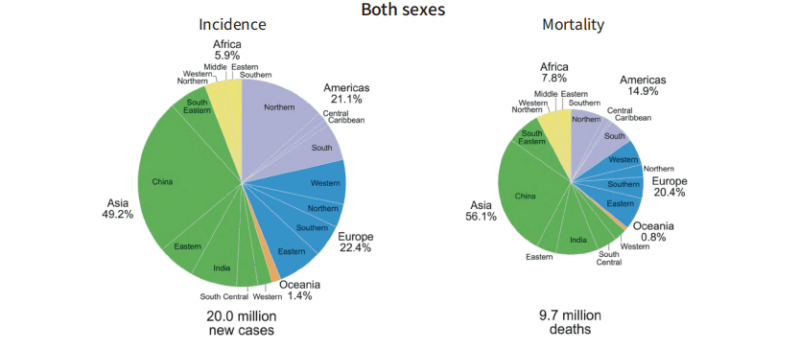
Cancer represents a major social, public health, and economic challenge, accounting for approximately one quarter of deaths related to non-communicable diseases (NCDs) worldwide. According to estimates from the World Health Organization (WHO) and the International Agency for Research on Cancer (IARC), there were approximately 20 million new cancer cases globally in 2022, with about 9.7 million cancer-related deaths. China ranked first worldwide in both the number of new cancer cases and cancer deaths.
Global Cancer Incidence and Mortality by Cancer Type
By tumor type, lung cancer was the most commonly diagnosed cancer globally in 2022, with approximately 2.5 million new cases, accounting for 12.4% of all cancers. This was followed by female breast cancer (11.6%), colorectal cancer (9.6%), prostate cancer (7.3%), and gastric cancer (4.9%).
Lung cancer also remained the leading cause of cancer-related mortality, with approximately 1.8 million deaths (18.7%), followed by colorectal cancer (9.3%), liver cancer (7.8%), female breast cancer (6.9%), and gastric cancer (6.8%).
Regional Differences in Cancer Epidemiology
Cancer incidence and mortality patterns vary significantly across countries and regions, influenced by factors such as ethnicity, socioeconomic development, life expectancy, and lifestyle. The epidemiological profiles of China and the United States are presented below as representative examples.
Cancer Epidemiology in China
In 2022, China was estimated to have 4.8247 million new malignant tumor cases. Lung cancer ranked first in incidence, with approximately 1.0606 million cases (22.0%), followed by colorectal cancer (517,100 cases; 10.7%), thyroid cancer (466,100 cases; 9.7%), liver cancer (367,700 cases; 7.6%), and female breast cancer (357,200 cases; 7.4%).
Cancer-related deaths in China were estimated at 2.5742 million cases, with lung cancer ranking first at approximately 733,300 deaths (28.5%). This was followed by liver cancer (316,500 deaths; 12.3%), gastric cancer (260,400 deaths; 10.1%), colorectal cancer (240,000 deaths; 9.3%), and esophageal cancer (187,500 deaths; 7.3%).
Since 2000, incidence rates for most cancer types in China have remained stable or shown a slow decline. Apparent increases in certain cancers may be attributable to advances in diagnostic technologies. Overall cancer mortality has demonstrated a downward trend.
Cancer Epidemiology in the United States
In 2025, the United States is projected to have approximately 2 million new cancer cases and about 610,000 cancer-related deaths.
Among men, the top three cancers by incidence are:
- Prostate cancer (30%)
- Lung cancer (11%)
- Colorectal cancer (8%)
The leading causes of cancer-related death in men are:
- Lung cancer (20%)
- Prostate cancer (11%)
- Colorectal cancer (9%)
Among women, the top three cancers by incidence are:
- Breast cancer (32%)
- Lung cancer (12%)
- Colorectal cancer (7%)
The leading causes of cancer-related death in women are:
- Lung cancer (21%)
- Breast cancer (14%)
- Pancreatic cancer (8%)
Long-Term Cancer Trends in the United States
From a long-term perspective, incidence rates for most cancers have declined. Prostate cancer remains the most prevalent cancer among men, accounting for 30% of male cancer cases. Notably, after a period of rapid increase followed by decline, prostate cancer incidence reached a new inflection point around 2015 and has since shown a renewed upward trend, consistently ranking first among male cancers in the U.S.
Both lung cancer and colorectal cancer incidence have declined significantly, each decreasing by approximately one-third compared with 1975 levels. Among women, breast cancer accounts for 32% of cases and has remained at a high level since 1975, with overall incidence continuing to rise despite fluctuations. Meanwhile, lung cancer, melanoma, thyroid cancer, and liver cancer have shown steadily increasing incidence rates.
Lung cancer remains highly prevalent in both men and women and is the leading cause of cancer-related death in both sexes. Over the past century, lung cancer mortality among men peaked around 1990, paralleling incidence trends, before declining rapidly. This rise was primarily driven by environmental pollution associated with industrialization beginning in the 1930s and widespread tobacco use, while the subsequent decline is largely attributed to anti-smoking initiatives launched around the 1960s. Mortality rates for other cancers in men have declined gradually. Among women, overall cancer mortality has also declined, with lung cancer mortality peaking around 2000 and decreasing thereafter.
Overall Cancer Spectrum in China and the United States
According to the perspectives of China’s National Cancer Center, both China and the United States share the prominent burden of lung cancer and breast cancer within their cancer spectra. China’s cancer profile reflects a coexistence of patterns seen in both developed and developing countries, characterized by a high incidence and mortality of gastrointestinal cancers, alongside a growing burden of colorectal cancer, prostate cancer, and other malignancies.
Five-Year Survival Rates of the Top 10 Cancers in China and the United States
Over the past five decades, improvements in lifestyle interventions, early cancer screening, and rapid advances in treatment modalities have led to significant changes in cancer mortality trends. According to data from the U.S. Surveillance, Epidemiology, and End Results (SEER) Program, the overall 5-year relative survival rate for cancer increased from 49% in the 1970s to 69% during 2013–2019.
However, among the top 10 most common cancers globally, substantial disparities in 5-year survival rates persist between China and the United States for several cancer types.
Innovation Drug R&D Activity by Cancer Type
From a drug development perspective, between January 1, 2015, and the present, non–small cell lung cancer (NSCLC) and breast cancer have consistently ranked first and second, respectively, in terms of:
- Number of globally approved innovative drugs
- Number of innovative drugs approved in China
- Number of global pivotal clinical trials
Cancer types ranking within the top 10 across all three dimensions include multiple myeloma, prostate cancer, diffuse large B-cell lymphoma, and colorectal cancer.
Focus Cancer Types for Analysis
Based on the combined analysis of epidemiological burden and innovation drug development intensity, six representative cancer types with high incidence and active pipelines were selected for in-depth analysis:
- Solid tumors: Non–small cell lung cancer, breast cancer, gastric cancer, prostate cancer
- Hematologic malignancies: Multiple myeloma and lymphoma
Additional representative tumor types will be analyzed in the future as needed.
About Dengyue Med
DengyueMed, as one of China’s leading innovative pharmaceutical distributors, is committed to advancing the global development and distribution of anticancer therapies. Through close collaboration with international medical and research institutions, the company promotes the global reach of China-originated innovative oncology drugs and provides patients worldwide with broader access to advanced treatment options.
Source:
Click for the: Full Story
You might like










You Might Like this