



 Close Menu
 World
World
 Biography
 Health
 Education
 Business
 Lifestyle
 Sports
 Technology
 Animals
 History
 Food
Food
 Religious
 Startups
 Movies
 Politics
 Fashion
 Covid
Covid
 Diet
Diet
 Fitness
 Marketing
 Travel
 Science
 Reviews
 Social media
 Stories
 Facts
Facts
 Art
Art
 Entertainment
samiksha
Business
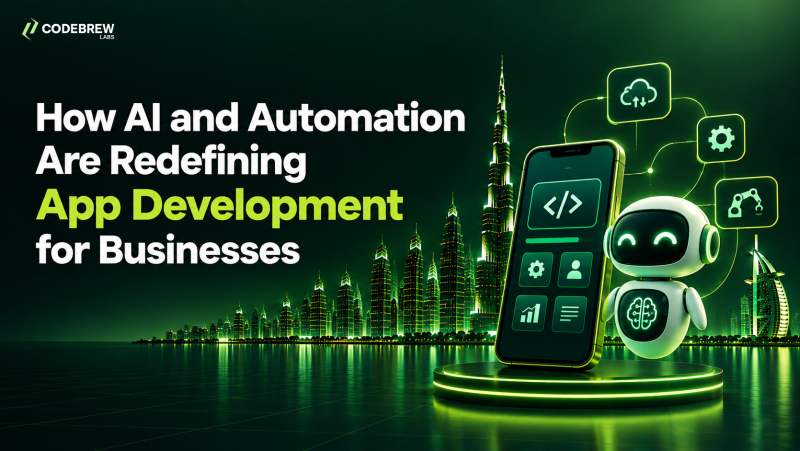
How AI and Automation Are Redefining App Development for Businesses?
 samiksha
Businesses are no longer developing mobile applications merely to provide customers with another digital channel. Instead, modern apps have become essential business tools that enhance sales, customer service, operations, communication, and decision-making.
At the same time, users expect faster responses, more personalized interactions, and simpler methods to complete tasks. To meet these expectations, businesses are rethinking the design of their applications.
Artificial intelligence (AI) and automation are playing significant roles in this transformation. AI can help applications analyze data, understand language and images, and track user behavior, while automation can manage repetitive processes with minimal manual input. When these technologies work together, businesses can create applications that are more responsive, efficient, and capable of handling complex workflows.
As a result, app development is shifting from a focus on individual features to a broader strategy aimed at improving overall business operations and enhancing customer service.
Why AI and Automation Matter in Modern Apps
Traditional applications generally work according to predefined rules. Users select an option, enter information, and receive a predetermined result.
That model still works for many functions, but businesses increasingly deal with large amounts of data, changing customer expectations, and complicated processes.
AI introduces the ability to interpret information and generate useful responses. Automation then allows the application to act on those results.
For example, an eCommerce application can use AI to understand what a customer is looking for and automation to update recommendations, trigger notifications, or initiate follow-up processes.
Instead of simply displaying information, the application becomes an active part of the business workflow.
1. Smarter Customer Support
Customer support is one of the most obvious areas where AI and automation can improve an application.
Instead of requiring customers to search through help pages or wait for an employee, an AI-powered system can understand questions and provide relevant answers instantly.
Automation can take the process further by handling actions such as:
- Creating support tickets
- Sending order updates
- Escalating complex issues
- Scheduling callbacks
- Sharing relevant documents
- Sending follow-up notifications
Simple requests can be handled automatically, while complicated cases can be transferred to human support teams.
This approach can reduce response times while allowing employees to focus on issues that genuinely require human attention.
2. More Personalized User Experiences
Users increasingly expect applications to understand their preferences.
AI can analyze factors such as browsing behavior, previous interactions, purchase history, location, and engagement patterns to identify what may be relevant to a particular user.
Automation can then deliver personalized experiences automatically.
For example, a retail application could recommend products based on recent activity. A fitness application could adjust suggestions based on user progress. A learning platform could recommend lessons based on previous performance.
The goal is not simply to show more recommendations. It is to make the application feel more relevant to each individual user.
3. Faster Business Operations
Many businesses still depend on repetitive manual tasks that consume employee time.
AI and automation can help applications handle some of these processes.
Consider a logistics company. An application could collect delivery information, analyze shipment data, identify potential delays, notify customers, and update internal teams automatically.
Similarly, a property management application could automate appointment reminders, tenant notifications, document collection, and routine requests.
These improvements can reduce administrative workloads and allow teams to spend more time on higher-value activities.
4. AI-Powered Search and Discovery
Search is also changing.
Traditional app search generally depends on keywords. Users need to know what terms to enter to find the information they want.
AI-powered search can understand intent and natural language.
A customer might search for:
“Show me comfortable business shoes under my budget.”
Instead of matching individual keywords, an AI-powered application can understand the meaning of the request and provide more relevant results.
This type of search can be useful in eCommerce, travel, real estate, healthcare information platforms, education, and enterprise applications.
5. Smarter Decision Support
Businesses generate large amounts of data through their applications. The challenge is turning that information into useful decisions.
AI can identify patterns and trends across large datasets and present insights in a more understandable way.
For example, a business application could highlight:
- Changes in customer behavior
- Products with increasing demand
- Unusual transaction activity
- Potential operational bottlenecks
- Customer engagement trends
- Areas with declining performance
The application does not necessarily make the final decision. Instead, it can give business teams better information to make decisions faster.
6. Automated Marketing and Engagement
Mobile applications are often closely connected to customer engagement strategies.
AI can help businesses identify which users may be interested in particular products, services, or content. Automation can then trigger appropriate communication based on user behavior.
For instance, if a customer abandons a shopping cart, the system could automatically send a reminder. If a user has not opened the application for an extended period, a personalized notification could encourage them to return.
However, effective automation requires balance. Too many notifications can frustrate users and damage engagement.
7. Better Fraud and Security Monitoring
AI can also support application security.
Financial and commerce applications, for example, can analyze transaction patterns and identify activity that appears unusual.
Instead of relying only on fixed rules, AI systems can recognize patterns across large amounts of data.
Automation can then trigger predefined security responses, such as requesting additional verification or alerting a security team.
Human review remains important for sensitive decisions, but intelligent monitoring can help businesses respond more quickly to potential threats.
8. Improved Application Testing
AI and automation are not limited to the user-facing side of an application.
They can also support the development process itself.
Automated testing can run repetitive test cases across devices, operating systems, and application versions. AI-assisted tools can help identify potential issues, analyze test results, and prioritize areas that require attention.
This can help development teams identify problems earlier in the product lifecycle.
The result is a development process that can become faster and more consistent without removing the need for experienced developers and testers.
9. AI Is Changing App Development Architecture
The introduction of AI is also influencing the technical architecture behind applications.
Modern apps may need to connect with:
- AI and machine learning models
- Cloud platforms
- Business APIs
- Customer databases
- Analytics systems
- Automation platforms
- Payment services
- Enterprise software
This makes API integration and scalable architecture increasingly important.
Businesses need to think about how AI functionality will communicate with existing systems and how the application will handle growing amounts of data and usage.
A well-designed architecture makes it easier to introduce new intelligent features later without rebuilding the entire application.
AI Does Not Mean Everything Should Be Automated
One of the biggest mistakes businesses can make is trying to automate every part of an application.
Some tasks are predictable and suitable for automation. Others require judgment, empathy, creativity, or human accountability.
For example, an automated system can confirm an appointment, but a complicated customer complaint may require a human representative.
The strongest applications usually combine automation with human involvement rather than treating AI as a complete replacement for people.
This approach can improve efficiency while maintaining the level of trust users expect.
Challenges Businesses Need to Address
AI-powered applications also introduce new considerations.
Data Privacy
AI systems often require access to significant amounts of information. Businesses must establish appropriate data protection, access controls, and security practices.
Accuracy
AI systems can make mistakes. Businesses need validation mechanisms and clear processes for handling incorrect outputs.
Integration
Connecting AI with existing business software can be complex. APIs, databases, authentication systems, and legacy platforms all need to work together properly.
Cost
AI models, cloud infrastructure, data storage, and API usage can increase operational costs. Businesses need to select technologies according to actual requirements rather than adopting expensive systems unnecessarily.
User Trust
Customers should understand how AI is being used and when they are interacting with automated systems. Transparency can make AI-powered experiences easier to accept.
How Businesses Should Approach AI-Powered App Development
Businesses should begin with the problem rather than the technology.
Instead of asking, “How can we add AI to our app?” teams should identify areas where customers or employees experience unnecessary friction.
The process can include:
- Identify repetitive or time-consuming processes.
- Understand customer and employee pain points.
- Determine where AI can add meaningful value.
- Identify workflows suitable for automation.
- Define security and data requirements.
- Build a focused initial use case.
- Measure results and user feedback.
- Expand AI capabilities gradually.
This approach reduces unnecessary complexity and gives businesses a clearer path toward measurable outcomes.
The Future of AI and Automation in App Development
The combination of AI and automation is likely to become a standard part of many business applications.
Applications will increasingly be expected to understand natural language, personalize interactions, automate workflows, summarize information, and support users throughout different stages of their journey.
At the same time, businesses will need to focus on responsible implementation. Security, transparency, human oversight, and reliable system design will become just as important as the AI capabilities themselves.
The future is not simply about adding more intelligent features. It is about creating applications that use intelligence and automation where they can genuinely improve the customer experience and business process.
Conclusion
AI and automation are redefining what businesses can expect from modern applications. From customer support and personalization to testing, security, marketing, and operational workflows, these technologies can improve both the user experience and the way businesses work behind the scenes.
However, successful implementation requires more than adding an AI chatbot or automated workflow. Businesses need a clear strategy, scalable architecture, appropriate security measures, and a strong understanding of where intelligent technology can deliver real value. A thoughtful app development approach can help businesses integrate these technologies in ways that support their specific goals.
As applications continue to evolve, companies that combine thoughtful app development with practical AI and automation can build digital products that are faster, smarter, and better aligned with changing business needs.
Source:
Click for the: Full Story
You might like










You Might Like this