



 Close Menu
 World
World
 Biography
 Health
 Education
 Business
 Lifestyle
 Sports
 Technology
 Animals
 History
 Food
Food
 Religious
 Startups
 Movies
 Politics
 Fashion
 Covid
Covid
 Diet
Diet
 Fitness
 Marketing
 Travel
 Science
 Reviews
 Social media
 Stories
 Facts
Facts
 Art
Art
 Entertainment
samiksha

Business
How AI Is Transforming App Development in 2026
 samiksha
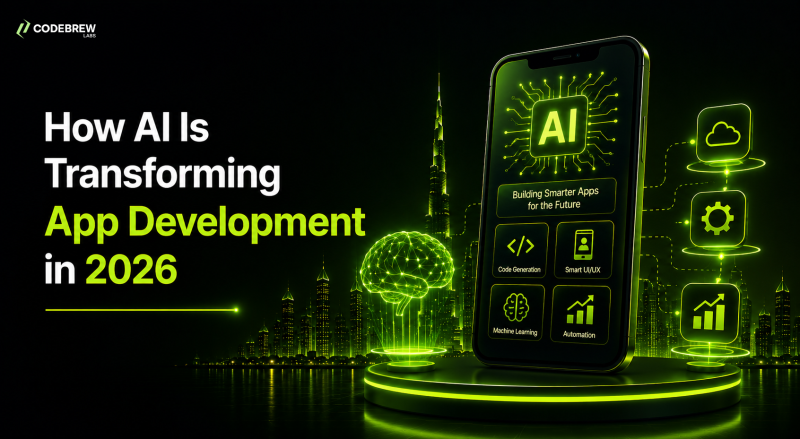
Artificial intelligence has evolved from a futuristic concept to a key element in mobile app development by 2026. AI is integral to planning, designing, developing, testing, and enhancing applications.
For businesses, this shift allows for the creation of smarter apps, simplified development processes, and improved user experiences. Companies are now embedding AI into their app strategies rather than treating it as just an extra feature.
Whether you're a startup launching your first app or an enterprise modernizing an existing one, understanding AI's impact on app development can guide better technology decisions.
The Growing Role of AI in App Development
Traditional app development often involves multiple stages, including business analysis, planning, UI/UX design, coding, testing, deployment, and maintenance. Each stage requires time, expertise, and significant resources.
AI is helping development teams optimize these processes.
Modern AI tools can assist developers with generating code, identifying bugs, analyzing application performance, creating test cases, and even recommending improvements. At the same time, AI-powered applications can provide users with personalized experiences based on their behavior and preferences.
This means AI is influencing app development in two major ways:
- AI is improving how apps are built.
- AI is changing what apps can do.
The combination of these two trends is creating a new generation of intelligent mobile applications.
1. AI Is Accelerating the Development Process
One of the biggest changes AI has introduced is faster software development.
Developers can now use AI-assisted development tools to generate code suggestions, explain complex code, identify potential errors, and automate repetitive programming tasks. Instead of spending significant time writing routine code manually, developers can focus more on application architecture, business logic, security, and user experience.
AI can also help teams quickly create prototypes and validate product ideas.
For startups, this can be particularly valuable. A business can move from an initial concept to a functional MVP faster, allowing the team to collect user feedback before investing heavily in a full-scale product.
However, AI does not eliminate the need for experienced developers. Human expertise remains essential for architecture, security, performance optimization, integration decisions, and quality control.
2. Smarter UI/UX Design
AI is also influencing the way mobile applications are designed.
Design teams can use AI-powered tools to explore different interface concepts, generate design ideas, analyze user journeys, and identify potential usability issues. AI can help designers understand how users interact with different elements and recommend improvements.
Personalization is another major advantage.
Instead of showing the same interface and content to every user, AI-powered applications can adapt experiences based on individual behavior. For example, an eCommerce application can recommend products based on browsing and purchasing patterns, while a fitness app can personalize recommendations based on user activity.
The result is a more relevant and engaging experience.
3. AI-Powered Personalization
Modern users expect applications to understand their needs.
AI makes this possible by analyzing large amounts of behavioral and contextual data. Applications can use these insights to provide personalized recommendations, notifications, content, offers, and services.
Consider a few examples:
- A shopping app can recommend relevant products.
- A streaming platform can suggest content based on viewing behavior.
- A financial app can provide personalized spending insights.
- A healthcare application can offer customized wellness recommendations.
- A travel app can suggest destinations based on previous searches.
Personalization can improve engagement because users receive information that is more relevant to their interests.
4. AI Chatbots and Virtual Assistants
AI-powered conversational interfaces have become another major part of modern app development.
Businesses can integrate intelligent chatbots into applications to provide customer support, answer questions, guide users, and automate routine interactions.
Unlike traditional rule-based chatbots, modern AI systems can understand natural language and handle more flexible conversations.
For businesses, this can reduce pressure on customer support teams while allowing users to receive assistance whenever they need it.
AI assistants can be particularly useful in industries such as:
- Healthcare
- Banking and FinTech
- eCommerce
- Travel
- Real estate
- Education
- Logistics
The key is to design these systems responsibly, especially when applications handle sensitive or important information.
5. AI Is Improving App Testing
Testing is one of the most important stages of app development, but it can also be time-consuming.
AI can help development teams automate several testing activities. Intelligent tools can identify patterns, generate test cases, detect anomalies, and highlight potential areas of failure.
AI-assisted testing can be used to evaluate:
- Application functionality
- User flows
- Performance
- Security vulnerabilities
- Interface behavior
- API responses
- Regression issues
By identifying problems earlier, development teams can reduce the risk of major issues appearing after an application is launched.
That can lead to better app quality and a smoother release process.
6. Predictive Analytics for Better Business Decisions
AI is also making mobile applications more valuable for business intelligence.
Applications generate large amounts of data about user interactions. AI can analyze this information to identify patterns and predict potential outcomes.
For example, businesses can use AI to understand:
- Which products users are likely to purchase
- When customers may stop using an application
- Which features receive the most engagement
- What type of content performs best
- Which customers are likely to respond to an offer
These insights can help businesses make data-driven decisions rather than relying entirely on assumptions.
7. AI and Voice-Based Experiences
Voice technology is becoming another important area of AI-powered app development.
Users can interact with applications through natural language instead of relying exclusively on traditional touch interfaces. Voice search, voice commands, transcription, and conversational interfaces can make applications more accessible and convenient.
For example, users could search for products, schedule appointments, request information, or perform certain application actions through voice commands.
As AI-powered speech technologies continue to improve, voice interaction can become a more natural part of mobile experiences.
8. Improved App Security
Security is a critical concern for every mobile application.
AI can assist security teams by identifying unusual activity, detecting suspicious patterns, and helping organizations respond to potential threats.
For example, an AI-powered financial application can identify transactions that differ significantly from a user's normal behavior. Similarly, an enterprise application can monitor access patterns for unusual activity.
AI should complement—not replace—traditional security practices. Secure architecture, encryption, authentication, access controls, regular testing, and responsible data handling remain essential.
9. AI Is Changing App Monetization
AI can also influence how businesses generate revenue from applications.
Personalized recommendations can improve conversion rates, while intelligent segmentation can help businesses deliver more relevant offers. AI can also help businesses understand which subscription plans, products, or services are most likely to appeal to specific users.
For example, a SaaS application could analyze customer behavior and recommend a more appropriate subscription tier.
This makes AI useful not only from a technology perspective but also from a business strategy perspective.
The Future of AI-Powered App Development
AI-powered app development is expected to continue evolving rapidly.
Future applications will likely become more contextual, predictive, conversational, and personalized. Instead of simply responding to user commands, applications will increasingly anticipate user needs and proactively provide useful information.
However, businesses should avoid adding AI simply because it is trending.
The right approach is to start with a clear business problem. Ask what users need, identify where AI can provide genuine value, and then select the appropriate technology.
Successful AI app development requires a balance between technology, usability, security, scalability, and business objectives.
Choosing the Right App Development Partner
Building an AI-powered application requires more than basic mobile development knowledge. Businesses need expertise across app architecture, AI integration, APIs, cloud infrastructure, data management, UI/UX, testing, and security.
An experienced app development company can help businesses evaluate whether AI is appropriate for their product, identify suitable use cases, select technologies, and develop a scalable solution.
Code Brew Labs, for example, brings 13+ years of industry experience and expertise across mobile app development, AI, cloud technologies, and other emerging technologies. With 2,500+ successfully delivered digital solutions and a team of technology and design professionals, the company helps businesses transform ideas into scalable digital products.
Conclusion
AI is transforming app development by changing both how applications are built and what applications can accomplish.
From faster development and automated testing to intelligent personalization, conversational interfaces, predictive analytics, and smarter security, AI is creating new opportunities for businesses across industries.
But successful AI adoption is not about adding as many AI features as possible. It is about identifying meaningful problems and using technology to solve them effectively.
Businesses that combine strong product strategy with experienced app development can use AI to create applications that are not only technically advanced but also useful, scalable, secure, and valuable to their customers.
Source:
Click for the: Full Story
You might like







You Might Like this