



 Close Menu
 World
World
 Biography
 Health
 Education
 Business
 Lifestyle
 Sports
 Technology
 Animals
 History
 Food
Food
 Religious
 Startups
 Movies
 Politics
 Fashion
 Covid
Covid
 Diet
Diet
 Fitness
 Marketing
 Travel
 Science
 Reviews
 Social media
 Stories
 Facts
Facts
 Art
Art
 Entertainment
Lunna

Education
How an Amazon FBA Training Course Can Help Sellers Build a Successful Online Business
 Lunna
Lunna
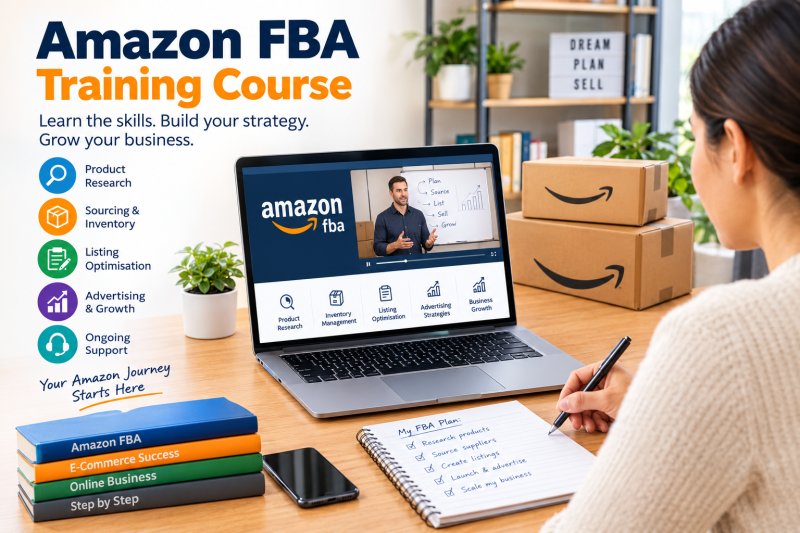
Starting an Amazon business can be an exciting opportunity for entrepreneurs who want to sell products online. However, understanding the marketplace, choosing profitable products, managing inventory, and attracting customers requires careful planning. An Amazon FBA Training Course can help aspiring sellers develop the knowledge and practical skills needed to approach these responsibilities with greater confidence.
Fulfilment by Amazon (FBA) allows sellers to send eligible inventory to Amazon's fulfilment network, where Amazon handles storage, order packing, shipping, and customer service for FBA orders, subject to its policies. Although this model can simplify certain operations, sellers remain responsible for important decisions involving product selection, costs, marketing, and business performance. Learning how the system works can help entrepreneurs prepare more effectively before investing their money.
Understanding How Amazon FBA Works
Before launching a product, sellers need to understand the basic processes involved in operating an FBA business. These include creating a seller account, researching products, sourcing inventory, preparing shipments, and monitoring sales.
Amazon FBA can reduce the workload associated with fulfilling individual orders, but it does not remove every operational responsibility. Sellers must still maintain suitable inventory levels, follow packaging and labelling requirements, understand marketplace rules, and monitor expenses.
An introductory Amazon FBA Training programme can explain these processes in a structured way. Instead of relying entirely on scattered online information, learners can develop a clearer understanding of how different activities connect.
This foundation is particularly useful for beginners who want to understand the business model before committing to product purchases or other significant expenses.
Learning Product Research and Market Analysis
Product selection is one of the most important decisions in an Amazon business. A product may appear attractive because it has strong demand, but competition, sourcing costs, customer expectations, and fulfilment fees can affect its commercial potential.
Successful research involves examining several factors rather than relying on sales estimates alone. Sellers should investigate competitor listings, customer reviews, pricing patterns, product differentiation, and possible seasonal changes in demand.
A structured Amazon FBA Course can introduce learners to research methods and tools that help them evaluate potential opportunities. It can also explain how to compare different products and recognise warning signs, such as intense competition or limited profit margins.
For example, a product with a low purchase cost may initially appear profitable. However, once shipping, import expenses where applicable, Amazon fees, advertising, and returns are considered, the actual margin may be much smaller.
Learning to calculate these expenses before placing an order can help sellers make more informed decisions and reduce avoidable financial risks.
Understanding Costs and Profit Margins
Revenue alone does not determine whether an Amazon business is successful. Sellers need to understand how much money remains after all relevant expenses have been deducted.
Common costs include inventory purchases, packaging, transportation, storage, fulfilment fees, referral fees, advertising, and other operating expenses. Depending on the business, additional costs may include software subscriptions, professional services, and taxes.
Amazon FBA Training UK programmes can help learners understand the importance of building a realistic financial plan. Sellers can learn to estimate their total costs, calculate contribution margins, and consider how price changes may affect profitability.
It is also important to allow for unexpected expenses. Delayed shipments, damaged inventory, product returns, and changing advertising costs can affect cash flow.
By developing basic financial management skills, entrepreneurs can assess opportunities more carefully and avoid treating high sales figures as proof of a profitable business.
Improving Product Listings and Search Visibility
Once a product has been selected, sellers need to create a listing that explains its features and benefits clearly. Product titles, bullet points, descriptions, images, and relevant search terms all contribute to the shopping experience.
A listing should provide accurate information and help customers understand whether the product meets their requirements. Misleading claims, unclear specifications, or poor-quality images can create confusion and potentially lead to customer dissatisfaction.
Training can help sellers understand how to organise listing information, conduct keyword research, and write useful product descriptions. Learners can also explore how product images and enhanced content, where available, help communicate product value.
The goal is to balance search relevance with readability. Repeating keywords excessively is unlikely to create a positive experience for shoppers.
A well-structured listing, combined with competitive pricing and reliable fulfilment, can support a stronger foundation for attracting relevant customers.
Developing an Effective Amazon Advertising Strategy
Advertising can help new products reach potential customers, but campaigns require careful monitoring. Without a clear plan, sellers may spend too much on keywords that generate clicks without producing sufficient sales.
A comprehensive training programme may introduce sponsored advertising formats, keyword targeting, bidding strategies, campaign organisation, and performance reporting.
Sellers can learn to review metrics such as click-through rate, conversion rate, advertising cost of sales (ACoS), and total advertising cost of sales (TACoS). These measurements provide different perspectives on campaign performance and should be interpreted alongside overall profitability.
For example, a campaign receiving many clicks but few orders may indicate a mismatch between the targeted search terms and the product listing. It may also suggest that the price, product presentation, or customer proposition needs further evaluation.
Learning how to investigate these patterns helps sellers make decisions based on evidence rather than assumptions. Advertising results are never guaranteed, but a thoughtful approach can improve budget management.
Choosing the Right Learning Resources
Aspiring sellers can choose from several learning options, including tutorials, online courses, group workshops, and individual coaching. The best choice depends on experience, learning preferences, available time, and business objectives.
An amazon fba course uk may be useful for learners who prefer structured lessons focused on the UK marketplace. When comparing programmes, it is worth examining the course syllabus, practical exercises, instructor experience, and opportunities to ask questions.
Some learners begin with an amazon fba free online course to understand basic terminology and processes. Free resources can provide a useful introduction, although their depth, accuracy, and coverage vary. More structured training may be helpful when learners need detailed explanations or guidance on specific business challenges.
The Amazon Trainer is one option to explore when comparing dedicated Amazon seller training. Prospective learners should review the available programme details and determine whether the teaching approach matches their requirements.
Regardless of the provider, learners should be cautious about claims promising guaranteed sales, rapid profits, or effortless business growth.
Getting Practical Support and Building Confidence
Learning concepts is valuable, but applying them to real business situations is equally important. Practical exercises can help learners understand how to research products, assess costs, prepare listings, and interpret performance data.
Access to Amazon FBA support can also be useful when sellers encounter unfamiliar processes. Depending on the training arrangement, this may involve instructor feedback, demonstrations, follow-up sessions, or explanations of common operational challenges.
Learners should remember that training providers cannot replace Amazon's official support channels when an issue requires account-specific assistance or a formal policy review.
The most effective learning approach encourages independent decision-making. Rather than relying on someone else to make every business decision, sellers should develop the skills to evaluate opportunities, identify problems, and adjust their strategies.
Consistent practice and regular performance reviews can help turn theoretical knowledge into practical business capabilities.
Conclusion
Building an Amazon FBA business requires research, financial planning, effective product listings, advertising knowledge, and ongoing operational management. A structured learning programme can help aspiring sellers understand these responsibilities and prepare for the decisions involved in running an online store.
By comparing training options, practising essential skills, and setting realistic expectations, entrepreneurs can develop a more informed approach to selling on Amazon. Education cannot eliminate business risks or guarantee profits, but it can provide a stronger foundation for making thoughtful decisions and pursuing sustainable growth.
Frequently Asked Questions
1. What is an Amazon FBA Training Course?
It is a learning programme that explains how to operate an Amazon business using Fulfilment by Amazon. Topics may include product research, sourcing, listing optimisation, advertising, inventory management, and profitability.
2. Is Amazon FBA suitable for beginners?
Yes, beginners can explore this business model, provided they understand the costs, responsibilities, and risks involved. Learning the fundamentals before investing in inventory can help them prepare more effectively.
3. Can I learn Amazon FBA through free online courses?
Yes. Free online tutorials and introductory courses can explain basic concepts. However, learners should check the accuracy and completeness of the material and use current official Amazon documentation for marketplace requirements.
4. How long does it take to learn Amazon FBA?
The time required depends on the learner's previous experience, the depth of the training, and the time spent practising. Understanding the fundamentals may take weeks, while developing practical experience can take considerably longer.
5. Does Amazon FBA training guarantee business success?
No. Training can improve knowledge and decision-making, but it cannot guarantee sales or profits. Results depend on factors such as product demand, competition, operating costs, cash flow, and how effectively sellers apply what they learn.
Source:
Click for the: Full Story
You might like









You Might Like this