



 Close Menu
 World
World
 Biography
 Health
 Education
 Business
 Lifestyle
 Sports
 Technology
 Animals
 History
 Food
Food
 Religious
 Startups
 Movies
 Politics
 Fashion
 Covid
Covid
 Diet
Diet
 Fitness
 Marketing
 Travel
 Science
 Reviews
 Social media
 Stories
 Facts
Facts
 Art
Art
 Entertainment
Ryan Joel

Business
How Copy Trading Software Development Connects Business Logic With Trading Infrastructure
 Ryan Joel
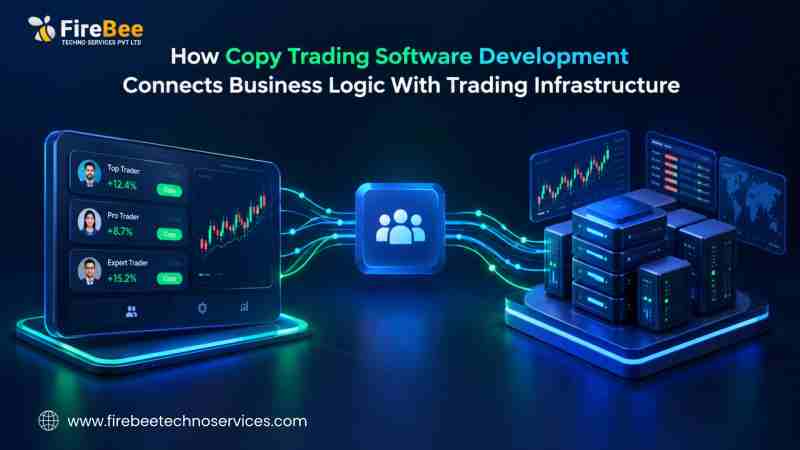
Copy trading platforms are designed to replicate trades across the accounts of several traders by connecting different trading methods. For new businesses entering the digital trading market, the ability to successfully implement the commercial rules will rely on the interaction between commercial rules and broker connectivity and execution systems. Copy Trading Software Development establishes this relationship by converting the requirements of the business into defined behavior of the system. The architecture needs to reconcile accounts' permissions and allocation of trades and keep order states consistent across the connected accounts. As more people join the platform, these decisions will affect the reliability of it and its operational supervision.
What role do business needs play in Copy Trading Software Architecture?
A copy trading platform's operations and revenue are dependent on its business needs. A platform can have some sort of subscription-based access, performance-based fees, or tiers based on accounts. Different eligibility criteria and fee calculation and permission management are required for each of the models.
These requirements need to be translated to an enforceable application rule, not an informal business policy, during the development phase. For instance, strategy access may be limited by account status, or you might have to give explicit permission in order to copy trades on a platform. These conditions can be handled by a separate rules layer, which is managed separately from the execution engine.
The architecture should also specify the registration process for the strategies provided by the business and the process of connecting follower accounts to the selected strategies. Business logic for trading operations should not be mixed with commercial rules, which can then be modified without affecting the actual execution logic.
Connecting Broker APIs With Trade Replication and Order Execution
Broker integration with API enables the linkage of strategy activity and execution on the follower account. When a strategy provider places an order, the platform captures the event and identifies the authorized follower accounts that should receive the corresponding trade instruction.
A crypto copy trading software system should be able to cover up various broker interfaces and the order requirements of exchanges. Different quantities, formats and symbol mappings or validation procedures may apply to the same order in different venues. An integration layer standardizes these variations and routes trade instructions to the appropriate execution interfaces.
It also needs to have unique event identifiers, and idempotent processing, to replicate trade data. If you have a timeout for an API request, the platform will need to know if that initial request succeeded or not before making another request. This means that there won't be a chance for duplicate orders due to unclear answers. This further reduces API delays and temporary connectivity issues for developers.
What is the relationship between capital allocation and account level risk rules?
When copying a strategy, there may be variations in account size and investment amounts. So, it's imperative that the platform has an allocation engine which determines the quantity of trades based on each account's rules.
For instance, the follower might set a set percentage of funds or a set amount of money to invest. The engine assesses the requested exposure in light of available funds and applicable restrictions to form an order. Risk controls can refuse instructions with exposure limits that are higher than the limit and/or account limits.
Businesses can establish consistent participation policies and maintain differences across participating accounts. It also documents why orders were accepted or declined.
Ensuring execution consistency with data reconciliation and infrastructure scaling.
Trading infrastructure should consider partially filled trades and orders that were rejected, and delays in getting status updates. The platform should provide an internal order ledger and should also balance the recorded activity to that of the broker/exchange record. Reconciliation compares expected trade outcomes with confirmed execution records to detect inconsistencies in order status and processing.
Asynchronous processing and queue-based workloads can help to decouple incoming strategy events from account-level processing tasks for growing platforms. Processing delays and failed requests and unfulfilled order states can be monitored using monitoring tools. These controls allow the operations team to probe for discrepancies without impact to unrelated trading activity.
Conclusion
Copy trading software development translates business rules into technical processes that coordinate trade replication and order execution. This enables businesses to create easier-to-govern and maintain platforms by separating business rules from broker integrations, and adding account level risk controls and systematic recon. A clearly structured architecture also enables seamless future extension to other brokers and trading accounts without compromising accountability of trading executions.
Source:
Click for the: Full Story
You might like









You Might Like this