Close Menu
 World
World
 Biography
 Health
 Education
 Business
 Lifestyle
 Sports
 Technology
 Animals
 History
 Food
Food
 Religious
 Startups
 Movies
 Politics
 Fashion
 Covid
Covid
 Diet
Diet
 Fitness
 Marketing
 Travel
 Science
 Reviews
 Social media
 Stories
 Facts
Facts
 Art
Art
 Entertainment
Yatin Samra

Technology
How to Build a Fantasy Sports App in the USA: Features, Technology, Cost, and Development Process
 Yatin Samra
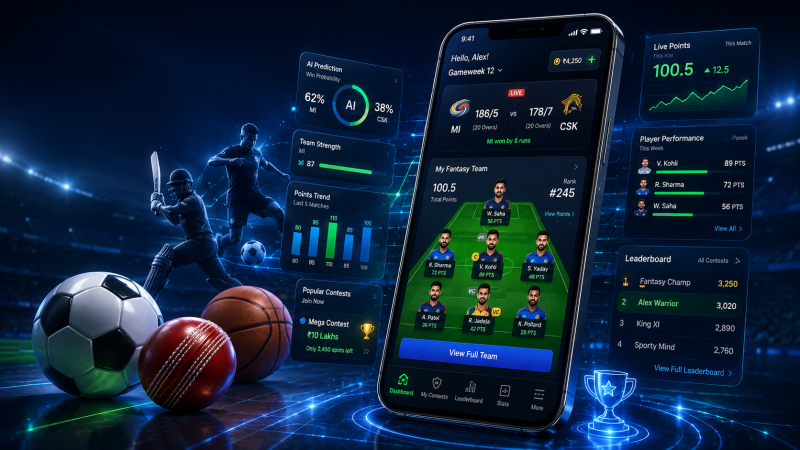
Fantasy sports have now turned into an interactive experience where sport enthusiasts can keep track of their favorite players, teams, or live events. Unlike traditional sports activities, fantasy fans can form their own teams, enter into competitions, and earn rewards based on performance records of athletes in real life.
While creating a fantasy sport platform, entrepreneurs need to consider important aspects related to product design, sports data integration, payment systems, security, scaling possibilities, and other legal issues. In the United States, the development of a fantasy sport app might also depend on specific rules related to a fantasy sports model.
This guide covers all important aspects of fantasy sports app development that include important features, technologies, development phases, prices, and strategies for developing a scalable platform.
What Is a Fantasy Sports App?
A fantasy sports app is a digital platform that allows users to create virtual teams using real-world athletes. Depending on the contest format, users may compete against individuals or larger groups while earning fantasy points based on the actual performance of selected players.
A typical fantasy platform connects several systems:
User Account → Contest → Team Selection → Sports Data → Scoring Engine → Leaderboard
If the platform supports paid contests, additional components may include:
KYC → Geolocation → Wallet → Payment Gateway → Contest Entry → Prize Distribution
This makes the application considerably more complex than a basic sports-statistics app.
Why Develop a Fantasy Sports App for the USA?
The USA has a large sports audience across football, basketball, baseball, hockey, soccer, and other competitions. This provides opportunities for businesses to create specialized or multi-sport fantasy experiences.
A platform can target:
- Daily fantasy sports users
- Season-long fantasy players
- Sports communities
- Private leagues
- Casual fans
- Professional sports enthusiasts
- Niche sports audiences
Businesses can also differentiate themselves through unique contest formats, better analytics, social features, personalized experiences, or specialized sports coverage.
However, the opportunity should be evaluated alongside applicable state-level requirements, operational costs, competition, and user-acquisition challenges.
1. Start With a Clearly Defined Business Model
Before writing code, establish what the platform is intended to accomplish.
Questions to answer include:
- Which sports will be supported?
- Will contests be daily or season-long?
- Will users participate for free or pay entry fees?
- How will the platform generate revenue?
- Will users compete in private leagues?
- Which US states are targeted?
- What type of prizes will be offered?
A focused MVP is generally easier to validate than an application attempting to support every sport and contest format from the beginning.
For example, a business could initially focus on one sport and a small number of contest types before expanding.
2. Understand the US Regulatory Environment
Regulatory planning should take place before product architecture is finalized.
Fantasy sports rules can vary between jurisdictions and can depend on the structure of the product.
Businesses should assess:
- State-specific requirements
- Player eligibility
- Age restrictions
- Contest structure
- Prize mechanisms
- Entry fees
- Payment rules
- Advertising requirements
- Responsible gaming considerations
- Data and reporting obligations
Legal professionals familiar with fantasy sports and gaming regulations should review the business model before launch.
From a technical perspective, the platform should be capable of enforcing jurisdiction-specific restrictions when necessary.
For example, the backend can determine whether a user is eligible to enter a particular contest rather than depending exclusively on frontend restrictions.
3. Design the User Registration System
Registration is the first major interaction between the user and the platform.
A streamlined process can include:
- Account creation
- Email or phone verification
- Identity verification where required
- Age verification
- Location verification where required
- Account activation
The platform should avoid collecting unnecessary information while still meeting applicable operational and compliance requirements.
Security should also be incorporated from the beginning through strong password policies, multi-factor authentication, session management, and secure account-recovery mechanisms.
4. Create an Intuitive Team-Building Experience
The team builder is one of the most important screens in a fantasy sports application.
Users should be able to:
- Search players
- Filter by position
- Review statistics
- Compare athletes
- View player availability
- Understand salary or selection limits
- Add and remove players
- Save teams
- Review projected points
A good interface should make complex information understandable.
For example, instead of presenting dozens of statistics simultaneously, the application can prioritize the metrics most relevant to the particular sport and contest.
This can improve usability for both experienced fantasy players and newcomers.
5. Integrate High-Quality Sports Data
Sports data is fundamental to the platform.
Depending on the sport, the application may require:
- Player profiles
- Team information
- Schedules
- Game status
- Live scores
- Player statistics
- Injuries
- Lineups
- Final results
The data provider should be selected based on coverage, reliability, update frequency, licensing rights, API performance, and cost.
A useful architecture is:
External Sports Feed → Data Ingestion → Normalization → Fantasy Engine → User Interface
This approach allows the platform to convert external data into a consistent internal format.
6. Develop a Configurable Scoring Engine
The scoring engine translates real-world sports events into fantasy points.
Different sports require different rules.
For example, a football platform may consider passing, rushing, receiving, and defensive statistics, while a basketball platform may use points, rebounds, assists, steals, and blocks.
Instead of hard-coding these rules, developers should create a configurable scoring engine.
Administrators can then define:
- Statistical categories
- Point values
- Position requirements
- Bonuses
- Penalties
- Contest-specific rules
- Tie-breaking rules
This architecture allows the business to introduce new contest formats without rebuilding the entire application.
7. Build Real-Time Leaderboards
Fantasy users want to know how their teams are performing while games are taking place.
A leaderboard can display:
- Current rank
- Fantasy points
- Player contributions
- Contest position
- Projected finish
- Remaining players
- Final results
Real-time scoring creates significant technical demands during major games.
The backend may need to process large volumes of incoming sports events and update thousands of contest entries simultaneously.
Caching, message queues, event-driven processing, distributed services, and scalable cloud infrastructure can help manage these workloads.
8. Integrate Wallet and Payment Infrastructure
If the business model includes paid contests, financial infrastructure becomes an essential component.
The application may support:
- Deposits
- Contest entry payments
- Prize credits
- Withdrawals
- Refunds
- Transaction history
A wallet service should maintain an accurate record of every financial event.
Developers should consider:
- Payment-provider integrations
- Transaction reconciliation
- Withdrawal workflows
- Fraud detection
- Account verification
- Secure payment processing
- Audit logs
The user interface should clearly communicate transaction status and available balances.
9. Implement Geolocation and Player Protection
Depending on the platform and applicable jurisdictional requirements, geolocation can determine whether a user is permitted to access particular services.
A location service can potentially use:
- GPS
- IP information
- Wi-Fi signals
- Device information
- Other approved location technologies
The platform should also consider account controls and responsible participation features where applicable.
These systems should be connected to the backend authorization layer so that restrictions cannot simply be bypassed by accessing an alternative application interface.
10. Add Security and Fraud Detection
A fantasy sports platform can handle personal data, account credentials, payment information, contest activity, and potentially significant financial transactions.
Security should therefore cover:
Application Security
- Secure APIs
- Authentication
- Authorization
- Encryption
- Input validation
Account Security
- Multi-factor authentication
- Session controls
- Device monitoring
- Account recovery
Financial Security
- Payment monitoring
- Transaction limits
- Fraud detection
- Withdrawal controls
Operational Security
- Audit logs
- Access controls
- Monitoring
- Incident response
- Backup and recovery
Fraud detection can use behavioral patterns to identify unusual account or transaction activity.
11. Develop an Administration Dashboard
A comprehensive admin dashboard allows operators to manage the platform without directly modifying databases or application code.
It can include:
- User management
- Contest management
- Sport management
- Player management
- Scoring configuration
- Payment monitoring
- Fraud alerts
- Promotions
- Notifications
- Reports
- System analytics
Role-based permissions should determine what different administrators can access.
For example, a content administrator may manage player information while a finance administrator manages transaction reviews.
12. Use Analytics to Improve the Product
Analytics can help businesses understand how users interact with the platform.
Useful metrics may include:
- New registrations
- Active users
- Contest participation
- Player-selection patterns
- Deposits
- Withdrawals
- Retention
- Contest completion
- Average session duration
Analytics can also identify where users abandon workflows.
For example, if many users leave during team creation, the business may need to simplify player discovery or clarify contest rules.
Over time, data can support personalization and product optimization.
Technology Stack for Fantasy App Development
The technology stack should be selected according to the application's scale, development team's expertise, performance requirements, and integrations.
Frontend
Possible choices include:
- React
- Next.js
- TypeScript
Mobile
Businesses can choose between native or cross-platform development.
Potential technologies include:
- Swift
- Kotlin
- Flutter
- React Native
Backend
Common options include:
- Node.js
- Java
- Go
- Python
Databases
A combination of technologies may be appropriate:
- PostgreSQL for transactional data
- Redis for caching
- Event-streaming systems for live updates
- Data warehouses for analytics
Cloud Infrastructure
Cloud platforms can support:
- Auto-scaling
- Load balancing
- Monitoring
- Disaster recovery
- Automated deployment
- High availability
The architecture should be designed around expected peak traffic rather than average daily usage.
Key Features to Include
A competitive fantasy sports platform may include the following feature groups.
Feature Category Examples
Account Registration, login, profile, verification
Fantasy Team builder, player selection, contest entry
Sports Data Scores, statistics, schedules, player information
Competition Leaderboards, rankings, contest results
Payments Deposits, withdrawals, wallet, transaction history
Communication Push notifications, alerts, email
Security MFA, fraud monitoring, access controls
Administration User, contest, sport, payment management
Analytics Player behavior, engagement, revenue metrics
The exact feature set should be determined by the MVP and business model.
How Much Does It Cost to Build a Fantasy Sports App?
There is no single development price because project complexity can vary considerably.
A basic MVP may require:
- User accounts
- Team builder
- Contest management
- Sports data integration
- Scoring engine
- Leaderboards
- Administration
A more advanced platform could add:
- Multiple sports
- Real-time scoring
- Payments
- KYC
- Geolocation
- Fraud prevention
- Native mobile apps
- AI-driven analytics
- Advanced reporting
- High-volume infrastructure
A rough planning timeline could look like:
Development Scope Approximate Timeline
Basic MVP 3–5 months
Medium-scale platform 5–9 months
Advanced multi-sport platform 9–15+ months
Actual cost depends on the development team's location, technology choices, number of platforms, third-party integrations, security requirements, design complexity, and regulatory scope.
Development Roadmap
A practical development process can be divided into eight stages.
Stage 1: Research
Analyze competitors, users, sports, contest types, monetization, and target US jurisdictions.
Stage 2: Business and Legal Planning
Define the business model and obtain appropriate legal and regulatory guidance.
Stage 3: UX/UI Design
Create user flows, wireframes, team-building screens, contest interfaces, and dashboards.
Stage 4: Architecture
Design APIs, databases, sports-data integration, scoring systems, payments, security, and infrastructure.
Stage 5: MVP Development
Build the minimum feature set required to validate the product.
Stage 6: Testing
Conduct functional, security, performance, API, payment, and live-data testing.
Stage 7: Launch
Deploy the application with monitoring, customer support, analytics, and operational procedures.
Stage 8: Continuous Improvement
Use user feedback and analytics to improve performance, engagement, contest formats, and feature quality.
To Know More About Fantasy App Development
If you want to learn more about the technology, architecture, features, and development process behind fantasy sports platforms, a relevant YouTube video can provide additional insight.
To know more about fantasy app development, watch the YouTube video below:
YouTube Video: https://www.youtube.com/watch?v=B_69bKUS94U
The video can serve as supplementary educational content. Businesses should obtain current legal and regulatory advice before launching fantasy sports contests in specific US jurisdictions.
Conclusion
Creating a fantasy sports application in the United States entails a complex interaction of such factors as sports technologies, product development, real-time data processing, finances, analytics, and proper regulation planning.
The first steps include the determination of target users, sports supported by the service, contest rules, revenue model, and the jurisdictions where the app will operate. Based on this, businesses can develop the player selection functionality, scoring engine, live leaderboards, payment system, security solutions, and administration features.
Considering the fact that major sporting events may result in significant surges in traffic, data processing, and users' activities, companies developing fantasy sports apps need to take scalability into account.
Generally, a fantasy sports application needs to provide accurate information, high performance, and a great user experience. All of these should be backed up by proper security and technology solutions to create a competitive platform in the US fantasy sports market.
Source:
Click for the: Full Story
You might like