Close Menu
 World
World
 Biography
 Health
 Education
 Business
 Lifestyle
 Sports
 Technology
 Animals
 History
 Food
Food
 Religious
 Startups
 Movies
 Politics
 Fashion
 Covid
Covid
 Diet
Diet
 Fitness
 Marketing
 Travel
 Science
 Reviews
 Social media
 Stories
 Facts
Facts
 Art
Art
 Entertainment
Sakshi Padiyar

Education
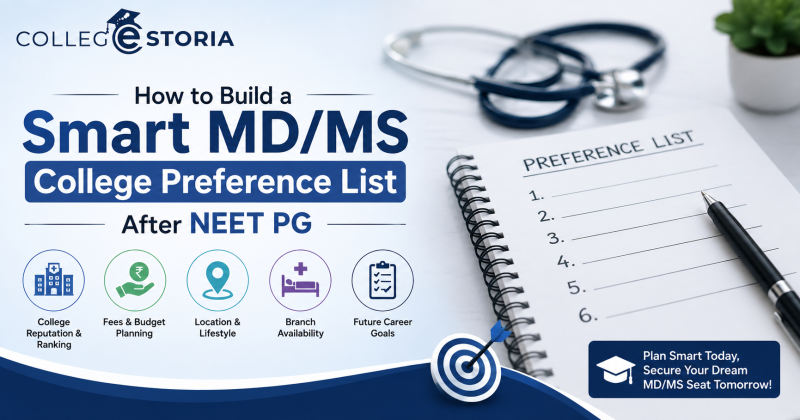
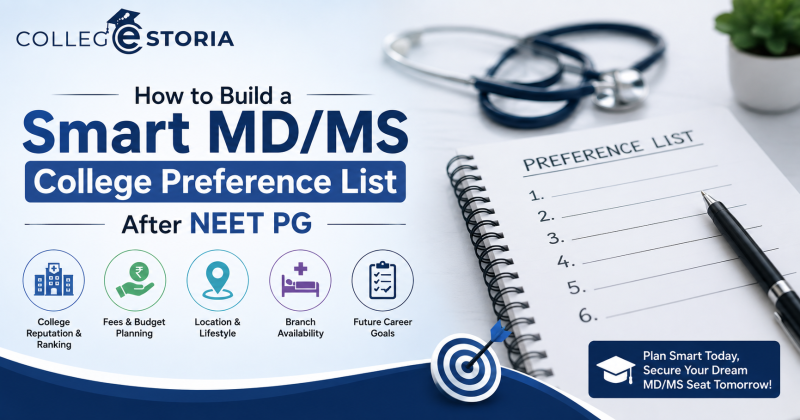
How to Build a Smart MD/MS College Preference List After NEET PG
 Sakshi Padiyar
Getting your NEET PG result is only the beginning of the postgraduate admission journey. One of the most important decisions comes during counselling: how should you arrange your MD/MS college preference list?
A well-planned preference list can improve your chances of finding a suitable seat while preventing last-minute decisions. For students planning MD/MS Admission in India, the list should consider much more than just college reputation.
Your NEET PG rank, category, preferred specialty, counselling route, fees, location, clinical exposure, and career objectives should all be considered.
Start With Your NEET PG Rank
Your rank is the foundation of your counselling strategy.
Before preparing your choices, understand the range of specialties and colleges that may realistically be available at your rank. Previous counselling trends can provide useful guidance, but they should not be treated as guaranteed cutoffs because seat availability and competition can change.
Make three groups:
- Ambitious choices: Colleges and branches that may be difficult but worth trying.
- Realistic choices: Options that reasonably match your rank and preferences.
- Backup choices: Acceptable alternatives that provide additional opportunities.
This structure can make your NEET PG Admission in India strategy more balanced.
Decide Your Branch Priority First
Do not build your preference list solely around college names.
First decide how you would rank your preferred specialties.
For example, your priority might be:
- MD General Medicine
- Pediatrics
- Psychiatry
- Pathology
Another student may have completely different priorities.
Once your specialty preference is clear, you can compare colleges offering those branches.
Compare Government, Private and Deemed Colleges
The type of institution can significantly affect your decision.
Government medical colleges may offer comparatively lower tuition fees and strong patient exposure in many locations.
Private and deemed universities may offer different combinations of infrastructure, facilities, location, academic environment, and fee structures.
Therefore, don't automatically assume that one category is best for everyone. Compare the actual college and specialty combination.
Look Beyond College Reputation
A famous college name is not enough.
Before placing a college high on your list, consider:
- Patient load
- OPD exposure
- Emergency workload
- OT exposure for surgical specialties
- Diagnostic facilities
- Faculty strength
- Academic environment
- Hostel facilities
- Location
- Fee structure
- Bond or service conditions, where applicable
For clinical branches, practical exposure should be an important part of your evaluation.
Check the Total Cost
Fees can vary substantially between institutions.
Don't consider tuition alone. Check the complete financial requirement, including applicable university charges, examination fees, hostel expenses and other mandatory charges.
Understanding the total cost before choice filling can help you avoid selecting an option that becomes financially difficult later.
Consider Location and Lifestyle
Location may seem less important during counselling, but you could spend several years there.
Consider:
- Distance from home
- Accessibility
- Climate
- Accommodation
- Living expenses
- Family support
- City environment
A college that looks excellent on paper may not necessarily be the best personal fit.
Don't Put Only “Dream Colleges”
One common counselling mistake is creating a list filled only with highly competitive colleges and branches.
Your preference list should be ambitious but also realistic.
Include enough acceptable alternatives so that your choices reflect both your aspirations and your actual admission possibilities.
Review Your List Before Locking Choices
Before final submission, review every option carefully.
Ask:
Would I actually join this college and branch if allotted?
If the answer is no, reconsider putting it on your list.
Choice filling should not be treated as a random exercise. Every selected option should represent a genuine preference.
Why Professional Guidance Can Help
NEET PG counselling involves multiple decisions, and students may find it difficult to compare hundreds of possible combinations.
College Storia can assist aspirants in understanding MD/MS Admission in India, comparing available options, and planning their preferences according to their individual admission goals.
Final Takeaway
A smart MD/MS preference list balances ambition with practicality.
Start with your rank, prioritize specialties, research colleges, compare clinical exposure and fees, consider location, and keep suitable backup options.
Remember, the objective is not simply to get an MD/MS seat. It is to find a college-branch combination that fits your academic, professional and personal priorities.
Source:
Click for the: Full Story
You might like