Close Menu
 World
World
 Biography
 Health
 Education
 Business
 Lifestyle
 Sports
 Technology
 Animals
 History
 Food
Food
 Religious
 Startups
 Movies
 Politics
 Fashion
 Covid
Covid
 Diet
Diet
 Fitness
 Marketing
 Travel
 Science
 Reviews
 Social media
 Stories
 Facts
Facts
 Art
Art
 Entertainment
Shewta Singh

Fashion
Ilkal Saree Designs: Finding a Pattern That Feels Traditional Yet Personal
 Shewta Singh
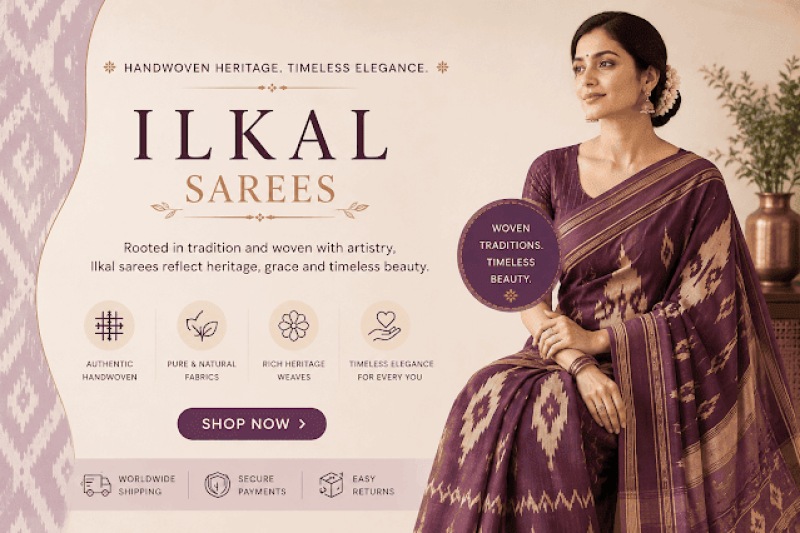
Choosing an Ilkal saree today isn't just about picking a colour — it's about finding a design that still feels rooted in the weave's centuries-old identity while suiting your personal style. With bold borders, contrasting pallus, and a range of geometric and motif-based patterns, Ilkal saree designs offer more variety than many first-time buyers expect. This guide walks through the design elements that define an authentic Ilkal saree, so you can choose one that feels both traditional and distinctly yours.
What Are the Different Ilkal Saree Designs You Should Know About?
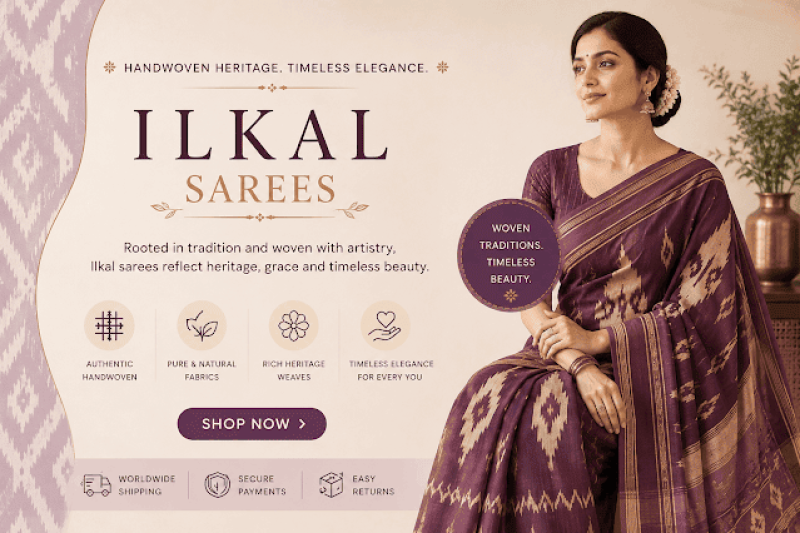
Ilkal saree designs are generally built around three elements: the body pattern, the border width and motif, and the pallu design. Body patterns typically consist of stripes, checks, or small rectangular and square motifs woven in cotton or art silk. The border is usually four to six inches wide in a contrasting colour, and the pallu — often woven separately and joined using the Tope Teni technique — carries the saree's most elaborate design work.
What Motifs Appear Most Often in Ilkal Saree Pallus?
Traditional Ilkal saree pallus commonly feature motifs such as temple towers, lotuses, palanquins, and elephants, woven in contrasting thread against a solid-coloured background. These motifs are drawn from temple architecture and everyday regional life, giving each pallu design a distinct visual rhythm. Red-and-silver or red-and-gold pallu combinations remain among the most recognisable and widely sought-after Ilkal saree designs.
What Does the Temple Tower (Gopura) Motif Represent?
The temple tower motif, inspired by South Indian temple architecture, is one of the most iconic design elements found in Ilkal saree pallus. It reflects the strong cultural and religious influence on the region's textile traditions and is often woven using extra warp threads to create a raised, textured effect. Sarees featuring this motif are especially popular for weddings and religious occasions.
What Are Common Geometric Patterns in the Saree Body?
The body of an Ilkal saree typically features repeating geometric patterns — stripes, checks, or small rectangular and square shapes — rather than large floral or figurative designs. These patterns are kept deliberately simple so they don't compete visually with the more elaborate pallu design. This balance between a minimal body and a detailed pallu is one of the defining characteristics of Ilkal saree designs as a category.
How Do Ilkal Saree Designs Differ Between Traditional and Contemporary Styles?
Traditional Ilkal saree designs stick closely to red, maroon, and dark green body colours with temple or geometric pallu motifs, while contemporary versions now experiment with pastel bodies, minimal borders, and lighter silk blends. Some modern weavers also reinterpret classic motifs in muted colour palettes to appeal to buyers looking for versatility beyond festive wear. Despite these variations, the core Tope Teni joining technique remains unchanged across both traditional and contemporary designs.
How Does Ilkal Saree Design Compare With Other GI-Tagged Karnataka Weaves?
Karnataka is home to several GI-tagged handloom sarees, and comparing their design elements helps clarify what makes Ilkal distinct.
Feature
Ilkal Saree
Mysore Silk
Molakalmuru Saree
Body design
Stripes, checks, geometric patterns
Plain or lightly patterned
Temple and floral motifs
Pallu style
Contrasting fabric, Tope Teni join
Matching silk, zari border
Rich zari pallu, same fabric
Border width
4–6 inches, bold contrast
Narrow to medium, zari-edged
Broad, heavily worked
Typical motifs
Temple towers, lotus, elephants
Minimal, mostly plain
Temple towers, peacocks
Design character
Bold, rustic, contrast-driven
Elegant, understated
Rich, densely patterned
How Do You Choose an Ilkal Saree Design That Feels Personal Yet Traditional?
Start by deciding whether you want the pallu or the body to be the visual focus — a bold temple-motif pallu with a simple body suits traditional occasions, while a subtler motif with a brighter body colour feels more versatile for everyday festive wear. Consider your blouse pairing early, since many Ilkal designs work best with a solid-coloured blouse that doesn't compete with the pallu. Personal preference in colour combination, more than motif choice, is usually what makes a design feel distinctly yours.
What Colour Combinations Work Best in Ilkal Saree Designs?
Classic Ilkal saree designs favour red or maroon bodies with white, cream, or green pallus, while newer designs explore combinations like mustard-and-maroon or teal-and-gold. Darker body colours tend to make the contrasting pallu motifs stand out more clearly, which is part of why red remains the most traditional and popular base colour. For everyday wear, lighter body tones with a smaller, subtler pallu design are increasingly common.
How Do You Identify an Authentic Ilkal Saree Design?
An authentic Ilkal saree design shows a visible, slightly raised join where the body meets the pallu, since genuine pieces use the hand-interlocked Tope Teni technique rather than a printed or machine-stitched pallu. Motifs should appear woven into the fabric using extra warp threads, not printed on top. According to India's national portal for regional crafts, Ilkal sarees are officially recognised as a GI-tagged product of Bagalkote, Karnataka, which is a useful reference point when verifying authenticity claims.
Where Can You Buy Ilkal Saree Online With Traditional Designs?
As more buyers look to buy Ilkal saree online, it helps to choose platforms that work directly with weaver clusters and clearly disclose fabric composition and design details. Indeloom is one such platform that curates traditional handloom sarees, including a range of Ilkal saree designs, for buyers who want authenticity without having to travel to source pieces directly. When you buy Ilkal saree online look closely at pallu close-up images and ask about the weaving technique used before purchasing.
How Much Do Different Ilkal Saree Designs Cost?
Simpler Ilkal saree designs with basic geometric bodies and smaller pallu motifs typically start around ₹2,500–₹4,000, while elaborate designs with dense temple motifs and pure silk pallus can range from ₹8,000 to ₹20,000 or more. Price generally reflects the complexity of the pallu design and the time taken to weave it, since intricate motifs require significantly more manual skill than simpler striped or checked patterns.
Frequently Asked Questions About Ilkal Saree Designs
What is the most traditional Ilkal saree design?
A red or maroon body paired with a contrasting white or green pallu featuring temple tower motifs is considered the most traditional Ilkal saree design.
Are Ilkal saree pallus always a different fabric from the body?
Traditionally, yes — the pallu is often woven in silk while the body uses cotton, joined using the Tope Teni interlocking technique.
Can Ilkal saree designs be customised?
Some weavers offer customisation in colour combinations, though the core motifs and joining technique generally remain within traditional design conventions.
How do I know if an Ilkal saree design is handwoven and not printed?
Check for a textured, raised pallu join and motifs with visible thread work rather than a flat printed surface.
Final Thoughts
Ilkal saree designs offer a rare combination of structural craftsmanship and visual variety, from bold temple motifs to simple geometric bodies, all built around a weaving technique that has remained largely unchanged for generations. Understanding these design elements makes it easier to choose a saree that honours the weave's traditional character while still reflecting your personal taste. For those ready to buy Ilkal saree online, platforms like Indeloom offer a practical starting point to explore authentic designs sourced from the weaving communities that keep this craft alive.
Source:
Click for the: Full Story
You might like