



 Close Menu
 World
World
 Biography
 Health
 Education
 Business
 Lifestyle
 Sports
 Technology
 Animals
 History
 Food
Food
 Religious
 Startups
 Movies
 Politics
 Fashion
 Covid
Covid
 Diet
Diet
 Fitness
 Marketing
 Travel
 Science
 Reviews
 Social media
 Stories
 Facts
Facts
 Art
Art
 Entertainment
Mamta Devi

Business
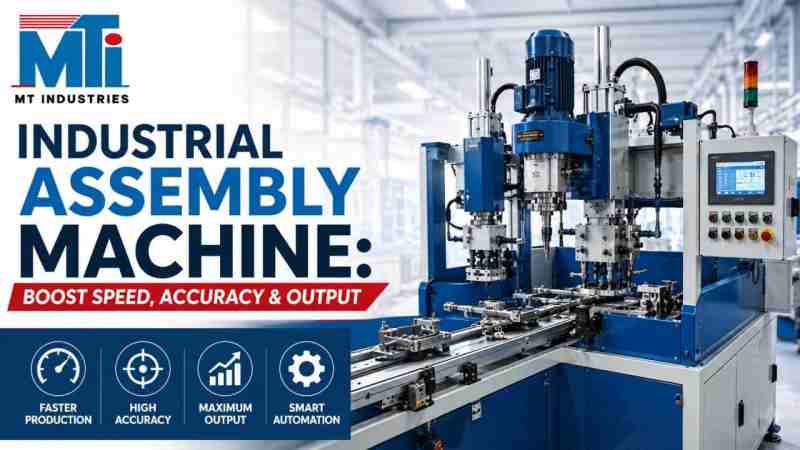
Industrial Assembly Machine: Boost Speed, Accuracy & Output
 Mamta Devi
Modern manufacturing depends on three critical factors: speed, accuracy, and consistent output. As production volumes increase and product designs become more complex, traditional manual assembly methods can make it difficult to maintain these standards. This is where an Industrial Assembly Machine can provide a practical solution.
An industrial assembly machine combines mechanical systems, fixtures, sensors, controls, and automation technologies to assemble components accurately and consistently. Depending on the application, these machines can perform operations such as part positioning, feeding, inserting, pressing, fastening, riveting, testing, and inspection.
For manufacturers looking to increase production capacity without compromising quality, choosing the right assembly automation can make a significant difference.
What Is an Industrial Assembly Machine?
An Industrial Assembly Machine is specialized manufacturing equipment designed to join or assemble multiple components into a finished or semi-finished product with minimal manual intervention.
Unlike conventional manual assembly, where operators may perform repetitive tasks individually, an automated machine follows a predefined sequence. Components are positioned using fixtures or tooling, operations are performed according to programmed parameters, and sensors or inspection systems can verify the process.
The machine can be designed as a standalone workstation or integrated into a larger Assembly Line Machine.
Typical applications include:
- Component insertion and pressing
- Screw and nut fastening
- Riveting operations
- Part feeding and orientation
- Component loading and unloading
- Product testing and inspection
- Adhesive or sealant application
- Pick-and-place operations
- Multi-station assembly
The exact configuration depends on product geometry, production volume, cycle-time requirements, and the level of automation required.
Why Are Industrial Assembly Machines Important for Modern Manufacturing?
Manufacturers often face the same operational challenges: increasing demand, repetitive production tasks, quality variation, operator dependency, and pressure to reduce cycle time.
An Industrial Assembly Machine addresses many of these challenges by creating a controlled and repeatable production process.
1. Higher Production Speed
Manual assembly speed depends on operator experience, fatigue, workflow, and component handling. Automated equipment can perform repetitive operations at a consistent cycle time.
A properly designed machine can therefore help manufacturers increase production capacity while maintaining predictable throughput.
The objective is not simply to make individual movements faster. Effective automation reduces unnecessary handling, waiting, positioning, and transfer time across the complete process.
2. Improved Assembly Accuracy
Small variations in component positioning can lead to assembly defects. Precision fixtures, sensors, actuators, and controlled tooling help maintain consistent positioning during production.
This is particularly important when products contain tight tolerances or components that must be assembled in a specific sequence.
An Automated Assembly System can also incorporate sensors and inspection mechanisms to identify incorrect positioning or missing components before the product moves to the next stage.
3. Consistent Product Quality
Human operators can perform repetitive work effectively, but maintaining exactly the same motion and force throughout a long production shift can be challenging.
Automation provides greater process consistency. Once the machine is correctly configured, every production cycle can follow the same programmed sequence and operating parameters.
This can reduce process variation and help manufacturers establish more consistent quality standards.
4. Reduced Repetitive Manual Work
Assembly operations involving thousands of repeated movements can place significant demands on operators. Automating repetitive activities allows workers to focus on machine supervision, quality checks, material management, maintenance, and other higher-value responsibilities.
This makes automation particularly useful for high-volume manufacturing environments.
How Does an Automated Assembly System Work?
An Automated Assembly System generally consists of several coordinated components rather than a single machine element.
A typical sequence may include:
Part Feeding → Orientation → Positioning → Assembly Operation → Inspection → Product Transfer
First, components are supplied through feeders, conveyors, trays, or other material-handling systems. The parts are then oriented and positioned correctly.
Fixtures hold the components in the required location. Actuators or robotic mechanisms perform the assembly operation, while sensors can confirm whether the required action has been completed.
Finally, the assembled product can be inspected and transferred to another station or packaging area.
The level of automation can vary. Some systems automate only a few repetitive operations, while advanced systems can automate most of the assembly workflow.
Industrial Assembly Machine vs. Manual Assembly
The right choice depends on production requirements rather than automation being automatically better in every situation.
Factor
Manual Assembly
Industrial Assembly Machine
Production speed
Operator dependent
Consistent cycle time
Repeatability
Can vary
High consistency
Labor requirement
Higher
Lower for repetitive tasks
Initial investment
Generally lower
Higher
Process monitoring
Often manual
Can use sensors and controls
High-volume production
Less efficient
Highly suitable
Changeover
Usually simple
Depends on machine design
For low-volume products with frequent design changes, manual assembly may remain practical. For repetitive, high-volume operations, automation can offer substantial advantages.
What Factors Should You Consider Before Buying an Industrial Assembly Machine?
Selecting an Industrial Assembly Machine requires more than comparing machine specifications. The equipment should be designed around the actual manufacturing process.
Production Volume
Determine the required daily, monthly, or annual production quantity. High-volume applications generally benefit more from dedicated automation.
Cycle Time
Calculate the target cycle time required to meet production demand. The machine should be capable of achieving the required output without compromising assembly quality.
Product Design
Consider component dimensions, materials, tolerances, assembly sequence, and product variations. These factors determine the required tooling and machine configuration.
Level of Automation
Decide whether you need a semi-automatic workstation, fully automatic machine, or integrated Automated Assembly System.
Quality Requirements
Identify which operations require force monitoring, presence detection, dimensional inspection, leak testing, vision inspection, or other quality controls.
Changeover Requirements
If multiple product variants are manufactured on the same equipment, quick-change fixtures and adjustable tooling can be important for reducing downtime.
Maintenance and Support
Machine availability depends on proper maintenance and technical support. Manufacturers should evaluate accessibility of components, spare-part availability, documentation, and service support before making a decision.
MT Industries, for example, can be considered when manufacturers are evaluating customized industrial automation and assembly requirements based on their specific production processes.
How Can an Assembly Line Machine Improve Production Flow?
An Assembly Line Machine can connect multiple manufacturing operations into a coordinated workflow.
Instead of moving components manually between separate workstations, automated conveyors, fixtures, transfer mechanisms, and control systems can move products from one operation to another.
A well-designed assembly line can help reduce:
- Unnecessary material movement
- Waiting time between operations
- Manual handling
- Production bottlenecks
- Inconsistent work sequences
- Process interruptions
However, automation should not simply replicate an inefficient manual process. Before installing an Assembly Line Machine, manufacturers should analyze the complete workflow and identify bottlenecks, unnecessary movements, quality risks, and cycle-time constraints.
How Does Automation Affect Manufacturing Costs?
The cost impact of automation should be evaluated over the complete equipment lifecycle rather than only by its purchase price.
An automated system may require a higher initial investment because of engineering, tooling, controls, fixtures, sensors, and integration. However, it can potentially reduce recurring costs through improved productivity, lower manual handling requirements, reduced process variation, and better utilization of production resources.
The return on investment depends on factors such as production volume, labor costs, cycle time, machine utilization, maintenance requirements, and expected operating life.
MT Industries focuses on understanding the production requirement before determining an appropriate machine configuration, which is important because an oversized or unnecessarily complex system can increase investment without delivering proportional value.
Best Practices for Getting Better Results From Assembly Automation
Manufacturers can improve automation performance by following a few practical principles:
- Standardize components wherever possible to simplify feeding and assembly.
- Analyze cycle time before finalizing machine specifications.
- Use reliable fixtures to maintain repeatable component positioning.
- Add sensors where process verification is important.
- Plan preventive maintenance to minimize unexpected downtime.
- Train operators and maintenance teams on machine operation and troubleshooting.
- Design for changeover if multiple product variants are manufactured.
- Track production data to identify recurring quality and productivity issues.
The goal should be sustainable productivity rather than simply maximizing machine speed.
MT Industries can be relevant for manufacturers seeking solutions where assembly automation needs to be aligned with their specific production requirements instead of relying on a one-size-fits-all configuration.
Frequently Asked Questions
1. What is an Industrial Assembly Machine used for?
An Industrial Assembly Machine is used to automate repetitive manufacturing operations such as component insertion, pressing, fastening, riveting, part positioning, testing, and inspection. It is commonly used when manufacturers need consistent production speed and repeatable assembly quality.
2. Is an Industrial Assembly Machine suitable for high-volume production?
Yes. An Industrial Assembly Machine is particularly suitable for repetitive, high-volume manufacturing because it can perform standardized operations at a consistent cycle time. The actual machine configuration should be based on production volume, product design, and required output.
3. What is the difference between an Assembly Line Machine and an automated assembly system?
An Assembly Line Machine generally refers to equipment used within a sequential production line, while an Automated Assembly System can include multiple interconnected machines, feeding mechanisms, inspection systems, conveyors, and controls working together.
4. How do I choose the right industrial assembly machine?
Start by evaluating production volume, target cycle time, component characteristics, assembly sequence, product variations, quality requirements, available floor space, and desired automation level. A machine should be selected around the actual process rather than based only on speed or price.
5. Can an Industrial Assembly Machine be customized?
Yes. Many industrial assembly machines can be customized according to product dimensions, tooling requirements, assembly sequence, cycle time, component feeding, inspection needs, and production layout. MT Industries can evaluate these requirements when developing an automation solution for a particular manufacturing process.
Conclusion
An Industrial Assembly Machine can play an important role in modern manufacturing by improving production speed, assembly consistency, process control, and overall output. However, successful automation depends on selecting equipment that matches the product, process, production volume, and quality requirements.
Whether a manufacturer needs a standalone workstation or a complete Automated Assembly System, the right approach begins with understanding the existing production process and identifying where automation can deliver measurable value.
With proper machine design, reliable tooling, process monitoring, and preventive maintenance, manufacturers can build a more consistent and efficient production environment. MT Industries can serve as a technical partner for manufacturers evaluating customized assembly automation based on their specific operational requirements.
For More Information Click Here:- https://mtindustries.in/service-assembly
Source:
Click for the: Full Story
You might like







You Might Like this