Close Menu
 World
World
 Biography
 Health
 Education
 Business
 Lifestyle
 Sports
 Technology
 Animals
 History
 Food
Food
 Religious
 Startups
 Movies
 Politics
 Fashion
 Covid
Covid
 Diet
Diet
 Fitness
 Marketing
 Travel
 Science
 Reviews
 Social media
 Stories
 Facts
Facts
 Art
Art
 Entertainment
Priyanshu codebrew
Business
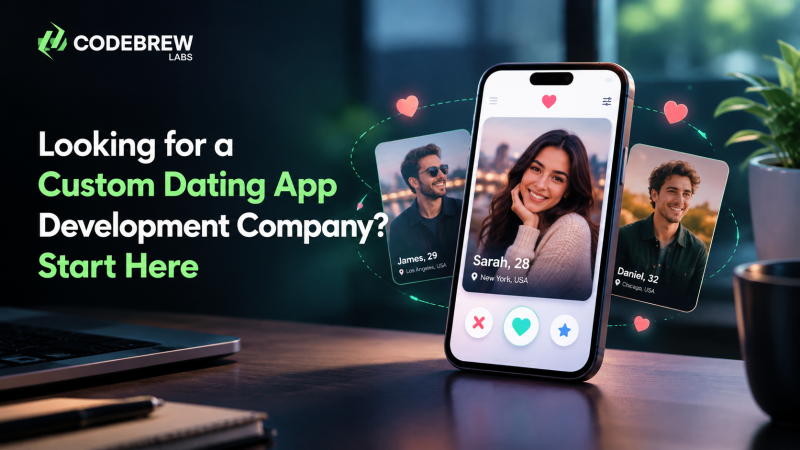
Looking for a Custom Dating App Development Company? Start Here
 Priyanshu codebrew
Choosing a dating app development partner can feel straightforward until you start comparing proposals. One company promises a working app in a few weeks. Another recommends AI-powered matching, video calls, identity verification, and a long list of features you hadn't considered. A third offers a surprisingly low price but can't explain what happens after launch.
Which one should you trust with your idea?
If you're planning to build a dating app, the decision goes well beyond finding developers who can write code. You need a team that understands how people meet, what makes them stay, why they leave, and what can go wrong when strangers interact online.
A good Custom Dating App Development Company will help you turn your concept into a product people can use safely, enjoy using, and return to regularly. This guide covers what to look for, what to avoid, and how to make a hiring decision without getting lost in technical details.
Why Choose Custom Dating App Development Over a Ready-Made Solution?
White-label dating apps can be useful when you want to test an idea quickly. You start with an existing platform, change the branding, configure a few settings, and launch with less upfront development work.
That approach has limits, though. You might have little control over the matching algorithm, user experience, integrations, or subscription structure. If your product depends on a feature the platform doesn't support, you may need expensive modifications or a complete rebuild later.
Custom dating app development gives you more control over the product from the beginning.
Build Around Your Audience, Not a Template
Consider two founders. One wants to create a dating app for professionals who value verified profiles and intentional relationships. The other wants a community-based app for people who share specific interests.
Both need profiles and messaging, but their matching logic, onboarding questions, moderation policies, and monetization models may be very different. A generic template won't necessarily support those differences.
A custom-built product can reflect your audience's preferences instead of forcing your audience to adapt to the software.
Keep Control of Your Product Roadmap
With a custom app, you can prioritize features based on user feedback. You might start with profile discovery and matching, then introduce video dates, compatibility insights, or paid memberships after validating demand.
You also have greater flexibility over integrations, analytics, backend architecture, and future platform changes. That matters when your initial launch is only the first stage of a larger business.
Custom development usually requires a higher initial investment. But if your business model depends on a distinctive user experience, that investment may be more practical than trying to reshape a ready-made product.
What Should a Custom Dating App Development Company Offer?
A development company shouldn't simply take your feature list and start coding. It should help you challenge assumptions, identify risks, and decide what belongs in the first release.
Here are the capabilities worth examining before you sign a contract.
Product Strategy and Technical Planning
Your development partner should ask about your target audience, competitors, revenue model, launch market, and expected user growth.
It should also help define your minimum viable product (MVP). You probably don't need every possible feature on day one. You do need the features required to test whether people will sign up, find relevant matches, and keep using the app.
Ask for a clear scope document that explains what's included, what isn't, and how changes will be handled.
UI/UX Design That Encourages Real Connections
Dating apps rely heavily on first impressions. If registration takes too long, profiles feel confusing, or users can't understand why someone appeared in their feed, they'll leave.
Look for a team that can map the complete user journey, from account creation and profile setup to matching, messaging, reporting, and subscription management.
Before development begins, you should see wireframes or interactive prototypes. These give you an opportunity to test the experience before committing to expensive engineering work.
Matching Technology and AI Expertise
A basic matching system might use location, age preferences, interests, and user-selected filters. More advanced products can incorporate compatibility signals, recommendation models, and personalized discovery.
AI can help rank relevant profiles or improve recommendations as the platform collects useful interaction data. However, it won't automatically make matches better. The results depend on data quality, model design, user feedback, and how the system handles bias.
Your developers should explain what AI would actually improve in your product and whether a simpler rules-based approach is sufficient for the first version.
Security, Privacy, and Scalability
Dating apps handle personal information, private conversations, photos, and sometimes sensitive identity details. Security needs to be part of the architecture, not a feature added shortly before launch.
Your partner should be able to explain its approach to secure authentication, access controls, data encryption, account deletion, backups, and vulnerability testing. Depending on your markets, you may also need to consider applicable privacy laws and app store requirements.
Scalability matters, too. The system should be designed so that growing user numbers, more messages, and increased media uploads don't force you into an unnecessary rebuild.
Dating App Features: What Should You Build First?
A feature-rich app isn't necessarily a successful one. The goal is to give users enough value to make meaningful connections while keeping the experience safe and easy to understand.
Essential Features for Your First Release
Start with the core experience:
- User registration and profiles: Email, phone, or supported social sign-in, plus photos, biographies, preferences, and profile controls.
- Matching and discovery: Search filters, profile recommendations, likes, mutual matches, and clear discovery preferences.
- Private messaging: Real-time chat, message notifications, blocking, and reporting.
- Geolocation: Location-based discovery with sensible distance settings and privacy controls.
- Safety and verification: Photo or identity verification options, suspicious-account detection, reporting, moderation tools, and account restrictions.
- Admin dashboard: Tools for managing users, reviewing reports, handling appeals, and monitoring platform activity.
- Monetization: Subscription plans, in-app purchases, or paid features supported by the relevant app store policies.
Don't overlook the admin dashboard. Users see the matching screen, but your operations team needs a way to manage abuse reports and investigate suspicious activity.
Imagine launching with attractive profiles and a smooth chat experience but no practical moderation workflow. As the user base grows, reports pile up, inappropriate accounts remain active, and legitimate members lose confidence. Fixing that problem after launch can be more expensive than planning for it early.
Standout Features to Consider Later
Once you have evidence that users value the core experience, you can explore features such as:
- Video dating: Let matched users arrange short video conversations before meeting in person.
- AI-assisted recommendations: Personalize profile suggestions using preferences and relevant behavioral signals.
- Advanced verification: Add stronger checks where appropriate, while explaining how personal information is handled.
- Voice introductions: Allow users to add short audio clips to their profiles.
- Compatibility insights: Explain shared interests or preferences without presenting algorithmic predictions as guaranteed relationship outcomes.
- Premium discovery: Offer additional filters, profile visibility controls, or other paid benefits.
- Community features: Support events, shared-interest groups, or curated introductions for a defined niche.
Choose these features based on your audience, not because another dating app has them. Every addition affects development cost, testing, maintenance, and the amount of work required to keep the platform safe.
Red Flags to Watch for When Comparing Developers
A low quote doesn't automatically mean poor work, and a large agency isn't automatically the right fit. Pay attention to how a company explains its decisions.
Watch for these warning signs:
- Unrealistic promises: A team guarantees a complete, scalable dating app in an unusually short time without understanding your requirements.
- Vague pricing: The proposal excludes essential items such as backend development, moderation tools, testing, deployment, or maintenance without clearly saying so.
- No relevant portfolio: The company can't demonstrate comparable social, community, marketplace, or messaging products.
- Weak security planning: Developers treat privacy, reporting, blocking, and account protection as optional extras.
- Unclear ownership: The contract doesn't specify who owns the source code, designs, documentation, and other deliverables.
- No post-launch plan: The company has no clear process for bug fixes, updates, monitoring, or support.
- Poor communication: You struggle to get direct answers about scope, timelines, responsibilities, or project risks before signing.
One more thing: be cautious if a company agrees with every idea you suggest. Experienced developers should explain trade-offs and challenge features that don't support your business goals.
Questions to Ask Before You Hire a Dating App Development Company
Use this checklist when interviewing potential partners:
- Have you built dating, social networking, or other apps with real-time messaging?
- Can you show relevant projects and explain your team's role in them?
- How would you define the MVP for my audience and business model?
- What security, privacy, verification, and moderation measures would you recommend?
- How will matching logic and any AI components be designed and evaluated?
- Which technologies will you use, and why are they suitable for this product?
- Who owns the source code, intellectual property, and design files?
- How will you manage scope changes, testing, and app store submissions?
- What's included in the quote, and what will cost extra?
- What support is available after launch, and how is it priced?
Pay attention to the answers, but also to the questions the team asks you. A thoughtful partner will want to understand your business before proposing a technical solution.
How the Dating App Development Process Usually Works
A well-managed project follows a series of stages. The details vary by product, but you should know what happens at each stage and what you'll receive.
1. Discovery and Requirements
The team clarifies your audience, core problem, business model, essential features, and launch requirements. You'll typically receive a project scope, initial feature priorities, and a proposed roadmap.
2. Wireframes and UI/UX Design
Designers map user journeys and create wireframes before developing the visual interface. Interactive prototypes help you identify confusing screens and unnecessary steps while changes are still relatively inexpensive.
3. Architecture and Development
Developers build the frontend, backend, database, APIs, authentication, matching functionality, and other agreed features. You should receive regular progress updates and have opportunities to review working builds.
4. Testing and Quality Assurance
The QA team checks registration, matching, messaging, subscriptions, notifications, account recovery, and other important workflows. Testing should also cover security, device compatibility, performance, and failure scenarios.
For example, what happens if a payment succeeds but the premium account doesn't activate? Or if a user blocks someone who already has an open conversation? These details can have a direct effect on trust.
5. Launch and App Store Submission
Your team prepares the production environment, configures analytics and monitoring, and supports submissions to the Apple App Store and Google Play. Approval isn't guaranteed, so the schedule should include time for addressing review feedback.
6. Maintenance and Improvement
After launch, you'll need bug fixes, security updates, infrastructure monitoring, and product improvements. Usage analytics and user feedback can help you decide which features deserve investment next.
Ask for a written post-launch support plan rather than assuming maintenance is included.
Dating App Development Cost and Timeline: What Should You Expect?
The cost to build a dating app depends on its scope, technical complexity, design requirements, team location, and ongoing support needs. The figures below are broad planning estimates, not fixed quotes.
Typical Cost Ranges
- Basic MVP: Approximately $20,000–$50,000 for essential profiles, discovery, matching, messaging, and an initial admin dashboard.
- Mid-level custom app: Approximately $50,000–$120,000 for a more refined user experience, stronger moderation, subscriptions, richer discovery, and additional integrations.
- Advanced dating platform: Approximately $120,000–$250,000 or more for sophisticated recommendations, video functionality, extensive verification, complex integrations, and larger-scale infrastructure.
These ranges assume professional custom development. Actual proposals can fall outside them, particularly when compliance needs, multiple platforms, or specialized features substantially change the scope.
How Long Does Development Take?
A relatively focused MVP may take around 3–5 months. A mid-level product often needs 5–8 months, while a more complex platform can take 8–12 months or longer.
The schedule depends on how quickly requirements are finalized, how many platforms you support, whether third-party services are involved, and how much testing is needed. App store review and feedback can add time, too.
What Usually Drives the Budget Up?
The biggest cost factors include:
- Native iOS and Android development versus a cross-platform approach.
- Custom matching algorithms or machine-learning features.
- Video calls, media storage, and real-time communication infrastructure.
- Identity verification, content moderation, and security testing.
- Subscription billing, payment integrations, and administrative tools.
- Ongoing cloud hosting, third-party service fees, maintenance, and customer support.
When comparing proposals, ask for a breakdown of one-time development costs and recurring operating expenses. A cheaper initial build may not be cheaper over two years if it requires extensive rework or expensive third-party services.
A sensible approach is to launch with a focused MVP, measure user behavior, and invest in advanced features once you know which ones solve real problems.
Why Choose Code Brew Labs for App Development?
Choosing the right development partner can help you turn an app idea into a product that meets customer needs and supports long-term business growth. Code Brew Labs works with startups, small businesses, and enterprises to develop mobile applications, from initial planning and UI/UX design to development, testing, deployment, and ongoing maintenance. For businesses exploring mobile app development in New York, the team offers solutions tailored to different industries, business models, and product requirements.
Whether you're validating an idea through an MVP or building a feature-rich enterprise application, the focus should be on creating a practical product with a clear development roadmap, reliable functionality, and room to scale.
Services Offered by Code Brew Labs:
- iOS App Development: Custom applications for iPhone and iPad, designed around your product requirements and target users.
- Android App Development: Android applications with user-focused interfaces and features tailored to your business goals.
- Cross-Platform App Development: Apps built using frameworks such as Flutter and React Native to support multiple platforms.
- UI/UX Design: User research, wireframing, prototyping, and interface design to make applications easier to use.
- AI App Development: AI-powered features such as intelligent chatbots, personalized recommendations, predictive analytics, and workflow automation.
- MVP Development: Lean product development to help startups test their ideas, gather user feedback, and validate demand before expanding.
- Custom Software and API Integration: Backend systems, third-party integrations, and business tools that connect your app with existing workflows.
- App Testing and Quality Assurance: Functional, usability, performance, and compatibility testing before launch.
- App Maintenance and Support: Ongoing updates, bug fixes, performance improvements, and technical support after deployment.
If you're comparing app developers in New York, discuss your requirements, expected timeline, budget, and long-term plans with Code Brew Labs to determine whether its services and development approach are the right fit for your project.
Final Thoughts: Choosing the Right Custom Dating App Development Company
Finding the right Custom Dating App Development Company starts with being clear about the product you want to build and the people you want to serve. Look beyond attractive mockups and low quotes. Evaluate the team's product thinking, technical decisions, security practices, communication, and willingness to support the app after launch.
The right partner won't simply promise to build everything on your wish list. They'll help you decide what matters now, what can wait, and how to avoid expensive mistakes.
If you're comparing development partners, Code Brew Labs is one option to evaluate for custom mobile app development, product engineering, and AI-enabled applications. Start with a conversation about your target audience, core features, budget, and launch goals. A clear scope is a much better starting point than a long feature list.
Source:
Click for the: Full Story
You might like