


 Close Menu
 World
World
 Biography
 Health
 Education
 Business
 Lifestyle
 Sports
 Technology
 Animals
 History
 Food
Food
 Religious
 Startups
 Movies
 Politics
 Fashion
 Covid
Covid
 Diet
Diet
 Fitness
 Marketing
 Travel
 Science
 Reviews
 Social media
 Stories
 Facts
Facts
 Art
Art
 Entertainment
THM Hydraulics

Business
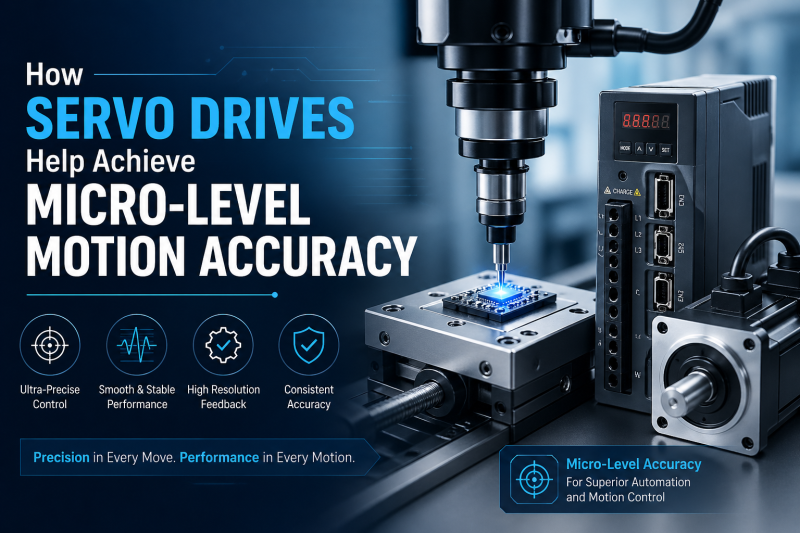
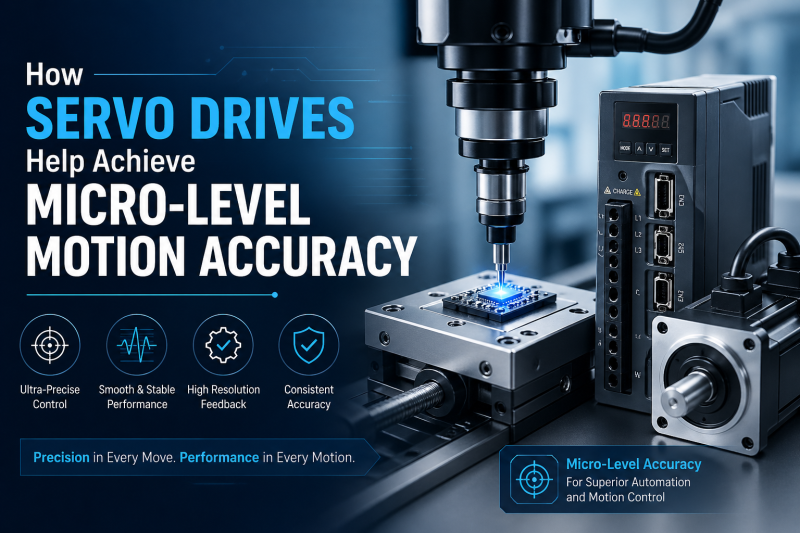
How Servo Drives Help Achieve Micro-Level Motion Accuracy
 THM Hydraulics
In today's high-demand manufacturing world, even the smallest error in movement can lead to costly product defects, production downtime, or mechanical failure. Industries such as semiconductor fabrication, medical device production, and precision machining require movement accuracy measured in micrometers — that's thinner than a single strand of human hair.
This is exactly where servo drives make a critical difference.
Servo drives are advanced electronic controllers that manage the speed, position, and torque of a motor with extraordinary precision. They are the backbone of modern precision machinery, enabling manufacturers to achieve micro-level motion accuracy consistently and reliably. In this blog, we'll break down how servo drives work, why they outperform standard motor controllers, and how they are transforming industries that cannot afford to compromise on accuracy.
What Is a Servo Drive?
A servo drive is an electronic amplifier used to power and control a servo motor. It receives a command signal — typically from a PLC (Programmable Logic Controller) or CNC system — and continuously adjusts the motor's performance to match the desired output. This adjustment happens in real time, thousands of times per second.
Unlike conventional drives that simply switch a motor on or off, a servo drive uses closed-loop feedback control. This means it constantly reads data from an encoder or resolver attached to the motor and compares the actual position with the target position. If there's any deviation — even at the micrometer scale — the drive corrects it instantly.
This feedback mechanism is what separates servo drives from ordinary variable frequency drives (VFDs) and makes them the preferred choice for applications demanding exceptional accuracy.
How Servo Drives Achieve Micro-Level Motion Accuracy
1. Closed-Loop Feedback ControlThe foundation of servo drive precision lies in its closed-loop system. An encoder mounted on the motor shaft sends position and velocity data back to the drive continuously. The drive's internal processor compares this real-time data against the programmed target and makes immediate corrections.
This constant self-correction cycle ensures that the motor always reaches and holds the exact position required — even when external forces like load variations or vibrations try to push it off course.
2. High-Resolution EncodersModern servo drives work with encoders that have resolutions of 17-bit to 24-bit, meaning they can detect millions of incremental positions within a single motor revolution. This level of detail allows the drive to control movement with sub-micron accuracy — essential in applications like laser cutting, PCB drilling, and lens grinding.
3. Advanced PID Control AlgorithmsServo drives use PID (Proportional-Integral-Derivative) control algorithms to eliminate positional error. The drive calculates the difference between the desired and actual position (error), then applies a mathematically calculated correction. The proportional component reacts to current error, the integral component corrects accumulated error over time, and the derivative component anticipates future error based on the rate of change.
This three-pronged approach ensures smooth, accurate, and stable motion even during high-speed operations.
4. Rapid Response TimeOne of the most underrated advantages of servo drives is their extremely fast response time. They can process feedback and make corrections in microseconds, which means they can maintain accuracy even during rapid directional changes or sudden load shifts. This is crucial in high-speed packaging, pick-and-place systems, and precision assembly lines.
5. Torque and Velocity ControlServo drives don't just control position — they simultaneously manage torque and speed. By balancing all three parameters in real time, they prevent overshooting (where a motor moves past the target point) and undershooting (where it stops short). This balance is what makes micro-level accuracy sustainable over long production cycles.
Why Micro-Level Accuracy Matters in Industry
Micro-level motion accuracy is not just a technical specification — it directly impacts product quality, operational efficiency, and profitability.
- In semiconductor manufacturing, a positional error of just a few micrometers can render an entire wafer batch defective.
- In medical device production, precision in cutting, drilling, or assembling components ensures patient safety and regulatory compliance.
- In CNC machining, tight tolerances translate directly into parts that fit together perfectly, reducing waste and rework.
- In electronics assembly, accurate placement of surface-mount components ensures circuit reliability and reduces failure rates.
In each of these sectors, servo drives are not optional — they are essential.
Servo Drives vs. Standard Motor Controllers: A Clear Advantage
FeatureServo DriveStandard DriveControl TypeClosed-loopOpen-loopPositional AccuracyMicro-levelLimitedResponse SpeedMicrosecondsMillisecondsEncoder FeedbackYes (high-resolution)NoTorque ControlPreciseBasicApplication FitHigh-precision tasksGeneral purpose
This comparison makes it clear: when accuracy is the priority, servo drives are in a league of their own.
Key Industries Benefiting From Servo Drive Precision
1. CNC Machining & Metalworking — Servo drives power multi-axis CNC machines, allowing cutting tools to follow complex paths with micron-level accuracy.
2. Pharmaceutical Manufacturing — Precise filling, capping, and labeling equipment relies on servo drives to maintain dosage accuracy and packaging consistency.
3. Printing & Converting — Register control in printing presses demands extremely accurate web tension and position control, both achievable with servo drives.
4. Textile Machinery — Yarn tension and fabric feed rates require consistent, fine-tuned control to maintain product uniformity.
5. Solar Panel Production — Accurate positioning during cell cutting and lamination ensures maximum efficiency in the finished panels.
Choosing the Right Servo Drive for Precision Applications
When selecting a servo drive for micro-level accuracy, consider the following:
- Encoder resolution — Higher bit-count encoders deliver finer positional feedback.
- Control bandwidth — A wider bandwidth means faster response to errors.
- Communication protocol — EtherCAT, PROFINET, and CANopen allow seamless integration with modern control systems.
- Tuning capabilities — Auto-tuning features help optimize PID parameters for different load conditions.
- Thermal management — Consistent temperature control within the drive ensures stable performance over long production runs.
Investing in the right servo drive not only improves accuracy but also extends the lifespan of your machinery and reduces maintenance costs.
Conclusion
Servo drives have become indispensable in any manufacturing environment where precision is non-negotiable. By combining closed-loop feedback, high-resolution encoders, intelligent control algorithms, and rapid response capabilities, they enable micro-level motion accuracy that standard drives simply cannot match.
Whether you're producing semiconductor chips, medical implants, or precision-machined components, a high-quality servo drive is the key to achieving the consistency and accuracy your process demands.
As manufacturing tolerances continue to tighten and product quality standards rise, servo drives will only grow more vital to the future of precision production.
Source:
Click for the: Full Story
You might like