Close Menu
 World
World
 Biography
 Health
 Education
 Business
 Lifestyle
 Sports
 Technology
 Animals
 History
 Food
Food
 Religious
 Startups
 Movies
 Politics
 Fashion
 Covid
Covid
 Diet
Diet
 Fitness
 Marketing
 Travel
 Science
 Reviews
 Social media
 Stories
 Facts
Facts
 Art
Art
 Entertainment
Alina

Technology
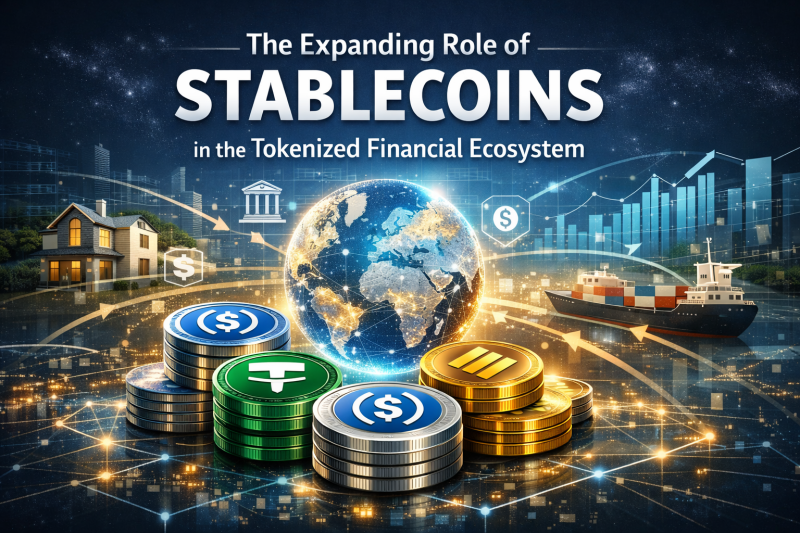
The Expanding Role of Stablecoins in the Tokenized Financial Ecosystem
 Alina
Alina
The financial services industry is undergoing a structural transformation driven by tokenization, distributed ledger technologies, and programmable digital assets. As institutions explore new methods of representing and transferring value, stablecoins have emerged as one of the most practical and widely adopted innovations within the tokenized financial ecosystem. Unlike volatile cryptocurrencies, stablecoins are designed to maintain a relatively stable value by being pegged to fiat currencies, commodities, or other reserve assets. This stability positions them as a critical bridge between traditional finance and blockchain-powered financial infrastructure.
As tokenized assets continue to gain traction across capital markets, payments, trade finance, and treasury management, stablecoins are increasingly becoming the foundational settlement layer that enables liquidity, interoperability, and efficiency. Their role extends far beyond simple digital payments, influencing how financial institutions approach asset issuance, transaction processing, and cross-border value exchange.
Stablecoins as the Settlement Backbone of Tokenized Finance
Tokenization allows real-world assets such as equities, bonds, real estate, commodities, and fund shares to be represented digitally on blockchain networks. However, tokenized assets require an equally efficient settlement mechanism. Traditional settlement systems often involve intermediaries, reconciliation processes, and delayed clearing cycles that introduce friction and operational costs.
Stablecoins address this challenge by enabling near-instant value transfer within blockchain ecosystems. Because they maintain price stability while operating on decentralized networks, they provide a reliable medium for settlement without exposing participants to significant market volatility.
The ability to facilitate atomic settlement—where asset transfer and payment occur simultaneously—represents a major advancement. This mechanism reduces counterparty risk, improves transparency, and streamlines transaction workflows. As tokenized financial markets mature, stablecoins are increasingly viewed as essential infrastructure rather than optional payment instruments.
Enhancing Liquidity Across Digital Asset Markets
Liquidity remains one of the most important determinants of market efficiency. In tokenized environments, stablecoins serve as a common denominator that allows participants to move capital quickly between various digital assets and financial products.
Several factors contribute to their growing importance in liquidity management:
- They provide a stable trading pair for tokenized securities and digital assets.
- They reduce dependence on traditional banking rails for settlement.
- They facilitate 24/7 market operations without geographical restrictions.
- They enable faster capital deployment across decentralized and institutional platforms.
- They support automated market-making and liquidity provisioning mechanisms.
By improving access to liquidity, stablecoins help create more dynamic and efficient financial ecosystems. This is particularly important for emerging tokenized markets where liquidity fragmentation can hinder growth and adoption.
As financial institutions expand their blockchain initiatives, the integration of stablecoins into liquidity management frameworks is becoming increasingly common. Their ability to function as digital cash within blockchain environments enhances capital efficiency while reducing operational bottlenecks.
The Evolution of Cross-Border Payments and Remittances
Cross-border transactions have historically been associated with high costs, multiple intermediaries, settlement delays, and foreign exchange complexities. Stablecoins are helping redefine this landscape by providing a programmable and globally accessible mechanism for transferring value.
Traditional international payment systems often require correspondent banking networks that add layers of complexity and cost. Stablecoins simplify this process by enabling direct peer-to-peer or institution-to-institution settlement on blockchain networks.
The implications are significant. Businesses can improve cash flow management through faster settlements, while financial institutions can reduce operational overhead associated with legacy payment infrastructures. In emerging markets, stablecoins also create opportunities for broader financial inclusion by providing access to digital financial services without requiring extensive banking infrastructure.
As regulatory frameworks continue to evolve, many organizations are investing in stablecoin development Solutions to build payment networks that combine blockchain efficiency with compliance-oriented controls. These initiatives reflect the growing recognition that stablecoins can play a central role in the modernization of global payment systems.
Institutional Adoption and Treasury Transformation
Institutional interest in stablecoins has accelerated as organizations seek greater efficiency in treasury operations and cash management. Corporate treasuries are increasingly evaluating digital assets that can support real-time settlements, liquidity optimization, and enhanced transparency.
Several institutional use cases are driving adoption:
- Real-time treasury transfers between subsidiaries and business units.
- Automated payment execution through smart contracts.
- Improved collateral management for financial transactions.
- Streamlined settlement for tokenized securities and digital assets.
- Enhanced transparency through immutable transaction records.
Stablecoins provide a programmable layer that allows treasury functions to become more agile and responsive. Instead of relying on fragmented banking processes, organizations can leverage blockchain-based settlement systems that operate continuously and support automated workflows.
Furthermore, stablecoins are beginning to play a role in decentralized finance integrations for institutional participants. By enabling secure and transparent movement of capital, they contribute to the development of hybrid financial ecosystems where traditional and decentralized infrastructures coexist.
The emergence of regulated stablecoin frameworks is also strengthening institutional confidence. Clear governance structures, reserve transparency, and compliance mechanisms are helping address concerns related to risk management and operational reliability.
Future Outlook: Stablecoins as Core Financial Infrastructure
The future of tokenized finance will likely depend on the ability to establish trusted and efficient mechanisms for value transfer. Stablecoins are uniquely positioned to fulfill this requirement because they combine the stability of traditional monetary systems with the technological advantages of blockchain networks.
As regulatory clarity improves and technological standards mature, stablecoins are expected to become deeply integrated into a wide range of financial applications. Their influence will extend beyond payments to include securities settlement, supply chain finance, trade execution, lending markets, and asset management.
The next phase of growth will likely focus on interoperability between blockchain networks, enhanced compliance frameworks, and greater integration with traditional financial institutions. These developments could create a more connected financial ecosystem where assets, capital, and information move seamlessly across jurisdictions and platforms.
At the same time, innovation in programmable money concepts will continue expanding the capabilities of stablecoins. Smart contract functionality may enable automated compliance checks, dynamic settlement conditions, and sophisticated financial products that operate with minimal manual intervention.
The tokenized financial ecosystem is moving toward a future where digital representations of assets become commonplace. In this environment, stablecoins are not merely supporting participants—they are becoming a fundamental layer of financial infrastructure. Their ability to provide stability, liquidity, efficiency, and programmability makes them a cornerstone of the emerging digital economy.
As governments, enterprises, financial institutions, and technology providers continue investing in tokenization initiatives, stablecoins will play an increasingly strategic role in shaping the architecture of modern finance. Their expanding utility demonstrates that they are no longer viewed solely as cryptocurrency instruments but as essential components of the next generation of financial systems.
Source:
Click for the: Full Story
You might like