Close Menu
 World
World
 Biography
 Health
 Education
 Business
 Lifestyle
 Sports
 Technology
 Animals
 History
 Food
Food
 Religious
 Startups
 Movies
 Politics
 Fashion
 Covid
Covid
 Diet
Diet
 Fitness
 Marketing
 Travel
 Science
 Reviews
 Social media
 Stories
 Facts
Facts
 Art
Art
 Entertainment
Kanhasoft LLP

Technology
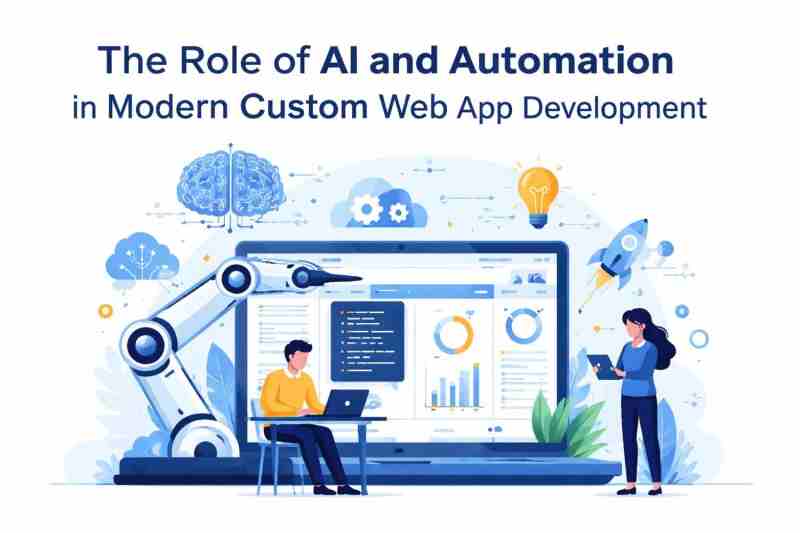
The Role of AI and Automation in Modern Custom Web App Development
 Kanhasoft LLP
Building a web application meant long nights, endless debugging, and deployment rituals that felt suspiciously like superstition. Today, artificial intelligence and automation have quietly stepped into the workshop not to replace human creativity, but to sharpen it. Modern custom web apps are no longer static systems; they are adaptive, intelligent, and increasingly self-optimizing. The conversation has shifted from Can this be built? to How smart can this become? That shift changes everything from coding practices to user experience strategy and it is redefining digital product development in ways few predicted.
What AI Really Means in Modern Web Development
Artificial intelligence in web development is less about sci-fi robots and more about practical intelligence embedded into systems. Machine learning models analyze patterns, natural language processing powers conversational interfaces, and predictive engines anticipate user behavior before it unfolds. The difference between automation and AI matters automation follows rules, while AI learns from data. A forward-thinking web application development company understands that AI is not decorative; it must solve real business problems. When used strategically, AI transforms web apps into responsive ecosystems that evolve alongside users rather than remaining frozen in time.
Automation as the Silent Productivity Engine
Automation rarely makes headlines, yet it performs the heavy lifting behind modern applications. Continuous integration and deployment pipelines eliminate manual release chaos. Automated workflows trigger notifications, approvals, and system responses without human intervention. Infrastructure provisioning that once required hours now happens in minutes. The result is consistency — fewer mistakes, fewer delays, fewer 2 a.m. emergencies. Automation reduces friction across development cycles and business operations alike. It does not demand applause; it demands efficiency. In custom web app development, that efficiency becomes a competitive advantage measured in speed, reliability, and operational stability.
AI-Assisted Coding Smarter, Faster, Al most Mind-Reading Development
AI-assisted development tools have become trusted co-pilots for modern teams. Intelligent code suggestions accelerate programming, while pattern recognition tools detect potential bugs before they escalate. Debugging feels less like hunting in the dark and more like guided discovery. That said, AI is not infallible — it occasionally suggests solutions that raise an eyebrow. Still, productivity gains are undeniable. web developers leverage AI to handle repetitive logic while focusing on architecture, innovation, and user experience. The partnership between human intuition and machine precision results in cleaner codebases and more scalable applications.
Automated Testing and Quality Assurance in Custom Applications
Testing once required exhaustive manual scenarios and significant time investment. Today, automated testing frameworks execute regression tests in minutes, ensuring that new updates do not disrupt existing functionality. AI-driven quality assurance tools predict vulnerabilities by analyzing code behavior patterns. Performance monitoring systems continuously evaluate speed, stability, and scalability. This level of oversight builds user trust and protects brand reputation. Instead of reacting to failures, development teams prevent them. Automated quality assurance transforms software reliability from an aspiration into a measurable standard embedded within every release cycle.
Personalization Powered by Artificial Intelligence
Modern users expect experiences tailored to their preferences, not generic interfaces. Artificial intelligence makes personalization scalable. Behavioral analytics track interactions, predictive models recommend relevant content, and adaptive dashboards adjust dynamically in real time. These features are not cosmetic; they influence engagement, retention, and revenue. Personalized experiences feel intuitive because systems learn continuously from user activity. Businesses benefit from deeper insights and stronger customer relationships. Custom web apps enhanced with AI-driven personalization shift from static platforms to responsive digital environments that feel attentive rather than transactional.
AI in Security and Threat Detection
Security can no longer rely solely on manual monitoring. AI-powered systems analyze vast streams of activity to detect anomalies that signal potential threats. Behavioral authentication verifies users based on patterns rather than passwords alone. Automated vulnerability scanning identifies weaknesses before attackers exploit them. In an environment where cyber risks evolve rapidly, intelligent security frameworks provide proactive defense. They do not wait for breaches; they anticipate them. For organizations managing sensitive data, integrating AI into security architecture is not optional — it is foundational to maintaining trust and operational continuity.
DevOps, Deployment, and Infrastructure Automation
Modern DevOps practices thrive on automation. Infrastructure as Code allows teams to replicate environments reliably across development and production. Auto-scaling systems respond instantly to traffic fluctuations, maintaining performance during peak demand. Predictive maintenance tools identify infrastructure issues before outages occur. Deployment cycles become shorter and more controlled, reducing downtime and accelerating time-to-market. These improvements translate directly into business agility. Companies that adopt infrastructure automation position themselves to innovate faster, adapt quicker, and compete more effectively in markets where speed often determines success.
Data-Driven Decision Making Through Intelligent Analytics
Data is abundant, but actionable insight requires intelligence. AI-powered analytics tools embedded within custom web applications interpret user behavior, forecast trends, and generate predictive reports. Instead of reviewing static dashboards, decision-makers access dynamic insights that evolve continuously. Businesses move from reactive adjustments to proactive strategies. Automated reporting eliminates guesswork and reduces dependency on manual analysis. Over time, this intelligence strengthens operational planning and customer engagement strategies. When analytics become intelligent, data transforms from a passive resource into a strategic driver of innovation.
Challenges and Ethical Considerations
Despite its advantages, AI integration presents challenges. Data quality determines system accuracy; biased inputs can lead to flawed outputs. Over-automation may reduce necessary human oversight. Compliance requirements, data privacy laws, and governance frameworks demand careful implementation. Ethical considerations must remain central, particularly when applications influence decision-making processes. Responsible development involves balancing innovation with accountability. AI should enhance transparency, not obscure it. Businesses adopting intelligent systems must commit to thoughtful design, continuous evaluation, and human supervision to ensure technology serves users responsibly.
The Human Element: Why Developers Still Matter
Technology evolves rapidly, yet human creativity remains irreplaceable. Architecture planning, complex problem-solving, and user empathy require judgment beyond algorithms. AI accelerates tasks, but developers define direction. Collaboration between humans and machines yields the strongest results — efficiency without losing imagination. Strategic thinking, adaptability, and ethical reasoning remain deeply human strengths. Custom web app development thrives when automation handles repetition while developers focus on innovation. The future belongs not to machines alone, but to teams who understand how to integrate intelligence without surrendering creativity.
The Future of AI and Automation in Custom Web Apps
The trajectory of AI and automation points toward increasingly adaptive applications. Predictive user interfaces, conversational experiences, and self-optimizing infrastructure will become standard rather than exceptional. Systems will learn continuously, refining performance with minimal intervention. Businesses prepared to invest strategically in intelligent technologies will gain long-term resilience. Yet sustainable growth will depend on thoughtful implementation rather than blind adoption. The goal is not to build apps that merely function, but applications that evolve. In that evolution lies the real promise of modern custom web development.
Conclusion
AI and automation have shifted modern custom web app development from manual execution to intelligent orchestration. Systems now learn, adapt, and optimize in ways that once seemed improbable. Yet the essence of innovation remains human thoughtful design, strategic foresight, and responsible implementation. Technology provides tools; vision determines impact. Organizations that balance intelligence with intention will build applications that endure, evolve, and deliver measurable value. In the end, progress belongs to those who embrace smart systems without forgetting the minds guiding them.
FAQs
How does AI improve custom web app development?
AI enhances efficiency through intelligent code suggestions, predictive analytics, personalization engines, and proactive security monitoring. It reduces repetitive tasks while improving accuracy and scalability.
Is automation replacing web developers?
Automation handles routine processes, but strategic planning, architecture design, and creative problem-solving remain human-driven. Developers work alongside AI rather than being replaced by it.
Are AI-powered web applications secure?
When implemented correctly, AI strengthens security through anomaly detection, behavioral authentication, and automated vulnerability scanning. Human oversight remains essential.
What industries benefit most from AI-driven web apps?
Healthcare, finance, e-commerce, logistics, SaaS, and education benefit significantly from AI-powered analytics, automation, and personalization.
How can businesses start integrating AI into their web applications?
Begin with clear objectives, evaluate data readiness, consult experienced professionals, and implement AI features in phases to ensure scalability and compliance.
Source:
Click for the: Full Story
You might like