Close Menu
 World
 Biography
 Health
 Education
 Business
 Lifestyle
 Sports
 Technology
 Animals
 History
 Food
 Religious
 Startups
 Movies
 Politics
 Fashion
 Covid
 Diet
 Fitness
 Marketing
 Travel
 Science
 Reviews
 Social media
 Stories
 Facts
 Art
 Entertainment
Ai agent
Business
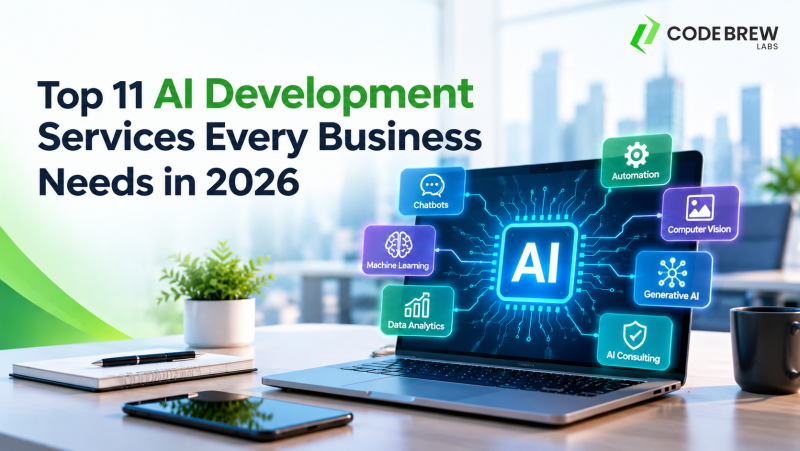
Top 11 AI Development Services Every Business Needs in 2026
 Ai agent
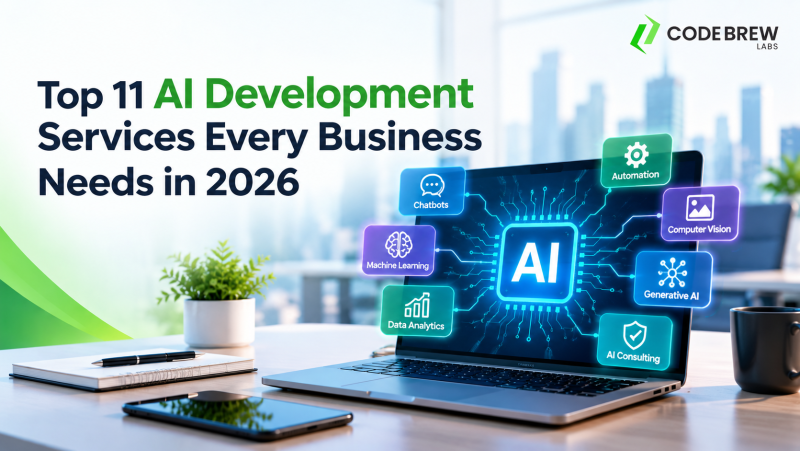
Top 11 AI Development Services Every Business Needs in 2026
In 2026, artificial intelligence is no longer an experiment that sits in an innovation lab. It is part of how customers are served, how decisions are made, and how products are built. Businesses that treated AI as optional two years ago are now competing against rivals that automate support, forecast demand and personalise every interaction.
The challenge is knowing where to start. The market for AI development services is crowded, and not every offering fits every business. A retailer needs different capabilities from a logistics firm or a fintech startup. This guide breaks down the 11 services that matter most this year, explains what each one does and shows how a reliable AI development company can turn them into measurable results.
Whether you are building your first intelligent feature or scaling an existing platform, these are the capabilities to put on your roadmap.
1. Custom Generative AI Solutions
Generative AI has moved from novelty to core infrastructure. Businesses now use large language models and diffusion models to draft content, summarise reports, generate code, create product images and answer complex questions in natural language. The real value, however, comes from customisation. Off-the-shelf tools know nothing about your products, policies or customers.
A skilled AI development company fine-tunes models on your own data, builds retrieval-augmented generation (RAG) pipelines so answers stay grounded in your documents, and adds guardrails that keep outputs accurate and on-brand. Typical projects include internal knowledge assistants, marketing content engines, sales proposal generators and design tools.
When evaluating AI development services in this category, ask how the vendor handles hallucinations, data privacy and model selection. The best teams stay model-agnostic, choosing between proprietary and open-source models based on cost, latency and compliance needs rather than hype.
2. AI Agents and Autonomous Workflows
If 2023 was the year of chatbots, 2026 is the year of agents. AI agents do not just answer questions; they take action. They can read an email, check inventory, update a CRM record, schedule a delivery and report back, all without a human clicking through each step.
Agent development involves designing planning logic, connecting tools and APIs, defining permissions and building monitoring so every action can be audited. Multi-agent systems, where specialised agents collaborate on a task, are becoming common in finance operations, customer onboarding, procurement and IT support.
This is one of the fastest-growing areas of AI development services, and also one of the riskiest if built carelessly. Look for partners who insist on human-in-the-loop checkpoints for high-stakes decisions, clear logging and rollback options. Autonomy should be earned gradually, not granted on day one.
3. AI Chatbot and Conversational AI Development
Customers expect instant answers at any hour, in their own language. Modern conversational AI delivers this across websites, mobile apps, WhatsApp, voice assistants and contact centres. Unlike the rigid scripted bots of the past, today's assistants understand intent, remember context and hand over smoothly to a human when needed.
A strong chatbot project covers conversation design, integration with order, booking or billing systems, multilingual support, analytics and continuous improvement based on real conversations. For many businesses, this is the quickest route to visible ROI, through lower support costs and higher customer satisfaction.
When choosing an AI development company for conversational AI, check for voice capability, support for regional languages and a clear escalation design. A bot that traps frustrated customers in a loop does more harm than having no bot at all.
4. Machine Learning and Predictive Analytics
Before generative AI grabbed headlines, machine learning was quietly driving results, and it still does. Predictive models forecast demand, score leads, detect fraud, estimate churn, optimise pricing and flag equipment failures before they happen. For data-rich businesses, these models often deliver the clearest and most defensible return on investment.
Custom machine learning development includes problem framing, data preparation, feature engineering, model training, validation and deployment. Industries such as retail, banking, healthcare, logistics and manufacturing rely on it daily.
A dependable AI development company will start with the business question, not the algorithm. If a simple regression model solves your problem, you should not be sold a complex neural network. Insist on clear success metrics, explainable outputs where regulation demands them, and a plan for retraining as your data changes.
5. Computer Vision Development
Computer vision teaches machines to interpret images and video. Retailers use it for shelf monitoring and cashierless checkout. Manufacturers use it to spot defects on production lines. Hospitals use it to support radiology review. Property, insurance and automotive firms use it to assess damage from photos in minutes rather than days.
Services in this area include object detection, facial and identity verification, optical character recognition, video analytics, quality inspection and augmented reality features. Edge deployment, where models run on cameras or phones instead of the cloud, is increasingly important for speed and privacy.
Because vision systems often handle sensitive imagery, ask any provider of AI development services about consent, data retention, bias testing and accuracy across different lighting and demographic conditions.
6. Natural Language Processing and Document Intelligence
Most business knowledge is locked inside unstructured text: contracts, invoices, emails, support tickets, reviews and reports. Natural language processing (NLP) unlocks it. Document intelligence systems extract fields from invoices, classify incoming mail, summarise long contracts, analyse customer sentiment and flag compliance risks automatically.
For finance, legal, insurance and healthcare teams, this can remove thousands of hours of manual review. Combined with generative models, NLP now supports semantic search that understands meaning rather than just keywords, helping employees find the right answer across millions of documents.
When shortlisting an AI development company for this work, ask for evidence of accuracy on documents similar to yours, support for scanned and handwritten files, and a clear approach to keeping confidential content secure.
7. AI-Powered Mobile and Web App Development
Users now expect apps to feel intelligent: personalised feeds, smart search, voice input, instant recommendations and predictive suggestions. Building these features into mobile and web products is a service in its own right, and it requires both app engineering and AI expertise under one roof.
Think of a food delivery app that predicts what you want to order, a fitness app that adapts your plan daily, a taxi app that forecasts surge demand, or a banking app that spots unusual spending. These experiences depend on models running behind a smooth, fast interface.
This is where established app studios with AI capability stand out. Companies such as Code Brew Labs, Royo Apps and Dubai App Developers are known for on-demand and consumer app work, and the natural next step for many of their clients is adding intelligence to those apps. Look for teams that can deliver the whole chain, from design and development to model integration and post-launch optimisation.
8. AI Integration and Business Process Automation
Many companies do not need a brand-new AI product. They need AI woven into the systems they already use: ERP, CRM, accounting software, HR platforms, helpdesks and legacy databases. Integration services connect models and agents to these tools through APIs, so intelligence appears inside the workflows employees already know.
Typical wins include automatic ticket routing, invoice processing, lead enrichment, meeting summaries pushed into the CRM, and approval workflows that run themselves. Combined with robotic process automation, AI can handle tasks that once needed a person to interpret the situation.
The best AI development services here are boring in the right way. They focus on reliability, security and change management, including training staff so the technology is actually adopted. Ask any vendor how they handle authentication, error handling and what happens when an upstream system changes.
9. Blockchain and AI Convergence
Two of the most discussed technologies of the decade are increasingly used together. Blockchain provides tamper-proof records, transparent transactions and programmable agreements. AI provides prediction, automation and analysis. Combined, they enable fraud detection on transaction data, AI-assisted smart contract auditing, verifiable data provenance for model training, and tokenised platforms with intelligent risk scoring.
Supply chain traceability, digital identity, decentralised finance, gaming and real-world asset tokenisation are all areas where the pairing is gaining traction. Providers that began in blockchain, such as Blocktech Brew, have naturally expanded into AI as customers ask for smarter, more automated platforms.
If your roadmap involves Web3, ask whether the AI development company you are considering can handle both layers: smart contract security on one side, and model reliability and data governance on the other. Few teams do both well.
10. Data Engineering and MLOps
Every AI project is only as good as the data beneath it, and every model decays without maintenance. Data engineering builds the pipelines, warehouses and quality checks that feed models clean, timely information. MLOps covers deployment, versioning, monitoring, automated retraining and cost control once models are live.
This service rarely makes headlines, yet it is the difference between a promising demo and a dependable product. Many failed pilots die here: the model worked in a notebook but could not be deployed, monitored or scaled.
A mature AI development company treats production readiness as part of the job from the first sprint. Ask about monitoring for model drift, rollback procedures, cloud cost management and how they document pipelines so your own team can take over later.
11. AI Consulting, Strategy and Governance
The eleventh service is the one that makes the other ten work: knowing what to build, in what order and under which rules. AI consulting helps leadership identify high-value use cases, estimate ROI, assess data readiness, choose build-versus-buy and plan a realistic roadmap. Governance work defines policies for responsible use, covering privacy, bias, transparency, security and compliance with regulations such as the EU AI Act and India's Digital Personal Data Protection Act.
With regulators paying closer attention and customers asking harder questions, governance is no longer a back-office detail. It protects your brand and shortens approval cycles for new projects.
A good consultant will sometimes tell you not to use AI at all for a particular problem. That honesty is a strong signal. Prefer AI development services partners who start with a discovery workshop or proof of concept, rather than those who arrive with a fixed solution and look for a problem to match it.
Leading AI Development Companies to Know in 2026
Choosing the right partner matters as much as choosing the right service. The names below are widely associated with app, blockchain and AI-led development. Capabilities and team focus change quickly, so treat this as a starting shortlist and verify current services, case studies and client references directly before signing anything.
1. Blocktech Brew. Known for blockchain, Web3 and fintech development, Blocktech Brew has expanded into AI-driven solutions such as smart automation, AI agents and intelligent platforms. It suits businesses that want AI and blockchain built together, for example in crypto, tokenisation or secure digital payments.
2. Code Brew Labs. A mobile development company recognised for on-demand and marketplace apps across industries such as food delivery, ride-hailing, and healthcare. Its experience in consumer apps makes it a practical choice for adding recommendations, chatbots and personalisation to a product.
3. Royo Apps. An app development company with a focus on startups and growing businesses. Royo Apps is a good fit for teams that want an end-to-end build, from idea and design to launch, with AI features included in the roadmap.
4. Dubai App Developers. A Dubai-based development company serving businesses in the UAE and wider Gulf region. Local presence is useful for companies that value in-region support, Arabic and English interfaces and familiarity with regional compliance and market expectations.
5. Newer AI-first startups and studios. Alongside established agencies, a wave of young teams now builds only on top of modern models. They are often faster, cheaper and more experimental, and they tend to specialise in one area such as agents, voice AI, or vertical tools for law, health, or finance. Open platforms such as Hugging Face and model providers such as Mistral AI also power many of these builds. The trade-off is a shorter track record, so ask for live references, security practices and a clear plan for long-term support.
How to Choose the Right AI Development Company
With so many options, a simple checklist keeps the decision grounded:
- Relevant experience. Ask for case studies in your industry or a closely related one, and speak to past clients.
- Technical depth. The team should cover data, models, engineering and design, not just one of them.
- Security and compliance. Confirm how your data is stored, who can access it and whether it is ever used to train third-party models.
- Transparent pricing. Expect clear estimates, defined milestones and honest discussion of ongoing model, cloud and maintenance costs.
- Start small. A paid pilot or proof of concept reduces risk and shows how the team actually works.
- Long-term support. Models drift and needs change, so look for a partner that offers monitoring and iteration after launch.
Conclusion
The 11 AI development services above, from generative AI and agents to data engineering and governance, form the building blocks of a competitive business in 2026. You do not need all of them at once. Start with the one tied most closely to a measurable goal, such as lower support costs, faster document handling, or better forecasting, then expand as results come in.
The right AI development company will act as a long-term partner, not just a vendor. Whether you work with an established studio like Blocktech Brew, Code Brew Labs, Royo Apps, or Dubai App Developers, or with a promising new startup, insist on clear goals, honest timelines and responsible practices. Businesses that move thoughtfully now will be the ones setting the pace in the years ahead.
Source:
Click for the: Full Story
You might like