



 Close Menu
 World
World
 Biography
 Health
 Education
 Business
 Lifestyle
 Sports
 Technology
 Animals
 History
 Food
Food
 Religious
 Startups
 Movies
 Politics
 Fashion
 Covid
Covid
 Diet
Diet
 Fitness
 Marketing
 Travel
 Science
 Reviews
 Social media
 Stories
 Facts
Facts
 Art
Art
 Entertainment
Newtech Water

Business
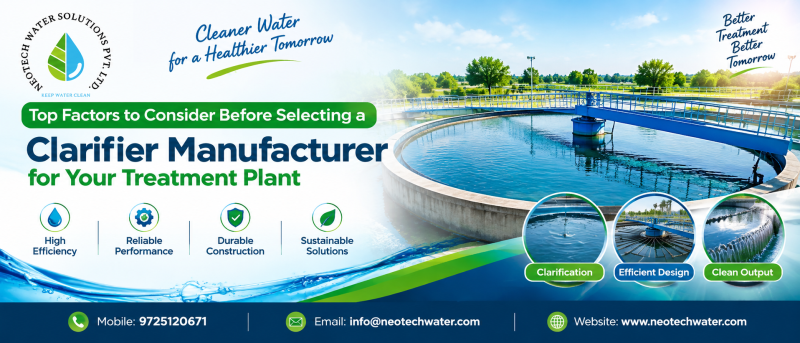
Top Factors to Consider Before Selecting a Clarifier Manufacturer for Your Treatment Plant
 Newtech Water
Choosing the right Clarifier Manufacturer is an important decision when designing, upgrading, or operating a water or wastewater treatment plant. A clarifier is a key component in many treatment systems because it helps separate settleable solids from water through sedimentation. The quality of the clarifier design and its suitability for the treatment process can directly affect downstream operations.
A clarifier should not be selected only by comparing tank size or equipment cost. Factors such as flow rate, solids loading, water characteristics, treatment objectives, sludge handling, available space, and maintenance requirements should all be reviewed before making a final decision.
For water and wastewater treatment projects in India, selecting an experienced Clarifier Manufacturer can help ensure that the clarifier tank and associated equipment are suited to the specific application.
What Is a Clarifier in a Water Treatment Plant?
A Clarifier in Water Treatment Plant is a treatment unit designed to separate settleable suspended solids from water or wastewater. The process generally relies on gravity, allowing heavier particles or flocs to settle toward the bottom while clarified water moves toward the outlet.
Depending on the treatment process, a clarifier may be used after:
- Coagulation and flocculation
- Biological treatment
- Chemical treatment
- Primary treatment
- Secondary treatment
The settled solids are collected as sludge and must be removed and managed through an appropriate sludge-handling process.
Clarifiers can be designed in different configurations, including circular, rectangular, inclined plate, and other application-specific arrangements. The appropriate design depends on the treatment requirements.
Why Choosing the Right Clarifier Manufacturer Matters
A clarifier is part of a larger treatment system. If it is not properly matched to the flow conditions or solids characteristics, it can affect the efficiency of the overall plant.
The right Clarifier Manufacturer should focus on application requirements rather than recommending the same design for every project.
A suitable clarifier design should consider:
- Influent flow rate
- Peak flow conditions
- Suspended solids loading
- Nature of the solids
- Required water quality
- Available installation area
- Sludge removal requirements
- Downstream treatment processes
A well-planned selection process can help reduce avoidable operational challenges and improve integration with the complete treatment plant.
Top Factors to Consider Before Selecting a Clarifier Manufacturer
1. Understand the Treatment Application
The first question should be: What is the clarifier required to do?
Clarifiers used for different treatment processes can have different operating requirements. For example, a clarifier following chemical flocculation may handle different solids than one used after biological treatment.
Before approaching a supplier, prepare information about:
- Type of water or wastewater
- Treatment plant capacity
- Average and peak flow
- Suspended solids concentration
- Existing treatment stages
- Required treated water quality
- Intended discharge or reuse requirements
A manufacturer can provide more relevant guidance when the application is clearly defined.
2. Consider Average and Peak Flow Rates
Clarifier design should consider realistic flow conditions rather than only the average daily flow.
Many treatment plants experience variations caused by:
- Production cycles
- Shift changes
- Batch discharges
- Rainwater entry
- Residential peak hours
- Process cleaning activities
Peak flows can influence hydraulic conditions inside the clarifier. If the system is not designed for expected variations, solids separation may be affected.
When discussing requirements with a Clarifier Manufacturer India, provide both normal and maximum expected flow information.
3. Evaluate Solids Characteristics
Not all suspended solids settle in the same way.
The following characteristics can influence clarifier selection:
- Particle size
- Density
- Settling behaviour
- Concentration
- Floc strength
- Organic or inorganic nature of solids
For example, solids produced after chemical treatment may have different settling characteristics from biological sludge.
Understanding the nature of solids can help determine the appropriate clarifier configuration and sludge removal system.
4. Select the Right Clarifier Tank Design
A Clarifier Tank can be designed in different shapes and configurations depending on the application and available site conditions.
Common considerations include:
- Circular or rectangular configuration
- Required surface area
- Water depth
- Inlet arrangement
- Outlet system
- Sludge collection mechanism
- Access for inspection and maintenance
The selected design should support effective flow distribution and solids settling under the intended operating conditions.
Rather than choosing a standard design based only on capacity, it is better to evaluate how the clarifier will fit into the complete treatment process.
5. Review Hydraulic Design
Hydraulic conditions are important in sedimentation.
Poor flow distribution can create short-circuiting or uneven treatment conditions. The inlet and outlet arrangements should therefore be designed to support controlled flow through the clarifier.
Key hydraulic considerations include:
- Flow distribution
- Detention time
- Surface loading
- Inlet energy
- Outlet arrangement
- Peak flow conditions
A properly designed system should aim to minimise unnecessary disturbances that could affect the settling process.
6. Consider Sludge Collection and Removal
Clarification produces settled sludge that needs to be removed from the tank.
The sludge handling system should be suitable for the expected solids quantity and characteristics.
Important questions include:
- How will settled sludge be collected?
- How frequently will sludge need to be removed?
- Is automatic sludge removal required?
- Where will the sludge go after removal?
- How will the system be accessed for maintenance?
Ignoring sludge management during the clarifier selection stage can create operational problems later.
7. Consider Material and Construction Requirements
Material selection should be appropriate for the operating environment.
Depending on the project, factors may include:
- Water chemistry
- Corrosion potential
- Exposure to treatment chemicals
- Outdoor conditions
- Structural requirements
- Expected operating life
- Maintenance accessibility
A Clarifier Manufacturer should consider these factors when recommending materials and equipment components.
The right material is not necessarily the same for every water or wastewater treatment application.
8. Evaluate Available Space and Installation Conditions
Site conditions can influence the most practical clarifier configuration.
Before finalising the design, consider:
- Available footprint
- Existing structures
- Pipe routing
- Inlet and outlet elevations
- Access for construction
- Space for maintenance
- Future expansion possibilities
A compact site may require a different design approach than a large greenfield treatment plant.
9. Review Energy and Operating Requirements
Clarification itself is primarily based on gravity, but associated systems may require power.
Depending on the design, energy may be needed for:
- Sludge scrapers
- Pumps
- Chemical dosing systems
- Control panels
- Sludge transfer equipment
Buyers should understand the complete operational requirements rather than considering only the clarifier tank.
10. Assess the Manufacturer's Technical Approach
When choosing a Clarifier Manufacturer, technical understanding is just as important as equipment supply.
Useful questions to ask include:
- Does the manufacturer review the complete treatment process?
- Is the clarifier design based on actual flow and solids characteristics?
- Are average and peak flow conditions considered?
- How will sludge be collected and removed?
- What maintenance access is provided?
- Can the clarifier integrate with existing equipment?
- Are technical specifications and operating requirements clearly explained?
The answers can help buyers compare suppliers based on application suitability rather than price alone.
Clarifier Selection: New Plant vs Existing Plant Upgrade
The requirements may differ depending on whether the clarifier is being installed in a new treatment plant or added to an existing system.
For New Treatment Plants
A new project may provide greater flexibility for:
- Tank configuration
- Equipment placement
- Piping design
- Sludge handling
- Future capacity planning
However, the clarifier should still be integrated with the complete treatment process from the beginning.
For Existing Plant Upgrades
Existing plants may have limitations such as:
- Fixed space
- Existing piping
- Limited civil modification options
- Restricted access
- Existing downstream equipment
In these situations, a site-specific assessment can help identify a practical clarifier solution.
Common Mistakes to Avoid When Selecting a Clarifier
Choosing Only on Price
A lower initial equipment cost may not reflect the suitability of the design or long-term operating requirements.
Ignoring Peak Flow
The clarifier should be evaluated for realistic variations in plant flow.
Overlooking Solids Characteristics
Different solids have different settling behaviour. Clarifier selection should reflect actual wastewater conditions.
Neglecting Sludge Handling
A clarifier is only one part of the solids separation process. Sludge collection and handling should also be planned.
Treating the Clarifier as an Independent Unit
The clarifier should be evaluated together with upstream and downstream treatment processes.
How Neotech Water Solutions Can Support Your Treatment Project
Selecting a clarifier requires a practical understanding of the treatment process and site conditions. Neotech Water Solutions works in the water and wastewater treatment sector and can be approached to discuss project-specific treatment requirements.
For a clarifier selection, factors such as flow rate, solids characteristics, treatment objectives, available space, and sludge management should be evaluated as part of the overall process.
Neotech Water Solutions can support discussions around suitable water and wastewater treatment solutions for industrial and other treatment applications in India.
Frequently Asked Questions
1. What is the purpose of a clarifier in a water treatment plant?
A clarifier is used to separate settleable suspended solids from water or wastewater through sedimentation. It is commonly used after processes such as coagulation, flocculation, or biological treatment.
2. How do I choose the right clarifier manufacturer?
Choose a manufacturer that considers your actual water characteristics, flow rate, solids loading, treatment requirements, available space, and sludge handling needs.
3. What factors affect clarifier performance?
Clarifier performance can be influenced by flow conditions, solids characteristics, hydraulic design, inlet and outlet arrangements, sludge removal, and operating practices.
4. What is the difference between a clarifier tank and a settling tank?
Both are used for solids separation through settling. The exact terminology and design can vary depending on the treatment process and application.
5. Can a clarifier be used for industrial wastewater?
Yes, clarifiers may be used in industrial wastewater treatment. The design should be based on the specific wastewater characteristics and treatment process.
6. Why is sludge removal important in a clarifier?
Settled solids accumulate at the bottom of the clarifier as sludge. Proper collection and removal help maintain the intended operating conditions and support consistent plant operation.
7. Can an existing treatment plant be upgraded with a new clarifier?
In some cases, yes. The feasibility depends on available space, existing infrastructure, flow conditions, and the compatibility of the proposed clarifier with the current treatment process.
Conclusion
Choosing the right Clarifier Manufacturer involves evaluating the complete treatment application rather than focusing only on tank size or purchase cost.
A suitable clarifier should be selected based on flow conditions, solid characteristics, hydraulic requirements, sludge handling, site limitations, and downstream treatment needs.
Whether the project involves a new treatment plant or an upgrade to an existing facility, a careful evaluation can help identify a practical and application-focused solution.
Contact Neotech Water Solutions to discuss your water or wastewater treatment requirements and explore a suitable clarifier solution for your treatment plant in India.
Source:
Click for the: Full Story
You might like








You Might Like this