


 Close Menu
 World
 Biography
 Health
 Education
 Business
 Lifestyle
 Sports
 Technology
 Animals
 History
 Food
 Religious
 Startups
 Movies
 Politics
 Fashion
 Covid
 Diet
 Fitness
 Marketing
 Travel
 Science
 Reviews
 Social media
 Stories
 Facts
 Art
 Entertainment
Shailaja Sangeetam

Technology
What Is Scrum? A Beginner’s Guide to Agile Scrum
 Shailaja Sangeetam
Software development projects often involve changing requirements, tight deadlines and teams working on different parts of a product. Managing all these activities through a fixed plan can become difficult, especially when customer needs change during development.
Scrum offers a structured way for teams to organise their work, review progress and make improvements regularly. It helps teams deliver work in smaller increments instead of waiting until the entire project is complete.
But what is Scrum, how does it work, and why do so many organisations use it? This beginner-friendly guide explains the Scrum framework, its roles, events, principles and practical applications.
What Is Scrum?
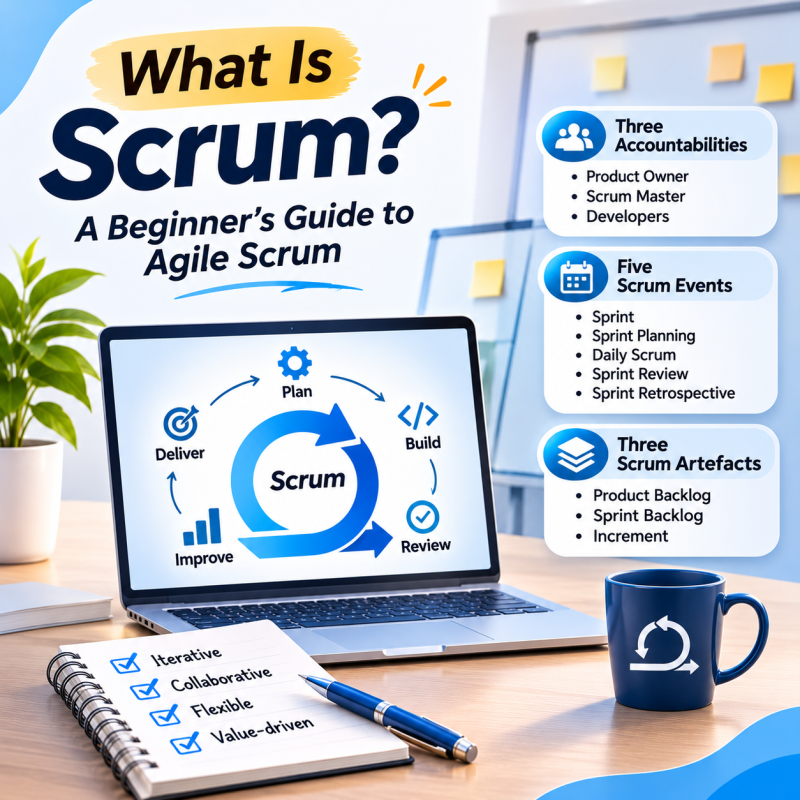
Scrum is a lightweight framework that helps individuals and teams develop, deliver and improve products through an iterative and incremental approach. It is based on empiricism, which means decisions are made using observation, experience and evidence.
Instead of planning every detail at the beginning of a project, a Scrum Team works in short cycles called Sprints. During each Sprint, the team focuses on a specific goal, completes selected work and reviews the outcome.
For example, consider a team developing an online shopping application. Instead of building the entire application before releasing anything, the team may first work on user registration, then product browsing and later payment functionality. Each completed Increment adds value to the product.
This approach helps teams respond to feedback and changing requirements while maintaining a clear direction.
How Does the Scrum Methodology Work?
The Scrum methodology follows a repeated cycle of planning, development, review and improvement. A Sprint is a fixed-length period of one month or less. A new Sprint begins immediately after the previous one ends.
The process generally involves:
- The Product Owner orders the Product Backlog based on product needs and priorities.
- During Sprint Planning, the Scrum Team discusses the value of the Sprint, selects work and creates a plan.
- Developers work towards the Sprint Goal and create a usable Increment.
- The Daily Scrum helps Developers inspect progress and adapt their plan.
- During the Sprint Review, the team and stakeholders inspect the outcome and discuss future changes.
- The Sprint Retrospective gives the team an opportunity to identify improvements.
This cycle continues throughout product development. Each Sprint provides an opportunity to learn from the work completed and adjust future plans.
What Are the Three Accountabilities in Scrum?
A Scrum Team has three accountabilities. Each contributes to product development in a different way.
1. Product Owner
The Product Owner is accountable for maximising product value. This includes developing and communicating the Product Goal, creating and clearly communicating Product Backlog items, and ensuring the backlog is ordered effectively.
2. Scrum Master
The Scrum Master is accountable for establishing Scrum and improving the effectiveness of the Scrum Team. The role involves coaching team members, supporting Scrum practices and helping remove impediments.
3. Developers
Developers are the people who create a usable Increment during each Sprint. They organise their work, maintain quality and adapt their plans to achieve the Sprint Goal.
All three accountabilities work together as one Scrum Team. Scrum does not prescribe separate sub-teams or hierarchies within it.
What Are the Five Scrum Events?
Scrum includes the Sprint and four events that take place within it.
- Sprint: The fixed-length period in which the team works towards the Sprint Goal.
- Sprint Planning: The event where the team discusses why the Sprint is valuable, what can be completed and how the work will be done.
- Daily Scrum: A 15-minute event for Developers to inspect progress towards the Sprint Goal and adjust their plan.
- Sprint Review: An opportunity to inspect the Sprint outcome with stakeholders and discuss what to do next.
- Sprint Retrospective: A meeting where the team identifies ways to improve its effectiveness and quality.
Each event has a specific purpose. They are not simply meetings to report completed tasks; they help the team inspect its work and make informed adjustments.
What Are the Three Scrum Artefacts?
Scrum uses three artefacts to make important information about the product and work transparent.
Product Backlog: An ordered, evolving list of what is needed to improve the product. Its commitment is the Product Goal.
Sprint Backlog: Contains the Sprint Goal, the Product Backlog items selected for the Sprint and the actionable plan for delivering the Increment. Its commitment is the Sprint Goal.
Increment: A usable, valuable step towards the Product Goal. It must meet the Definition of Done. Its commitment is the Definition of Done.
These artefacts help everyone understand what the team is working towards, what needs to be completed and whether the expected quality has been achieved.
Why Do Teams Use Scrum?
Scrum is useful when product development involves uncertainty, changing requirements and regular feedback.
Some of its practical benefits include:
- Better visibility: Teams and stakeholders can inspect progress regularly.
- Frequent feedback: Product outcomes can be reviewed during each Sprint.
- Improved collaboration: Defined accountabilities and events support communication.
- Early identification of problems: Teams can discuss impediments and delivery concerns before they grow.
- Continuous improvement: Retrospectives help teams identify and address recurring challenges.
However, Scrum does not automatically guarantee faster delivery or successful projects. Its effectiveness depends on how well the team understands and applies the framework.
How Can Beginners Start Learning Scrum?
If you are new to Agile, begin by reading the official Scrum Guide to understand the framework's purpose, accountabilities, events and artefacts.
Next, practise applying Scrum to a small project. For example, plan a simple website or task management application using a Product Backlog and a one-week Sprint. Define a Sprint Goal, organise the work and conduct a review at the end.
You can also explore Scrum training programmes and certifications such as Certified ScrumMaster (CSM) or Professional Scrum Master (PSM). Practical exercises can help you understand how Scrum works beyond textbook definitions.
Conclusion
Scrum provides a clear framework for teams to manage complex product development through short cycles of work, regular feedback and continuous improvement. Understanding its accountabilities, events and artefacts is the first step towards applying it effectively.
For beginners, learning Scrum is not about memorising meeting names or following a checklist. It is about understanding how teams collaborate, make decisions and deliver value while adapting to change.
Source:
Click for the: Full Story
You might like









You Might Like this