Close Menu
 World
World
 Biography
 Health
 Education
 Business
 Lifestyle
 Sports
 Technology
 Animals
 History
 Food
Food
 Religious
 Startups
 Movies
 Politics
 Fashion
 Covid
Covid
 Diet
Diet
 Fitness
 Marketing
 Travel
 Science
 Reviews
 Social media
 Stories
 Facts
Facts
 Art
Art
 Entertainment
Charles Franklin

Business
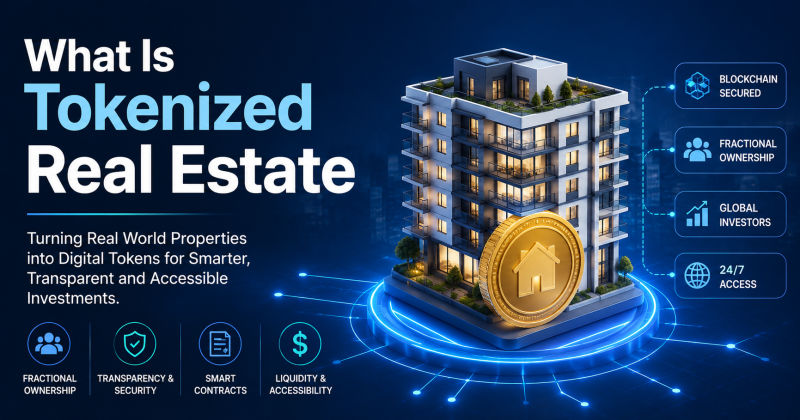
What Is Tokenized Real Estate? Understanding Fractional Ownership, Benefits, and Risks
 Charles Franklin
Real estate has traditionally been viewed as one of the most stable long-term investment categories, but entering the market can be difficult. High property prices, paperwork, geographic limitations, lengthy transactions, and limited liquidity often prevent smaller investors from participating directly. Tokenized real estate is emerging as a blockchain-based approach to address some of these limitations by converting economic or ownership interests in property into digital tokens.
Instead of requiring one investor to purchase an entire property, tokenization can divide an asset into numerous digital units. Investors can then purchase a fraction of the underlying economic interest, depending on the legal structure of the offering. This model has attracted increasing attention from property owners, investment managers, blockchain companies, and financial institutions. Deloitte estimates that the value of tokenized real estate could reach approximately $4 trillion by 2035, compared with less than $0.3 trillion in 2024, although this is a forecast rather than a guaranteed market outcome.
What Is Tokenized Real Estate?
Tokenized real estate refers to the process of representing ownership rights, investment interests, debt claims, or other economic rights associated with real estate through blockchain-based digital tokens.
The important point is that the token itself does not automatically mean that someone owns a physical building. The legal structure behind the token determines what investors actually receive. For example, a property may be placed inside a special-purpose company, and investors may receive tokens representing shares or economic interests in that entity. In another structure, tokens could represent interests in a real estate fund, mortgage, loan, or securitization.
The blockchain provides the digital infrastructure for recording token ownership, transferring eligible tokens, executing programmed transactions, and maintaining an auditable transaction history. Smart contracts can automate certain processes, such as transferring tokens after payment, enforcing investor eligibility requirements, or distributing income according to predefined rules.
This distinction between digital representation and legal ownership is critical. Tokenization modernizes how an investment interest can be issued and managed, but it does not eliminate property law, securities regulation, tax obligations, or investor-protection requirements. The U.S. Securities and Exchange Commission, for example, has stated that tokenized securities can still be securities under federal securities laws; putting an asset on a blockchain does not inherently remove its existing legal characteristics.
How Does Fractional Ownership Work?
Fractional ownership is one of the most attractive concepts associated with tokenized real estate. Imagine a commercial property valued at $10 million. Rather than asking a single investor to provide the entire amount, a legally structured offering could divide the investment interest into 1 million tokens, with each token representing a defined fraction of the investment.
An investor purchasing 1,000 tokens would therefore have exposure equivalent to 0.1% of the tokenized interest, subject to the offering's legal terms. If the property generates rental income, eligible token holders could receive their proportional share after expenses, taxes, management costs, and other deductions.
The model can potentially reduce the capital barrier to real estate investing. However, fractional ownership should not be confused with simply buying a fraction of a physical building. The investor's rights depend on the legal documents governing the offering.
For example, a token could represent equity in an entity that owns the property rather than direct title to the property itself. Investors therefore need to understand voting rights, distributions, redemption provisions, transfer restrictions, liquidation procedures, and what happens if the underlying property is sold.
Platforms already demonstrate how this concept can work in practice. RealT, for example, markets fractional, tokenized interests connected to U.S. real estate and provides property offerings where investors can purchase tokenized interests.
How Does Real Estate Tokenization Work?
A typical tokenization structure involves considerably more than creating a blockchain token. The process usually begins with selecting and evaluating an underlying property or real estate investment.
The asset is then placed within an appropriate legal structure. This could involve a special-purpose vehicle, fund, trust, or another entity depending on the jurisdiction and investment model. Legal and financial professionals determine what rights the digital tokens will represent.
Next, the issuer establishes the token economics and investor rules. These may define the total token supply, ownership percentages, income distribution mechanisms, transfer restrictions, investor eligibility, and other conditions.
The token is then created through a blockchain smart contract. A compliant platform can integrate identity verification, KYC/AML procedures, investor whitelisting, payment processing, custody, and reporting. Once eligible investors purchase tokens, ownership records can be maintained on-chain while the underlying legal ownership remains governed by conventional legal documents.
The final stage involves ongoing asset management. Rental income, expenses, property valuations, distributions, investor communications, and potential secondary transfers must all be managed throughout the property's lifecycle.
This is why successful tokenization is not simply a blockchain development exercise. It combines real estate structuring, legal compliance, financial modeling, smart contracts, investor management, and technology infrastructure.
Major Benefits of Tokenized Real Estate
Lower Barriers to Investment
Traditional property investment often requires substantial capital. Tokenization can divide an investment into smaller units, allowing investors to gain exposure to assets that would otherwise be financially inaccessible.
For example, an investor who cannot afford a multimillion-dollar commercial property may potentially participate in a tokenized investment with a much smaller allocation. The exact minimum depends on the offering and applicable regulations.
Greater Transparency
Blockchain networks provide an auditable record of token transactions. Depending on how the platform is designed, investors can potentially verify token balances, transaction histories, and other information without relying entirely on manually maintained records.
This does not guarantee transparency about the underlying property itself. Property valuations, maintenance expenses, rental agreements, and financial statements still require reliable off-chain reporting.
Potentially More Efficient Transactions
Traditional real estate transactions can involve brokers, banks, registrars, lawyers, custodians, and other intermediaries. Tokenization can automate portions of administration through smart contracts and digital workflows.
This may reduce certain administrative costs and shorten settlement processes, particularly when the surrounding legal and financial infrastructure is designed to support digital assets.
Deloitte identifies reduced administrative inefficiency, lower investor costs, and expanded participation as some of the potential advantages of tokenized real estate.
Global Investor Access
Tokenized platforms can potentially allow investors from different jurisdictions to participate in qualifying offerings through digital interfaces. However, "global access" does not mean unrestricted access. Securities laws, tax rules, KYC requirements, sanctions restrictions, and investor eligibility requirements can still apply.
Programmable Ownership and Income Distribution
Smart contracts can automate certain financial processes. For example, when rental income is received and approved for distribution, a system could calculate each eligible investor's allocation and initiate payments according to predefined rules.
This programmability can become particularly useful for large portfolios where manually processing thousands of investor accounts would be expensive and time-consuming.
What Are the Risks of Tokenized Real Estate?
Tokenization does not remove the fundamental risks of real estate investment. It adds another technological and regulatory layer that investors need to evaluate.
Regulatory risk is one of the most important considerations. Tokenized property interests may fall under securities, real estate, tax, money-transmission, or other regulations depending on jurisdiction and structure. Regulatory frameworks are still evolving, and changes can affect how platforms operate and how tokens can be transferred.
Liquidity risk is another major issue. A token may be technically transferable without having an active market. Tokenization creates digital units, but it does not automatically create buyers. Academic research on tokenized real-world assets has highlighted the difference between putting an asset on-chain and achieving meaningful secondary-market liquidity.
There are also property-level risks. Vacancy, declining rents, maintenance expenses, property damage, interest rates, local economic conditions, and falling property values can all affect investor returns.
Technology risk should also be considered. Smart contract vulnerabilities, wallet security problems, private-key loss, oracle failures, platform outages, or flawed integrations can potentially create financial losses.
Finally, there is counterparty and management risk. Blockchain records can show who owns tokens, but they cannot independently guarantee that a property manager will maintain a building properly, collect rent efficiently, or make sound investment decisions. The underlying asset and the organization managing it remain fundamental to the investment.
A Real-World Lesson: Tokenization Does Not Replace Asset Management
The experience of tokenized property platforms illustrates an important lesson: blockchain infrastructure cannot compensate for weak real-world operations.
RealT has demonstrated the accessibility side of the model by offering fractional tokenized real estate interests. At the same time, reporting surrounding some of its Detroit properties has highlighted problems involving property maintenance, tenants, taxes, and management. These developments demonstrate why investors must evaluate the underlying properties, operators, legal structure, and governance rather than judging an investment solely by its blockchain technology.
The broader lesson is straightforward: tokenization can improve the financial infrastructure surrounding real estate, but it cannot make a poor property a good investment.
What Does the Future Hold for Tokenized Real Estate?
The future of tokenized real estate will likely depend less on simply creating more tokens and more on developing reliable infrastructure around them.
Deloitte's forecast of approximately $4 trillion in tokenized real estate by 2035 reflects the scale of the opportunity if institutional adoption, regulation, infrastructure, and market participation continue to develop. Its analysis expects tokenized private real estate funds, loans and securitizations, and undeveloped or under-construction projects to become important segments of the market.
The next phase is therefore likely to focus on regulated marketplaces, compliant investor onboarding, interoperable blockchain infrastructure, stronger custody systems, automated reporting, and genuinely useful secondary markets.
For property owners and investment firms, tokenization could eventually become another capital-raising and asset-management mechanism rather than a purely cryptocurrency-focused product. For investors, the appeal will depend on whether tokenized offerings provide transparent legal rights, reasonable costs, credible property management, and sufficient liquidity.
Choosing Real Estate Tokenization Development Services
Businesses planning to enter this market need technology that supports both blockchain functionality and the operational requirements of real estate investing. Real estate tokenization development services can cover token creation, smart contract development, investor dashboards, KYC/AML integrations, payment systems, asset management modules, compliance workflows, and secondary-market functionality.
Similarly, Real estate tokenization platform development services can help businesses build complete ecosystems where properties can be listed, investors can complete onboarding, tokens can be purchased and managed, and distributions can be administered through a unified platform.
The technology should be designed around the legal and financial structure rather than treating token creation as the starting point. Security audits, access controls, wallet infrastructure, investor verification, transaction monitoring, and transparent reporting are particularly important when the platform handles real financial assets.
Conclusion
Tokenized real estate represents a significant evolution in how property investment can be structured, offering the potential for fractional ownership, improved administrative efficiency, greater transparency, and broader market access. However, tokenization is not a shortcut around real estate fundamentals or financial regulation. The quality of the underlying property, legal rights, management team, compliance framework, technology, and secondary-market infrastructure ultimately determines whether a tokenized offering delivers real value. As the sector matures, businesses need experienced blockchain development partners capable of combining secure technology with practical real estate requirements, and Blockchain App Factory provides best services for real estate tokenization development, helping businesses build scalable and secure solutions for the emerging tokenized property market.
FAQs
1. What is tokenized real estate?
Tokenized real estate uses blockchain-based tokens to represent ownership interests or economic rights connected to real estate assets.
2. Is tokenized real estate the same as fractional ownership?
Not always. Tokenization can enable fractional ownership, but the token may represent an interest in a company, fund, debt instrument, or other legal structure rather than direct property ownership.
3. Can tokenized real estate generate rental income?
Yes, some offerings distribute rental or other property-related income to eligible token holders according to their legal rights and ownership percentage.
4. Is tokenized real estate risky?
Yes. Investors can face property, market, regulatory, liquidity, technology, smart-contract, and management risks.
5. Why is blockchain used for real estate tokenization?
Blockchain can provide programmable ownership records, automated transactions, transparent transaction histories, and infrastructure for managing digital investment interests.
Source:
Click for the: Full Story
You might like