Close Menu
 World
World
 Biography
 Health
 Education
 Business
 Lifestyle
 Sports
 Technology
 Animals
 History
 Food
Food
 Religious
 Startups
 Movies
 Politics
 Fashion
 Covid
Covid
 Diet
Diet
 Fitness
 Marketing
 Travel
 Science
 Reviews
 Social media
 Stories
 Facts
Facts
 Art
Art
 Entertainment
Art william

Education
What Makes Cambridge International Schools in Punjab Different from Traditional Schools?
 Art william
The education landscape in Punjab is evolving rapidly, with more parents exploring international curricula for their children. Among these, Cambridge International Schools have gained significant popularity. But what truly sets them apart from traditional boards like CBSE or ICSE? Let’s break it down in a simple and practical way.
📚 Curriculum Approach: Concept vs Memorization
One of the biggest differences lies in how students are taught.
- Cambridge Schools: Focus on conceptual understanding, encouraging students to ask questions, analyze, and apply knowledge.
- Traditional Schools: Often rely more on rote learning and textbook-based preparation.
In Cambridge classrooms, students are active participants rather than passive learners.
🧠 Skill Development Over Marks
Traditional systems in India have long emphasized marks and rankings. Cambridge schools, on the other hand, focus on developing real-world skills.
- Critical thinking
- Problem-solving
- Communication skills
- Research and analytical abilities
This approach helps students become more confident and independent learners.
🌍 Global Recognition & Opportunities
Cambridge qualifications such as IGCSE and A Levels are recognized worldwide.
- Easier access to international universities
- Globally benchmarked curriculum
- Exposure to diverse perspectives
Traditional boards are widely accepted in India, but Cambridge offers a broader global pathway.
📝 Assessment Style
Evaluation methods also differ significantly:
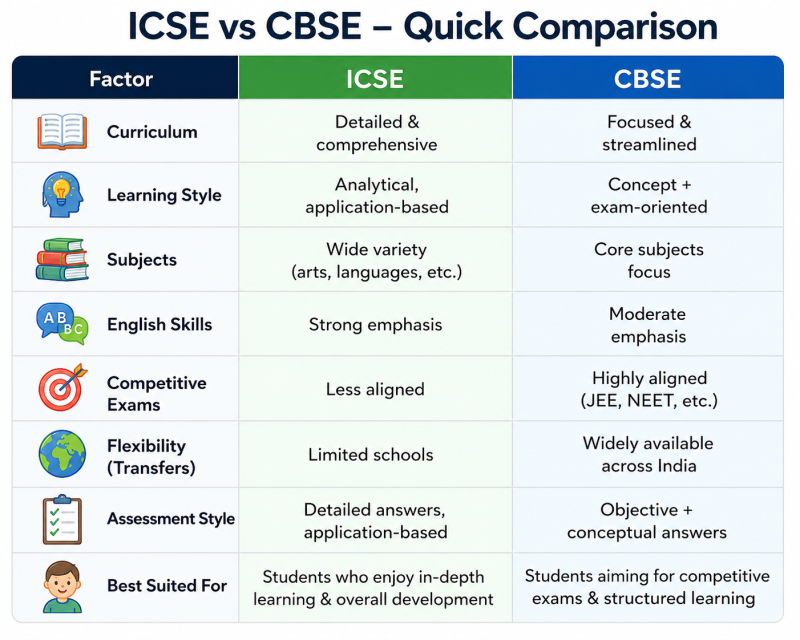
- Cambridge Schools: Mix of written exams, practicals, projects, and coursework
- Traditional Schools: Primarily theory-based exams at the end of the term
This ensures that Cambridge students are assessed on overall understanding, not just exam performance.
🎯 Flexibility in Subject Choices
Cambridge curriculum allows students to choose subjects based on their interests and career goals.
- Freedom to mix sciences, arts, and commerce
- Personalized learning pathways
In contrast, traditional systems often have fixed subject streams with limited flexibility.
🏫 Teaching Methodology
Cambridge schools adopt modern teaching techniques:
- Interactive classrooms
- Group discussions and presentations
- Technology-integrated learning
Teachers act as facilitators rather than just lecturers, making learning more engaging.
🏢 Infrastructure & Learning Environment
Most Cambridge International Schools in Punjab invest in:
- Smart classrooms
- Advanced labs
- Activity-based learning spaces
- Sports and creative facilities
The focus is on holistic development, not just academics.
📍 A Growing Presence in Punjab
Cities like Patiala, Ludhiana, and Amritsar are seeing a rise in Cambridge-affiliated schools. Parents are increasingly choosing these institutions to give their children a global edge while staying rooted locally.
Kaintal Global School in Patiala is emerging as one of the Cambridge International Schools in Punjab, offering a modern, globally aligned learning environment.
✅ Final Thoughts
Cambridge International Schools in Punjab are redefining education by focusing on how students learn, not just what they learn. While traditional schools still offer strong academic foundations, Cambridge schools provide a more flexible, skill-oriented, and globally relevant education.
For parents, the choice ultimately depends on their child’s learning style and future aspirations. If you’re looking for a system that encourages curiosity, independence, and global exposure, Cambridge education could be the right fit.
Source:
Click for the: Full Story
You might like