Close Menu
 World
World
 Biography
 Health
 Education
 Business
 Lifestyle
 Sports
 Technology
 Animals
 History
 Food
Food
 Religious
 Startups
 Movies
 Politics
 Fashion
 Covid
Covid
 Diet
Diet
 Fitness
 Marketing
 Travel
 Science
 Reviews
 Social media
 Stories
 Facts
Facts
 Art
Art
 Entertainment
claire evans

Startups
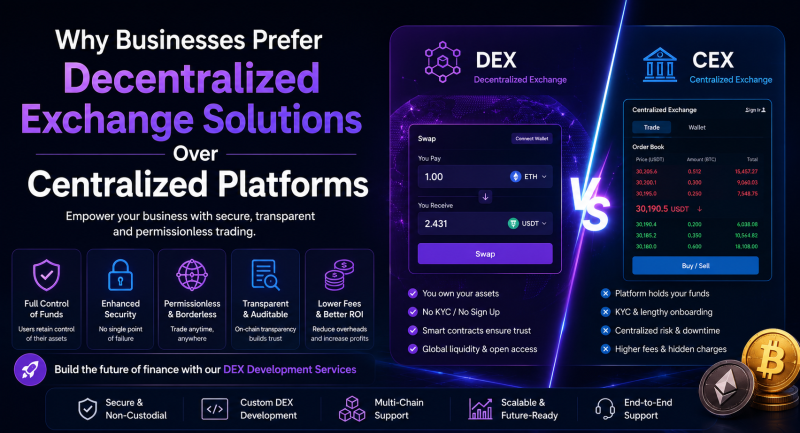
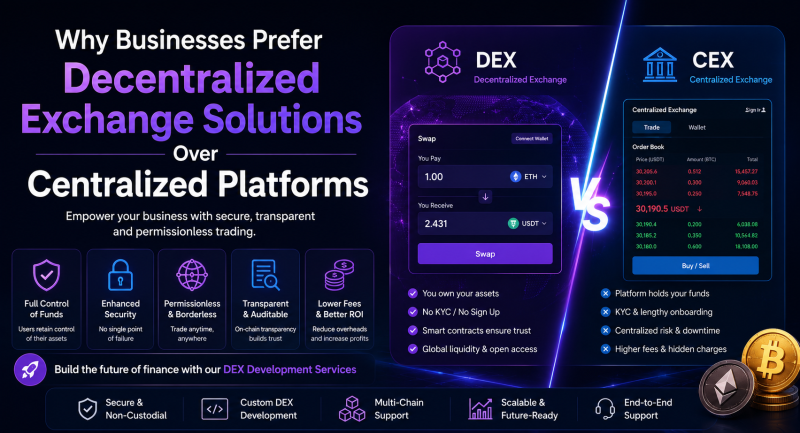
Why Businesses Prefer Decentralized Exchange Solutions Over Centralized Platforms
 claire evans
The cryptocurrency landscape has evolved dramatically, transforming how businesses and individuals exchange digital assets. While centralized exchanges have historically dominated the market, decentralized exchanges (DEXs) are rapidly gaining momentum due to their transparency, security, and operational flexibility. As blockchain technology matures and decentralized finance continues to expand, organizations are increasingly recognizing the strategic advantages of adopting decentralized exchange solutions that align with the future of digital commerce.
Understanding Decentralized and Centralized Exchanges
What is a Centralized Exchange (CEX)?
A centralized exchange operates through a governing authority that manages user accounts, stores digital assets, processes transactions, and maintains platform infrastructure. These platforms simplify trading but require users to entrust their assets to a third party.
What is a Decentralized Exchange (DEX)?
A decentralized exchange facilitates peer-to-peer cryptocurrency trading using smart contracts. Instead of relying on an intermediary, transactions are executed directly on the blockchain, allowing users to retain full custody of their digital assets throughout the trading process.
Key Differences Between CEX and DEX Platforms
The primary distinction lies in asset ownership and transaction execution. Centralized exchanges control user funds and trading infrastructure, whereas decentralized exchanges empower users with direct control over their wallets and transactions. This decentralized framework minimizes reliance on intermediaries while increasing transparency and resilience.
Why Businesses Are Choosing Decentralized Exchange Solutions
Enhanced Security Through Non-Custodial Architecture
Security remains one of the most compelling reasons businesses are embracing decentralized exchanges. Since users maintain custody of their private keys, the risks associated with centralized wallet breaches and large-scale asset theft are substantially reduced. Smart contracts automate transactions without requiring a trusted intermediary, strengthening the platform's security posture.
Greater Transparency with Blockchain Technology
Every transaction executed on a decentralized exchange is permanently recorded on a public blockchain. This immutable ledger provides unparalleled transparency, allowing participants to verify transactions independently. Such visibility enhances trust while supporting regulatory accountability where applicable.
Improved User Control Over Digital Assets
Businesses increasingly value solutions that provide users with complete ownership of their assets. Decentralized exchanges eliminate unnecessary custodial risks by enabling traders to execute transactions directly from their wallets. This architecture promotes autonomy while reinforcing confidence in the trading ecosystem.
Operational Advantages of Decentralized Exchanges
Reduced Dependency on Intermediaries
Traditional trading platforms rely heavily on centralized administrators for transaction validation and fund management. Decentralized exchanges replace these manual processes with programmable smart contracts, streamlining operations and minimizing administrative complexity.
Global Accessibility and Uninterrupted Trading
A decentralized exchange operates continuously without geographical limitations or centralized operational constraints. Users from different regions can access the platform, trade digital assets, and participate in decentralized finance with minimal barriers, fostering a truly global marketplace.
Lower Operational Costs and Higher Efficiency
Automation significantly reduces operational overhead by eliminating many intermediary processes. Smart contracts handle order execution, settlements, and token swaps efficiently, enabling businesses to optimize resources while delivering faster transaction experiences.
Scalability and Future Growth Opportunities
Multi-Chain Compatibility
Modern decentralized exchanges increasingly support multiple blockchain networks, expanding asset availability and improving interoperability. Multi-chain capabilities provide businesses with greater flexibility while reducing dependence on a single blockchain ecosystem.
Smart Contract Automation
Smart contracts automate complex trading functions such as liquidity management, token swaps, staking, and governance. This intelligent automation enhances operational precision while reducing manual intervention and transaction delays.
Adapting to the Expanding DeFi Ecosystem
The rapid evolution of decentralized finance presents new opportunities for innovation. Businesses adopting decentralized exchange solutions can integrate lending, yield farming, staking, and cross-chain functionality, positioning themselves to capitalize on emerging blockchain trends.
Selecting the Right Decentralized Exchange Development Partner
Essential Features to Consider
Robust decentralized exchange development services should include secure wallet integration, automated market maker functionality, liquidity management, advanced trading analytics, multi-token support, responsive user interfaces, and comprehensive administrative controls.
Importance of Customization and Security
Every business has unique operational requirements. Selecting a development partner capable of delivering customized features, conducting smart contract audits, and implementing advanced security protocols ensures long-term platform reliability and competitive differentiation.
Long-Term Technical Support and Scalability
Blockchain technology evolves rapidly. Continuous maintenance, feature enhancements, protocol upgrades, and scalable architecture are essential for sustaining platform performance and supporting future business expansion.
Conclusion
As the digital asset economy continues to mature, decentralized exchanges are becoming the preferred choice for businesses seeking greater transparency, stronger security, operational efficiency, and full user control over their assets. Their non-custodial architecture, blockchain-based automation, and scalability provide a powerful foundation for long-term growth in the decentralized finance ecosystem. By partnering with SpotnTrade, businesses can build secure, scalable, and feature-rich decentralized exchange solutions that are prepared to meet the evolving demands of the global cryptocurrency market.
Source:
Click for the: Full Story
You might like