Close Menu
 World
 Biography
 Health
 Education
 Business
 Lifestyle
 Sports
 Technology
 Animals
 History
 Food
 Religious
 Startups
 Movies
 Politics
 Fashion
 Covid
 Diet
 Fitness
 Marketing
 Travel
 Science
 Reviews
 Social media
 Stories
 Facts
 Art
 Entertainment
Thomas Shellby

Business
Why Food Delivery Businesses Need Integrated Software Solutions
 Thomas Shellby
Food delivery has become a technology-driven business where restaurants, customers, delivery partners, kitchens, payment systems, and ordering channels all need to work together. A customer may only see a menu, place an order, and track a delivery, but the business behind that experience is managing several connected processes at the same time.
The challenge becomes greater as order volume increases. A restaurant may receive orders through its own website, mobile app, third-party marketplaces, phone calls, and other channels. If each channel operates separately, employees may have to enter the same information into multiple systems, update menus manually, track deliveries across different dashboards, and reconcile payments afterward.
Integrated software solves much of this operational complexity by connecting these processes into a common system. POS, ordering, kitchen operations, inventory, payments, delivery management, customer data, and analytics can work together instead of becoming isolated tools.
This does not mean every food business needs one enormous software platform. The goal is to create a connected technology environment where important business processes can exchange information automatically and provide teams with a clearer view of what is happening.
Why Food Delivery Businesses Need Connected Systems
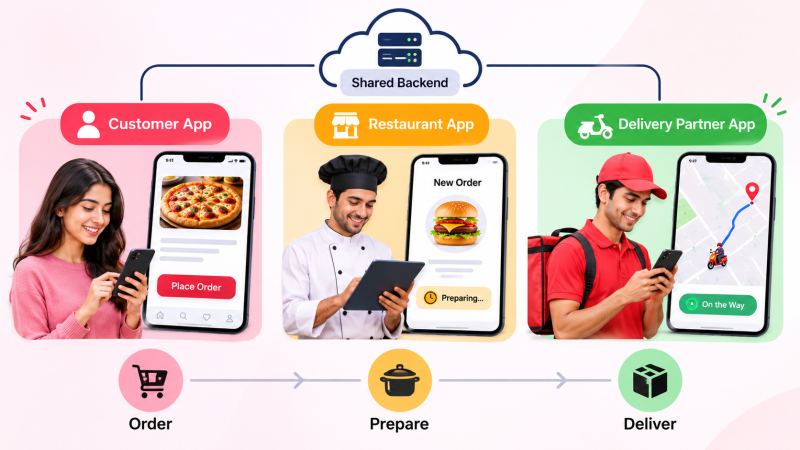
A food delivery operation can quickly become difficult to manage when every business function uses a separate system. An order might start in a customer's mobile app, move to the restaurant's ordering system, reach the kitchen, get assigned to a delivery partner, and finally trigger a payment and customer notification.
If these steps are not connected, employees become the link between the systems.
For example, a customer places an online order for a meal. If the ordering platform does not connect directly to the restaurant's POS, an employee may need to manually enter the order. The kitchen then prepares it based on that information, while another employee may have to update the delivery status separately. This creates opportunities for delays, incorrect information, duplicate work, and missed orders.
Modern restaurant technology increasingly focuses on connecting online ordering with POS and delivery systems for exactly this reason. Integrated platforms can automatically transfer orders, improve visibility into fulfillment, and reduce the need for manual entry.
This becomes particularly important for businesses investing in food delivery app development. The mobile application is only one part of the overall system. If the customer-facing application is disconnected from restaurant operations, the business may have a good interface but an inefficient fulfillment process behind it.
An integrated approach instead connects the customer experience with the systems responsible for actually delivering the order.
The result is a more consistent flow:
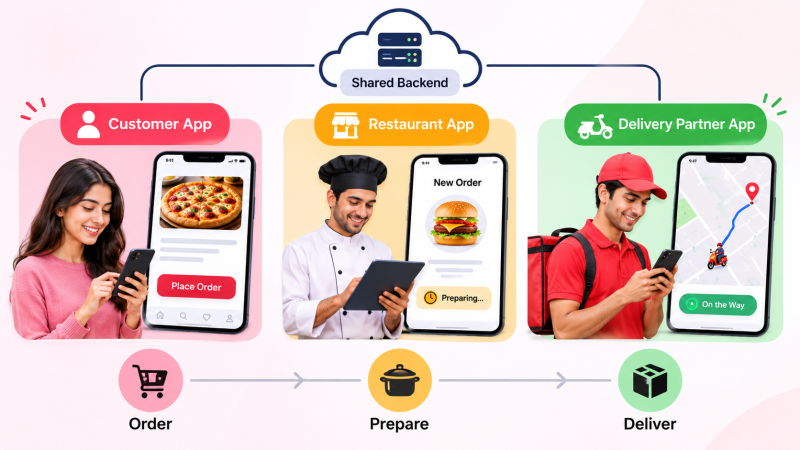
Customer order → Order management → Restaurant/POS → Kitchen → Delivery assignment → Tracking → Payment → Customer notification
When these stages share relevant data, businesses can spend less time transferring information manually and more time managing the actual operation.
Bring Orders, Kitchens, and Delivery Operations Into One Flow
One of the biggest advantages of integrated software is the ability to centralize order management.
Food delivery businesses often operate across several ordering channels. These may include a branded mobile app, website, third-party marketplaces, social channels, phone orders, and in-store ordering. Each channel can generate different volumes of orders, and managing them independently can create confusion during busy periods.
An integrated system can bring these orders into a central workflow. Instead of employees constantly checking multiple screens, orders can be routed to the appropriate restaurant or kitchen and then move through clearly defined stages.
The kitchen can receive the order with the correct items, modifiers, quantities, and special instructions. Once preparation begins, the order status can be updated. When it is ready, the delivery workflow can begin without requiring another round of manual coordination.
This type of connection is especially valuable during peak hours. A few manual mistakes may be manageable when a restaurant receives ten delivery orders, but the same process becomes difficult when dozens of orders arrive within a short period.
POS integration can also keep information synchronized. Menu availability, pricing, order details, and sales records can be connected rather than maintained independently. Industry guidance on restaurant POS integration highlights how centralized systems can reduce manual entry and make it easier to manage orders across different channels.
The kitchen is another important part of the equation. Orders should reach kitchen staff in a format that is easy to understand and prioritize. A kitchen display system or connected order workflow can reduce the need for employees to repeatedly check phones, tablets, or printed tickets.
The objective is not simply to collect orders in one place. It is to create a continuous operational flow from the moment a customer places an order until that order reaches the customer.
Connect Inventory, Payments, and Customer Data
Order management is only one part of an integrated food delivery system. Businesses also need accurate information about inventory, payments, customer behavior, and finances.
Consider a menu item that becomes unavailable during a busy evening. If inventory information is disconnected from the ordering channels, customers may continue ordering that item even though the kitchen cannot fulfill it. Employees then have to contact customers, offer alternatives, issue refunds, or cancel the order.
A connected system can make inventory information available across relevant channels and reduce these situations.
Inventory integration can also provide businesses with better visibility into ingredients and demand. When order information is connected to inventory records, managers can identify popular items, monitor stock movement, and make purchasing decisions based on actual sales patterns rather than assumptions.
Payments benefit from integration as well.
A food delivery business may need to manage customer payments, refunds, delivery fees, restaurant commissions, taxes, driver payouts, and promotional discounts. If these transactions exist across disconnected systems, reconciliation can become a time-consuming process.
An integrated platform can connect order information with payment records, making it easier to understand what was charged, what was refunded, and how revenue should be distributed.
Customer data is another major advantage.
When customers order through different channels, businesses can struggle to understand their complete relationship with those customers. An integrated system can provide a more unified view of order history, preferences, frequency, average order value, and other useful information.
That information can support more relevant marketing. A restaurant might identify customers who have not ordered recently, promote popular items to specific customer groups, or create loyalty programs based on actual purchasing behavior.
The important point is that integration turns isolated transactions into useful business information.
Improve Delivery Management and Customer Visibility
The delivery stage is where many food businesses experience operational pressure. Once an order leaves the kitchen, the business still needs to know who is delivering it, where the driver is, when the customer can expect it, and whether something has gone wrong.
An integrated delivery management system can connect order status with driver assignment and tracking.
For example, when an order becomes ready, the system can identify available delivery resources and assign the order according to defined rules. The driver can receive the relevant pickup information, while the customer can receive updates about the order's progress.
This creates visibility for all sides.
The restaurant knows whether an order has been collected. The driver knows which order needs to be delivered. The customer can see whether the order is being prepared, picked up, or delivered.
Without these connections, employees may need to call drivers, update customers manually, and search through separate systems to determine the current status of an order.
Delivery management software is increasingly designed around this centralized model, bringing together ordering, dispatch, tracking, and operational information rather than treating delivery as a completely separate process.
Route and dispatch capabilities can also become more important as order volume grows. Businesses with their own delivery fleet may need to consider driver availability, delivery zones, distance, estimated delivery time, and multiple orders being handled simultaneously.
The goal is not simply to make drivers move faster. It is to create a delivery process that uses available resources efficiently while keeping customers informed.
That customer visibility matters because uncertainty can damage the overall experience. A customer who knows that an order is delayed can respond differently from someone who receives no information and has no idea where the order is.
Give Businesses Better Data for Decision-Making
Integrated software creates another important advantage: businesses can make decisions using information from across the operation rather than relying on isolated reports.
A restaurant owner may want to know which ordering channel produces the most profitable orders, which dishes are most popular during certain periods, where delivery delays happen most frequently, or which customers are returning regularly.
When data exists across disconnected systems, answering these questions can require manual reports and spreadsheets.
An integrated system can make it easier to bring the information together.
Businesses can examine metrics such as order volume, average order value, preparation time, delivery time, cancellation rate, repeat orders, customer retention, and performance by location or channel.
These insights can influence operational decisions.
If a particular menu item generates high demand but consistently creates long preparation times, the restaurant might change its preparation process. If a specific delivery zone produces frequent delays, management may reconsider its delivery radius or driver allocation. If customers who order through a direct channel return more often, the business may invest more heavily in its own ordering experience.
Integration therefore has value beyond automation. It creates a stronger feedback loop between business activity and business decisions.
This is particularly useful for growing restaurant groups and multi-location food businesses. As the number of outlets increases, centralized systems can help standardize menus, delivery zones, pricing rules, reporting, and operational processes while still allowing individual locations to manage their day-to-day activity.
Build an Integrated Architecture That Can Grow With the Business
Integration does not mean connecting every possible tool simply because an API exists. Businesses need to decide which systems should communicate, what data should move between them, and which platform should remain the source of truth for each type of information.
A practical food delivery technology ecosystem may include a customer application, restaurant dashboard, delivery partner application, admin panel, backend services, payment gateway, mapping service, POS, kitchen display system, inventory platform, CRM, analytics tools, and third-party delivery channels.
These components need clear data flows.
For example, menu information may originate in the restaurant's management system and then be distributed to the customer app and website. Orders may move from customer channels into the central order management system and then into the POS or kitchen system. Delivery status may flow back through the backend to the customer application.
Good architecture also considers what happens when one integration fails.
If a payment service becomes temporarily unavailable, if a delivery partner does not respond, or if a POS connection breaks, the platform should have appropriate error handling instead of losing the order.
Scalability matters as well. A system that works for one restaurant and a few hundred orders may need significant changes when the business expands to multiple locations and thousands of daily orders.
For this reason, businesses should think about integration during the initial product architecture rather than treating it as an upgrade for later.
How Integrated Software Creates a Stronger Business
The biggest benefit of integrated software is not that it adds more technology. It reduces the gaps between the different parts of the business.
Customers receive clearer order updates. Restaurant employees spend less time re-entering information. Kitchens receive orders more efficiently. Delivery teams gain better visibility. Managers receive more complete operational data. Finance teams can reconcile transactions more easily.
These improvements can also work together.
Better order accuracy can reduce customer complaints. Better kitchen coordination can improve preparation times. Better delivery visibility can reduce uncertainty. Better customer data can support retention. Better reporting can help management identify where the operation needs improvement.
This is why businesses should evaluate software based on the entire customer-to-delivery journey rather than individual features.
A food delivery platform may have an attractive customer app, but if its restaurant workflow is inefficient, the business will eventually feel the consequences. Likewise, a sophisticated backend provides limited value if customers cannot easily place orders or track them.
The strongest systems connect both sides.
For businesses planning this kind of technology, Triple Minds can help bring product development, backend systems, mobile experiences, integrations, and business requirements together within a single development approach. The important objective is to build software around the actual operating model instead of simply adding disconnected digital tools.
Conclusion
Food delivery businesses are becoming increasingly dependent on software to coordinate customer orders, restaurant operations, kitchens, payments, inventory, and delivery. As order volume and the number of sales channels increase, disconnected systems can create unnecessary manual work and operational gaps.
Integrated software provides a more practical alternative. By connecting ordering channels with POS systems, kitchen workflows, inventory, payments, delivery management, customer data, and analytics, businesses can create a more consistent flow from order placement to delivery.
The goal should not be to build the most complicated technology stack. It should be to create a connected system where every important part of the food delivery operation can exchange the right information at the right time.
For growing businesses, this approach can provide a stronger foundation for efficiency, customer experience, data-driven decisions, and future expansion. With the right architecture and development partner, Triple Minds can help food delivery businesses turn separate operational processes into a more connected and scalable digital ecosystem.
Source:
Click for the: Full Story
You might like