Close Menu
 World
World
 Biography
 Health
 Education
 Business
 Lifestyle
 Sports
 Technology
 Animals
 History
 Food
Food
 Religious
 Startups
 Movies
 Politics
 Fashion
 Covid
Covid
 Diet
Diet
 Fitness
 Marketing
 Travel
 Science
 Reviews
 Social media
 Stories
 Facts
Facts
 Art
Art
 Entertainment
Mamta Devi

Business
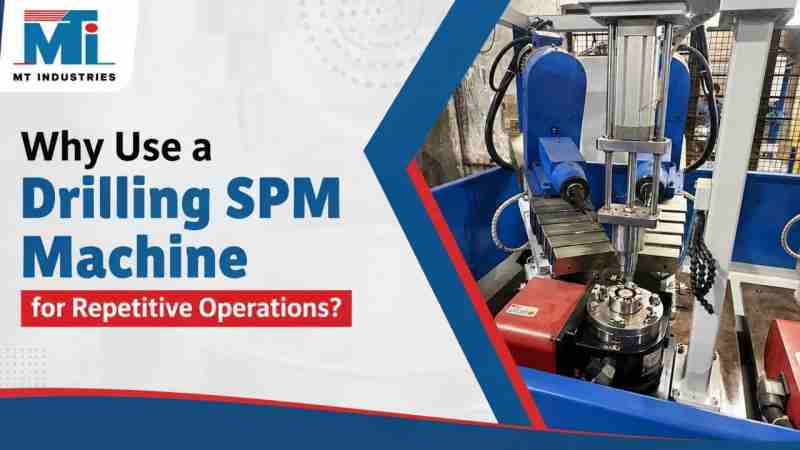
Why Use a Drilling SPM Machine for Repetitive Operations?
 Mamta Devi
Repetitive drilling is common in industries that manufacture metal components, automotive parts, machine components, electrical fittings, and other precision-engineered products. When the same holes must be drilled repeatedly across hundreds or thousands of components, manual or conventional drilling can become time-consuming and inconsistent.
A Drilling SPM Machine is designed specifically for such repetitive operations. By combining dedicated tooling, controlled movement, and automated drilling cycles, it can help manufacturers achieve more consistent results while reducing unnecessary handling and cycle time.
For production environments where the same drilling pattern is repeated continuously, choosing the right machine is not simply about drilling faster. It is about achieving the required accuracy, repeatability, productivity, and process stability.
What Is a Drilling SPM Machine?
A Drilling SPM Machine is a Special Purpose Machine designed to perform drilling operations for a specific component, process, or production requirement. Unlike general-purpose drilling machines, an SPM is generally configured around the workpiece and the required operation.
The machine may incorporate:
- Dedicated fixtures
- Automatic or semi-automatic feeding
- Multiple drilling stations
- Multi Drilling Head configurations
- Hydraulic, pneumatic, or servo-based movements
- Coolant systems
- Sensors and safety mechanisms
- Programmable controls
The exact configuration depends on the component, hole diameter, material, production volume, required cycle time, and level of automation.
The biggest advantage is process specialization. Instead of manually positioning every component and drilling each hole separately, the machine can be engineered to perform a defined sequence repeatedly.
Why Are SPM Machines Useful for Repetitive Drilling?
Repetitive operations place different demands on production equipment than occasional drilling. Operators may need to load similar components repeatedly, position them accurately, perform the drilling operation, inspect the result, and repeat the process.
A properly designed Drilling SPM Machine can standardize much of this workflow.
1. Consistent Hole Positioning
One of the biggest challenges in repetitive drilling is maintaining consistent hole location.
Small positioning variations can occur when components are manually aligned or clamped. Over a large production batch, these variations may result in rejected components or additional inspection work.
An SPM uses dedicated fixtures and controlled tooling to establish a repeatable relationship between the workpiece and drilling tool.
This helps maintain consistent:
- Hole location
- Hole spacing
- Drilling depth
- Component orientation
- Tool movement
For precision applications, fixture design and machine rigidity remain just as important as the drilling unit itself.
2. Reduced Cycle Time
Production efficiency is closely connected to cycle time—the time required to complete one production cycle.
A conventional setup may require several individual steps:
- Position the component.
- Clamp it.
- Align the drilling point.
- Drill the hole.
- Retract the tool.
- Unclamp the component.
- Reposition for the next operation.
A purpose-built Drilling SPM Machine can combine several of these activities into a defined sequence.
When multiple holes need to be produced on the same component, a Multi Spindle Drilling Machine can be particularly useful. Multiple spindles allow several drilling operations to be performed during the same machine cycle, depending on the component geometry and process requirements.
The actual productivity improvement depends on factors such as spindle speed, feed rate, tool selection, loading method, and component design.
3. Multiple Holes Can Be Drilled Efficiently
Some components require several holes at predetermined locations. Drilling these holes individually can increase handling and positioning time.
A Multi Drilling Head can provide a solution by allowing multiple drilling tools to operate together.
For example, if a component requires several holes with a fixed positional relationship, the drilling head can be configured around that pattern. Instead of moving the component repeatedly between drilling positions, multiple holes may be processed in one operation.
This can help reduce:
- Manual repositioning
- Loading and unloading time
- Alignment variations
- Non-productive movement
However, the number of spindles should not be selected simply because "more spindles" sounds better. The spindle arrangement must match the component's hole pattern, available space, tooling requirements, and machine capacity.
4. Better Repeatability in High-Volume Production
Repeatability is particularly important when thousands of similar components are manufactured.
A Precision Multi Drill Spindle arrangement can help maintain a fixed drilling relationship between multiple tools. When the tooling, fixture, and machine structure are properly designed, each cycle can follow the same basic process.
This is valuable for industries where components must remain dimensionally consistent across production batches.
However, repeatability depends on more than machine automation. Tool wear, fixture condition, spindle alignment, material variation, coolant performance, and maintenance can all affect the final result.
That is why production teams should evaluate the complete drilling system rather than focusing only on the machine's headline specifications.
5. Less Operator Dependency for Repetitive Tasks
Repetitive drilling can place a significant workload on operators, especially when the process requires constant positioning and manual drilling.
Automation can shift the operator's role from manually controlling every drilling movement toward:
- Component loading
- Process monitoring
- Tool inspection
- Quality checks
- Routine maintenance
This does not necessarily mean removing operators from the process. Instead, it allows skilled personnel to focus more on process control and quality rather than repetitive machine movements.
MT Industries approaches SPM solutions around application-specific production requirements, making factors such as component geometry, drilling pattern, and desired production cycle important considerations when defining a machine configuration.
6. Improved Process Standardization
Manufacturing quality depends heavily on process consistency.
If different operators use slightly different positioning methods or drilling sequences, production results can vary. A dedicated SPM can standardize the operating sequence so that the same basic process is followed from cycle to cycle.
This makes it easier to establish:
- Standard operating procedures
- Defined cycle times
- Inspection points
- Tool-change schedules
- Maintenance routines
- Production benchmarks
Standardization also makes it easier to identify process deviations when something goes wrong.
7. Suitable for Industry-Specific Applications
A major advantage of Special Purpose Machines is their ability to be configured around a particular production requirement.
A Drilling SPM Machine can be developed for applications involving components used in sectors such as:
- Automotive manufacturing
- Engineering
- Electrical equipment
- Agricultural machinery
- Industrial equipment
- Fabrication
- General component manufacturing
The machine configuration can vary significantly between applications. A component requiring four simultaneous holes will have different requirements from one requiring sequential drilling at multiple angles.
Therefore, application engineering should come before machine selection.
What Should You Consider Before Choosing a Drilling SPM Machine?
Choosing an SPM requires more than comparing drilling capacity. Manufacturers should first understand their actual production requirements.
Component Specifications
Consider:
- Component dimensions
- Material type
- Component weight
- Hole diameter
- Hole depth
- Number of holes
- Hole-to-hole distance
- Required positional accuracy
Production Volume
A highly automated machine may make more sense for large-volume production than for low-volume or frequently changing jobs.
Estimate your expected:
- Daily production
- Monthly production
- Required cycle time
- Machine utilization
- Future production requirements
Tooling and Spindle Requirements
For multiple-hole applications, determine whether a Multi Spindle Drilling Machine, individual drilling stations, or a Multi Drilling Head would be more appropriate.
Tool selection should also consider material hardness, hole size, drilling depth, coolant requirements, and expected tool life.
Machine Accuracy and Rigidity
Machine rigidity influences drilling stability, particularly when working with harder materials or demanding tolerances.
Ask about:
- Spindle accuracy
- Fixture rigidity
- Guide systems
- Machine construction
- Tool holding
- Alignment procedures
Automation Level
Automation can range from basic semi-automatic operation to integrated production systems.
Depending on requirements, the machine may include automatic component loading, sensing, drilling, unloading, and quality monitoring.
How to Maintain a Drilling SPM Machine for Consistent Results
Even a well-designed machine requires proper maintenance.
A practical maintenance program should include:
Tool inspection: Check cutting tools regularly for wear, chipping, or damage.
Fixture inspection: Ensure components are positioned and clamped consistently.
Lubrication: Follow the manufacturer's recommended lubrication schedule.
Coolant management: Maintain appropriate coolant concentration and cleanliness where applicable.
Spindle checks: Monitor unusual vibration, noise, heat, or runout.
Fastener inspection: Check critical mechanical connections periodically.
Accuracy verification: Conduct periodic dimensional checks to identify gradual process drift.
MT Industries also highlights the importance of designing machines around practical manufacturing requirements rather than treating every drilling application as identical.
Is a Drilling SPM Machine Worth It for Repetitive Operations?
For manufacturers producing large quantities of similar components, a Drilling SPM Machine can be a practical way to improve process consistency and production efficiency.
The strongest business case usually comes when:
- The same operation is repeated frequently.
- Component geometry remains relatively consistent.
- Production volume justifies dedicated equipment.
- Manual drilling creates unnecessary cycle time.
- Multiple holes can be processed more efficiently.
- Consistent positioning is important.
- Labour-intensive handling limits production capacity.
However, an SPM is not automatically the right solution for every manufacturer. Low-volume production, frequent component changes, highly variable drilling patterns, or very complex geometries may favor more flexible equipment.
The right choice should therefore be based on total production requirements, not simply machine capacity.
Conclusion
Repetitive drilling requires consistency, controlled positioning, and efficient production flow. A properly designed Drilling SPM Machine can address these requirements by combining dedicated fixtures, controlled drilling cycles, specialized tooling, and automation.
For applications involving multiple holes, technologies such as a Multi Spindle Drilling Machine, Multi Drilling Head, or Precision Multi Drill Spindle can further streamline the drilling process.
The key is to match the machine configuration with the component, material, hole pattern, production volume, tolerance requirements, and desired cycle time.
For manufacturers evaluating an SPM, the best approach is to first map the existing drilling process, identify its biggest productivity or consistency limitations, and then determine which level of automation and tooling provides a measurable improvement.
Frequently Asked Questions
1. What is the main advantage of a Drilling SPM Machine?
The main advantage is process specialization. A Drilling SPM Machine can perform repetitive drilling operations with controlled positioning and consistent cycles, potentially reducing handling and production time.
2. When should I use a Multi Spindle Drilling Machine?
A Multi Spindle Drilling Machine is useful when a component requires multiple holes that can be drilled simultaneously or through a coordinated drilling sequence. It is particularly suitable for repetitive, higher-volume production.
3. What is a Multi Drilling Head used for?
A Multi Drilling Head holds multiple drilling tools in a configured arrangement. It can allow several holes to be produced during the same operation when the component geometry and hole pattern permit it.
4. How does a Precision Multi Drill Spindle improve production?
A Precision Multi Drill Spindle can maintain a defined relationship between multiple drilling tools, helping produce consistent hole patterns while reducing repeated positioning and handling.
5. How can MT Industries help with drilling SPM requirements?
MT Industries develops industrial machinery around specific manufacturing applications. When evaluating a drilling SPM, manufacturers should discuss component dimensions, material, hole pattern, production volume, accuracy requirements, and desired automation level to determine a suitable configuration.
For More Information Click Here:- https://mtindustries.in/service-drilling
Source:
Click for the: Full Story
You might like