


 Close Menu
 World
 Biography
 Health
 Education
 Business
 Lifestyle
 Sports
 Technology
 Animals
 History
 Food
 Religious
 Startups
 Movies
 Politics
 Fashion
 Covid
 Diet
 Fitness
 Marketing
 Travel
 Science
 Reviews
 Social media
 Stories
 Facts
 Art
 Entertainment
Priyanshu codebrew
Business
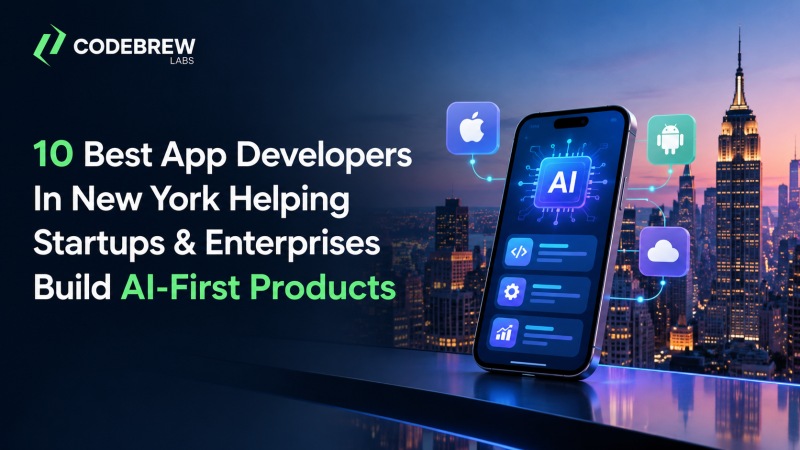
10 Best App Developers in New York Helping Startups & Enterprises Build AI-First Products
 Priyanshu codebrew
New York’s startup scene is moving beyond apps that put existing services on a screen. Founders are building products around AI assistants, smarter search, personalized recommendations, predictive analytics, and automated workflows. Enterprises have their own priorities: bringing AI into established systems, protecting sensitive information, and turning promising prototypes into tools people can rely on every day.
Choosing a development partner for this kind of work takes more than spotting “AI development” on a company’s services page. You need a team that understands the product, knows how to work with data, and can make sound decisions about models, architecture, and user experience. Getting a demo to work is one thing. Building a product people will keep using is another.
If you're exploring app developers in New York, the ten companies below are worth considering for different reasons. Some focus on digital product design and mobile development; others bring broader software engineering capabilities that can support more complex AI projects. Not every firm is headquartered in New York, so check its current delivery arrangements if local, in-person collaboration matters to you.
What Makes an App Development Company Genuinely AI-First?
An AI-first product is built around an intelligent capability that improves how people use it or how a business operates. AI isn't an extra feature added at the end simply because it sounds impressive.
Take customer support software. A conventional app might let customers submit tickets and check their status. An AI-first version could categorize requests, find relevant answers in approved company documents, draft responses based on the conversation, and send complicated cases to a human agent. That takes thoughtful engineering, not just an API connection.
Here are four capabilities worth looking for.
LLM Integration and AI Application Engineering
A capable team should understand large language models (LLMs), retrieval-augmented generation (RAG), conversation context, and response evaluation. It should also know when a hosted model makes sense, when an open-source alternative is worth exploring, and when ordinary search or rule-based logic would do the job better.
Machine Learning and Data Infrastructure
Predictive products need reliable data, suitable models, and a way to measure performance over time. Ask how a development partner will collect, clean, store, secure, and monitor data as the application grows. Weak data infrastructure can undermine an otherwise promising AI product.
Product Thinking Beyond the Prototype
A convincing demo is a starting point, not proof that the product is ready. Real applications have to deal with slow responses, inference costs, inaccurate outputs, accessibility, and situations where the AI cannot provide a useful answer. Some workflows will also need human review.
Security, Privacy, and Production Readiness
Before sharing customer or enterprise data with an AI system, establish how it will be handled. Access controls, encryption, data retention, third-party model providers, and deletion policies all deserve attention. Depending on the industry, regulatory requirements may influence the architecture from the beginning.
These considerations apply whether you're launching an AI startup from scratch or adding intelligent features to an established enterprise application.
10 Best App Developers in New York for AI-First Products
1. Code Brew Labs
Best for: Startups and enterprises building AI-powered mobile and web products
Code Brew Labs is worth considering if your product needs more than a chatbot or a standalone AI model. Its development services cover AI and machine learning, generative AI, AI agents, custom software, and native and cross-platform mobile applications. The company also supports product discovery, UI/UX design, development, and deployment, which can help businesses move from an early concept to a working application.
For startups, that combination can be useful. An AI-powered marketplace, for instance, might need intelligent recommendations alongside user accounts, payment processing, APIs, an administrative dashboard, and mobile apps. Code Brew Labs works with technologies such as Flutter and React Native, giving businesses options for building across iOS and Android without maintaining two completely separate codebases when a cross-platform approach is appropriate.
The company has also worked on AI-enabled healthcare applications combining teleconsultation, appointment management, and electronic medical record synchronization. Projects like these highlight an important point: AI features rarely operate in isolation. They need to fit into established workflows, integrate with other systems, and account for the sensitivity of the information involved.
For enterprises, Code Brew Labs' broader development capabilities may be useful when AI needs to connect with existing business processes. Startups should discuss engagement options, delivery milestones, ownership, and the team's experience with comparable products. A phased approach, beginning with a proof of concept and progressing to a minimum viable product (MVP), can help validate assumptions before a larger investment.
2. Dubai App Developer
A mobile development option for companies looking for app delivery alongside broader system integration.
Dubai App Developer focuses on mobile applications and related technology services, including AI-enabled features, cloud solutions, and enterprise integrations. For a business building a customer-facing application that must communicate with existing operational systems, this combination deserves consideration.
For example, a service marketplace might need customer and provider apps, an administrative dashboard, payment processing, notifications, and integrations with scheduling or customer relationship management software. The challenge isn't simply building individual screens; it's ensuring the components work together reliably. A development partner should be able to explain the data flow, access controls, failure handling, and monitoring behind that experience.
When assessing this company, ask to see examples of applications with comparable complexity. Find out whether it offers product discovery and UX research, who handles backend engineering, and whether its developers have experience supporting apps after release. Also establish how time-zone differences and stakeholder meetings would be managed if your team operates in New York.
Dubai App Developer may suit businesses seeking mobile development with integration-heavy requirements, particularly those considering international delivery teams. Treat New York availability, relevant client references, and project ownership as items to verify during your evaluation.
3. Royo Apps
An option to investigate for on-demand services and marketplace-style applications.
Royo Apps is associated with ready-made and customized digital product solutions for on-demand business models. That makes it relevant to founders exploring concepts such as delivery platforms, appointment-booking services, service-provider marketplaces, or applications that connect customers with local businesses.
These products share several engineering challenges. A marketplace may need separate experiences for customers, vendors, and administrators, along with location-based discovery, order management, payments, notifications, ratings, and operational reporting. The underlying workflows must remain consistent even when users interact with different parts of the platform.
A packaged starting point can help businesses validate demand without building every feature from scratch. However, founders should examine the trade-offs carefully. Ask which features are configurable, whether custom source-code changes are possible, how third-party integrations are handled, and what recurring licensing or maintenance fees apply. A fast initial launch is less valuable if the platform becomes expensive or restrictive when the business grows.
Royo Apps may be a fit for entrepreneurs and established service businesses evaluating on-demand or marketplace products. Before committing, request a demonstration of the actual product architecture and a clear explanation of the difference between a ready-made solution and a fully custom application.
4. Blocktech Brew
A candidate for products that bring mobile applications together with blockchain or other emerging technologies.
Blocktech Brew focuses on blockchain-related solutions and emerging technology services. For companies exploring digital assets, tokenized ecosystems, decentralized applications, or mobile products that interact with blockchain infrastructure, that specialization may be more relevant than a general-purpose app agency.
Consider a mobile application that lets users view digital assets, manage transactions, or interact with blockchain-based records. The user interface must make complex operations understandable, while the engineering team must account for transaction confirmation, wallet security, network fees, key management, and the consequences of irreversible actions. These are product and security decisions, not merely development tasks.
If you're considering this company, ask how it approaches security reviews, smart-contract testing, external audits, and recovery procedures. Clarify which components it builds directly and which rely on third-party services. A blockchain label alone doesn't establish that a provider has the experience required for a production financial application.
Blocktech Brew is worth assessing for businesses whose mobile product depends on blockchain or Web3 functionality. It may be less relevant if your requirements are limited to a conventional business app, customer portal, or standard e-commerce experience.
5. Switch to Future
Best for: Startups looking for mobile, web, and AI development under one roof
Switch to Future presents itself as a software and AI studio working on mobile applications, web platforms, and cloud products. Its service offering includes chatbots, workflow automation, intelligent applications, product design, and end-to-end development.
For an early-stage company, having these capabilities coordinated within one team can make the development process easier to manage. A service marketplace, for example, might require a mobile app, a cloud backend, and AI-assisted customer support. Each component needs to work with the others, and decisions made early can affect the cost of scaling later.
The important question is how the company handles AI beyond initial implementation. Ask about model evaluation, deployment, monitoring, and maintenance, then look for relevant examples before deciding whether the team fits your product.
6. Tidecove Studio
Best for: Early-stage businesses and focused product teams
Tidecove is a New York City-based product studio working with founders, investors, and enterprise teams. Its services include mobile and web applications, MVPs, prototypes, LLM integrations, AI agents, workflow automation, and recommendation systems.
A smaller studio can be appealing when founders want direct access to the people making product and technical decisions. Instead of starting with a large development program, a team can focus on a specific problem, test its assumptions, and work toward a defined first release.
Tidecove is worth exploring if you want product strategy and AI engineering considered together from the beginning. Ask to see a comparable implementation and discuss what happens after launch, including model updates, performance monitoring, and ongoing application support.
7. Utility
Best for: Custom mobile apps and enterprise digital experiences
Utility is a New York app development agency that brings together product strategy, design, software development, and digital transformation. Its broad service offering makes it relevant to companies that need a custom application with AI capabilities built into the overall product.
For a startup, that might mean developing a new mobile service with intelligent recommendations or AI-assisted interactions. An enterprise could be looking to add AI to an established customer-facing platform without disrupting the experience people already know.
As with any agency offering a wide range of services, look closely at the team proposed for your project. Ask who will handle AI architecture, data integration, testing, and ongoing evaluation. It's worth confirming these responsibilities before the project scope and budget are finalized.
8. BairesDev
Best for: Growing engineering teams and complex AI implementations
BairesDev provides software development teams for businesses across multiple industries. Its AI capabilities cover machine learning, generative AI, custom LLM applications, AI agents, predictive analytics, and business process automation. Businesses can explore different delivery arrangements, including dedicated engineering teams and full-project development.
This flexibility can help companies that already have product managers and internal developers but need additional AI expertise. A startup with an ambitious technical roadmap may also need a mix of frontend, backend, data, and AI engineering skills that would be difficult to hire all at once.
BairesDev is worth evaluating when the project extends beyond the user interface into data pipelines, integrations, and production deployment. Before signing, discuss team continuity, technical leadership, working-hour overlap, and who will be responsible for maintaining the system after launch.
9. EPAM Systems
Best for: Enterprise AI applications and complex digital transformation projects
EPAM Systems is an established software engineering and digital transformation provider serving large organizations and businesses developing sophisticated digital products. Its broad engineering capabilities make it a potential fit for AI initiatives involving cloud infrastructure, application development, system integration, and changes to established business processes.
Consider a financial services company developing AI-assisted document processing. It may need secure access to internal systems, detailed audit trails, user permissions, performance monitoring, and an interface that fits existing employee workflows. The AI model is only one part of the solution; the surrounding software needs to be designed just as carefully.
EPAM is worth considering when a project spans multiple systems or departments. Smaller startups should check whether the proposed team size, engagement structure, and budget fit their needs. An enterprise-scale provider can be suitable for a complex product, but it may not be the most practical choice for a narrowly scoped MVP.
10. Vention
Best for: Businesses that need dedicated software engineering and AI expertise
Vention is a software engineering company that businesses can consider when they need additional development capacity for complex digital products. Its engineering-led approach may suit projects that require application development, technical architecture, and specialist skills working together.
AI products vary considerably in their technical demands. A recommendation engine needs a different approach from a generative AI assistant, while predictive analytics depends heavily on the available data and the quality of the underlying models. A development partner should understand those differences rather than propose the same solution for every use case.
Vention may suit companies looking to expand an existing engineering team or assemble a dedicated group for a new product. Ask about hands-on AI experience, architecture responsibilities, data requirements, and whether ongoing model monitoring and application maintenance are part of the engagement.
How Should Startups Choose an AI-First App Development Partner?
A convincing proposal should explain how the product will work, what it will cost to run, and how the team plans to measure its performance. AI terminology alone isn't enough.
1. Who Will Build the AI Components?
Ask to meet the people responsible for AI architecture, backend engineering, data infrastructure, and application development. If a team can build the interface but lacks the expertise to manage the AI system, problems may become difficult to resolve once the product is in use.
A small MVP team may combine several responsibilities. A regulated or data-intensive enterprise project, on the other hand, may require dedicated AI, security, and data specialists.
2. Can the Company Demonstrate Relevant Production Experience?
Ask for examples that match the problem you're trying to solve. For an LLM-powered assistant, look for experience with retrieval, access permissions, response evaluation, and reducing hallucinations. For a predictive product, ask about training data, model performance, and how the team responds when the underlying data changes.
A polished demo is encouraging. A working product with a clear explanation of its architecture is more useful.
3. How Will Customer Data Be Protected?
Find out where information will be stored, which model providers will receive it, and whether customer data may be used for model training. Discuss encryption, access controls, retention policies, audit logging, and deletion procedures.
If your product operates in healthcare, financial services, or another regulated industry, identify the relevant compliance requirements before development begins. Retrofitting privacy and security controls later can be expensive.
4. What Does the Pricing Model Include?
Compare fixed-price milestones, dedicated teams, and time-and-materials arrangements in light of your project's uncertainty. Each model has trade-offs, and the cheapest initial quote may not reflect the full cost of delivery.
For a new AI-first product, starting with discovery and a limited proof of concept can be a sensible way to test feasibility. If the results are promising, move into an MVP with clear acceptance criteria. Remember to budget for model usage, cloud hosting, third-party services, monitoring, and maintenance as well as the initial build.
5. How Will Success Be Measured?
Agree on meaningful outcomes before development starts. Depending on the product, those might include response accuracy, task completion, user retention, processing time, support costs, or the cost of each AI request.
Ask what happens when a model produces a poor answer, a service becomes unavailable, or operating expenses climb. A production-ready application needs sensible fallback behavior and a plan for improving performance over time.
Final Thoughts
New York offers startups and enterprises plenty of opportunities to build AI-first products, but the right development partner depends on the problem you're trying to solve. A founder validating a new idea may need a compact team that can test assumptions quickly. An enterprise introducing AI into sensitive workflows may need deeper expertise in security, data infrastructure, and integration with existing systems.
Start with the business need, not the technology trend. Compare relevant project experience, ask how the team handles failure cases, and make sure the budget accounts for running and maintaining the product after launch.
The right app development partner won't simply add AI to your application. They'll help you decide where it belongs, build an experience people can use, and create a product that holds up beyond the first demo.
Source:
Click for the: Full Story
You might like







You Might Like this