


 Close Menu
 World
 Biography
 Health
 Education
 Business
 Lifestyle
 Sports
 Technology
 Animals
 History
 Food
 Religious
 Startups
 Movies
 Politics
 Fashion
 Covid
 Diet
 Fitness
 Marketing
 Travel
 Science
 Reviews
 Social media
 Stories
 Facts
 Art
 Entertainment
samiksha

Business
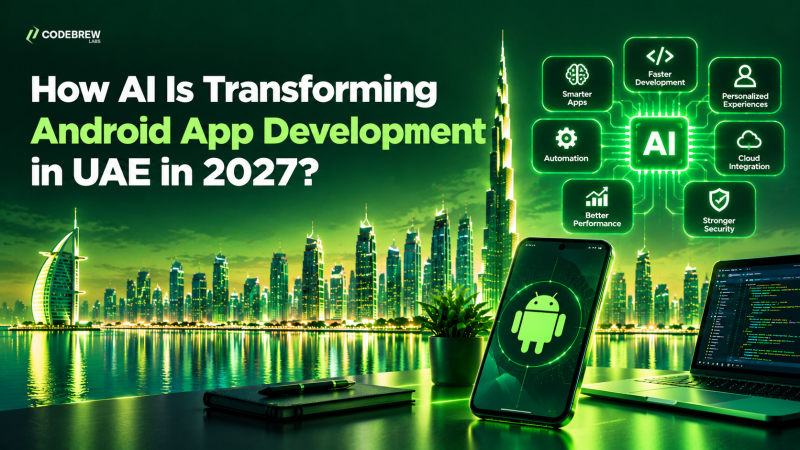
How AI Is Transforming Android App Development in UAE in 2027?
 samiksha
Artificial intelligence is revolutionizing mobile applications by enabling advanced features that automate tasks, personalize content, and improve user efficiency. In the UAE, sectors such as retail, healthcare, real estate, logistics, and fintech are investing in digital solutions, with AI becoming essential for Android app development.
By 2027, businesses will seek apps that not only display information but also understand user requests, provide recommendations, automate workflows, and integrate with existing systems.
For companies developing new mobile products, these trends are crucial for informed technology decisions. Collaborating with an experienced Android app development company can help identify suitable AI features and ensure seamless integration without complicating the user experience.
This article explores how AI is transforming Android app development in UAE in 2027, the benefits businesses can expect, and the important factors to consider when building AI-powered applications.
Why AI Is Becoming Important for Android App Development in UAE
The UAE has a diverse business environment, with companies serving both local customers and international markets. Mobile applications provide a convenient way to deliver services, communicate with customers, manage transactions, and support employees.
However, users increasingly expect applications to be responsive, easy to navigate, and relevant to their needs. Traditional app features may not be enough for businesses looking to differentiate their products.
AI can help address this challenge by introducing capabilities such as natural language interaction, personalized recommendations, intelligent search, and automated assistance.
For example, an eCommerce app could recommend products based on a user's interests, while a property platform might help customers find listings based on their preferences. A logistics application could use predictive analytics to identify potential delivery delays.
These features are not necessary for every application. Their value depends on the business problem being addressed, the available data, and the expectations of the intended users.
1. Personalized Mobile App Experiences
Personalization is one of the most practical applications of AI in Android development. Instead of presenting identical content to every user, an application can use relevant information and behavioral patterns to tailor selected parts of the experience.
An eCommerce application, for instance, may recommend products based on previous purchases, browsing activity, or stated preferences. A travel app might suggest destinations based on a user's interests, while a learning platform could recommend educational content according to progress.
For UAE businesses serving customers from different backgrounds, personalization may also help organize content around language preferences, location, or service requirements, provided the information is collected and used appropriately.
Developers need to consider privacy, transparency, and user control when implementing these features. Users should be able to manage relevant preferences, and businesses should avoid collecting unnecessary information.
When designed carefully, AI-driven personalization can make an Android application more relevant while helping businesses understand what their customers need.
2. AI Chatbots and Virtual Assistants
Customer support is another area where AI is influencing mobile applications. Many businesses receive repeated questions about pricing, bookings, delivery updates, product availability, and account management.
An AI-powered assistant can help answer common questions, guide users through selected processes, and direct more complicated requests to human support teams.
For example, a real estate application could allow users to ask about property features or arrange a viewing. A retail app might help customers check order information, while a service-booking platform could guide users through appointment selection.
Modern conversational systems can interpret natural language, making it easier for users to interact without navigating multiple menus.
However, these assistants need appropriate safeguards. Businesses should ensure that answers are relevant, sensitive information is protected, and users can reach a human representative when necessary.
For an Android app development project, the best approach is to identify the support tasks that can be handled reliably through automation and establish clear limits for the assistant.
3. Smarter Search and Voice Interaction
Traditional search features often depend on users entering exact words or selecting filters. AI can make search more flexible by helping applications interpret the intent behind a request.
For example, a property app user might search for a family-friendly apartment near public transport rather than entering several separate filters. An online shopping application could help customers find products using descriptive phrases.
Voice interaction can provide another way to search, navigate, or complete selected tasks. This can be useful when users prefer speaking rather than typing or need a more convenient way to access information.
Android applications can use suitable speech recognition and language-processing services to support these features. The implementation depends on the application's requirements, language coverage, network conditions, and privacy considerations.
Businesses serving multilingual audiences in the UAE should test language support carefully rather than assuming that every AI service performs equally well across languages and regional variations.
4. Predictive Analytics for Better Business Decisions
AI can help mobile applications identify patterns in historical data and generate predictions that support business planning. This capability is known as predictive analytics.
For example, a retail application may help estimate product demand, while a logistics platform could analyze historical delivery information to identify possible delays. A fitness application might use activity patterns to suggest suitable goals, subject to the quality of its data and appropriate user consent.
For businesses, these capabilities can improve the information available to employees and customers. They may also help teams identify operational issues earlier.
However, predictions are not guarantees. Results depend on data quality, model performance, changing conditions, and how the predictions are used.
Developers should test models against realistic scenarios, monitor their performance, and communicate uncertainty where it matters. Businesses should also determine whether predictions should trigger automated actions or simply provide recommendations for human review.
5. AI-Powered Automation Within Android Apps
AI can work alongside conventional automation to simplify repetitive tasks. While rule-based automation follows predefined instructions, AI can help interpret unstructured information, classify requests, or generate suggestions before a workflow continues.
Consider a business application that receives customer documents. AI could help categorize the files, extract selected information, and route them to the relevant department. Employees could then review the results before approving the next step.
In a logistics application, intelligent systems might organize incoming requests or flag unusual shipment patterns. A customer relationship management app could summarize selected interactions to help employees prepare for follow-up conversations.
The key is to identify tasks where automation can reduce manual effort without introducing unacceptable risks.
An Android app development company should assess how the AI component will connect with the application's existing workflows, how errors will be handled, and which decisions require human approval.
6. Improved Security and Fraud Detection
Security is an essential part of mobile application development, particularly for apps that handle payments, personal information, or business transactions.
AI-based systems can help analyze patterns and flag activity that differs from expected behavior. Depending on the use case, this may support fraud detection, suspicious login monitoring, or risk-based alerts.
For example, a financial application could use an appropriate detection system to identify unusual transaction patterns for further review. A business platform might flag repeated access attempts that require additional verification.
These systems should complement established security measures rather than replace them. Secure authentication, encryption, access controls, application testing, and timely updates remain important.
Businesses should also consider false positives, privacy implications, and the need for human review. An automated system that incorrectly blocks legitimate users can create significant inconvenience.
In the UAE, organizations should evaluate applicable privacy laws and sector-specific requirements when planning applications that process sensitive information.
7. AI Integration With Cloud and Existing Business Systems
Many AI features depend on access to data, computing resources, or specialized services. Cloud platforms and APIs can help Android applications connect with these capabilities without requiring every operation to run directly on the user's device.
For example, an application might connect to an AI service for conversational assistance, use a cloud database to retrieve relevant information, and send approved updates to an existing business platform.
Some AI tasks can also run directly on compatible devices. On-device processing may support selected features while reducing network dependence or limiting the need to send certain information to external services.
The right approach depends on performance requirements, device compatibility, data sensitivity, connectivity, and operating costs.
Businesses should also consider what happens when a service is unavailable. Core application features should remain usable wherever practical, and the system should handle network failures or unexpected responses gracefully.
8. Better App Testing and Development Workflows
AI is influencing not only the features inside applications but also parts of the development process.
Development teams may use AI-assisted tools to help draft code, identify potential defects, generate test cases, summarize technical documentation, or review repetitive tasks. These tools can support productivity, but their output still requires professional review and testing.
For Android applications, quality assurance should cover different device sizes, operating system versions, network conditions, accessibility requirements, and user journeys.
AI-powered features require additional testing. Developers need to check response accuracy, inappropriate outputs, performance, data handling, and how the application behaves when an AI service returns an unexpected result.
Using AI during development does not remove the need for sound architecture, code reviews, security checks, and user testing. The goal is to improve the workflow while maintaining software quality.
Industries Benefiting From AI-Powered Android Apps in UAE
AI-enabled Android applications can support different business needs across the UAE.
- Healthcare: Administrative assistance, appointment management, and selected patient communication workflows.
- Real estate: Property recommendations, conversational search, and lead management.
- Retail and eCommerce: Product discovery, personalized recommendations, and customer support.
- Logistics: Delivery forecasting, operational alerts, and shipment information management.
- Fintech: Transaction monitoring, customer assistance, and selected risk analysis workflows.
- Education: Personalized learning recommendations, study assistance, and administrative automation.
These examples illustrate possible applications rather than guaranteed outcomes. Each organization should assess its data, technical requirements, compliance obligations, and users before selecting a particular AI feature.
How to Choose an Android App Development Company for AI Projects
Selecting a development partner is an important step in building a reliable AI-powered Android application. Businesses should assess both mobile development expertise and the ability to implement AI responsibly.
Consider the following factors:
Technical experience: Review experience with Android development, APIs, cloud platforms, AI integration, and relevant programming technologies.
Relevant project portfolio: Ask for examples of applications with similar requirements, integrations, or user needs.
Data security: Understand how the provider plans to protect user information, manage permissions, and work with third-party AI services.
Scalability: Ensure the application can accommodate additional users, features, and integrations as the business grows.
Transparent pricing: Request details about development costs, AI service usage, cloud infrastructure, testing, and maintenance.
Post-launch support: Confirm how bugs, security updates, model changes, and future improvements will be managed.
Dubai-headquartered Code Brew Labs is one option businesses can explore for mobile application development, AI solutions, custom software, cloud development, and automation. Established in 2013, the company works with startups, SMEs, enterprises, and global businesses. Prospective clients should review its current portfolio and service capabilities to determine whether it suits their specific Android app requirements.
Conclusion
AI is transforming Android app development in UAE by introducing more personalized interfaces, conversational assistance, predictive insights, intelligent automation, and additional security capabilities. In 2027, these technologies will offer businesses more ways to improve digital services and respond to changing customer expectations.
However, successful AI adoption requires more than adding new features. Businesses should define clear objectives, select appropriate technologies, protect user information, and test applications thoroughly before launch.
Code Brew Labs helps businesses explore tailored digital products through services that include mobile application development, AI solutions, custom software, cloud technologies, and automation. With the right development strategy and a suitable technology partner, UAE businesses can create Android applications that meet current needs while remaining adaptable to future opportunities.
The most valuable AI-powered application is one that solves a genuine problem, provides a useful experience, and supports measurable business goals.
Source:
Click for the: Full Story
You might like








You Might Like this