


 Close Menu
 World
 Biography
 Health
 Education
 Business
 Lifestyle
 Sports
 Technology
 Animals
 History
 Food
 Religious
 Startups
 Movies
 Politics
 Fashion
 Covid
 Diet
 Fitness
 Marketing
 Travel
 Science
 Reviews
 Social media
 Stories
 Facts
 Art
 Entertainment
Ai agent
Technology
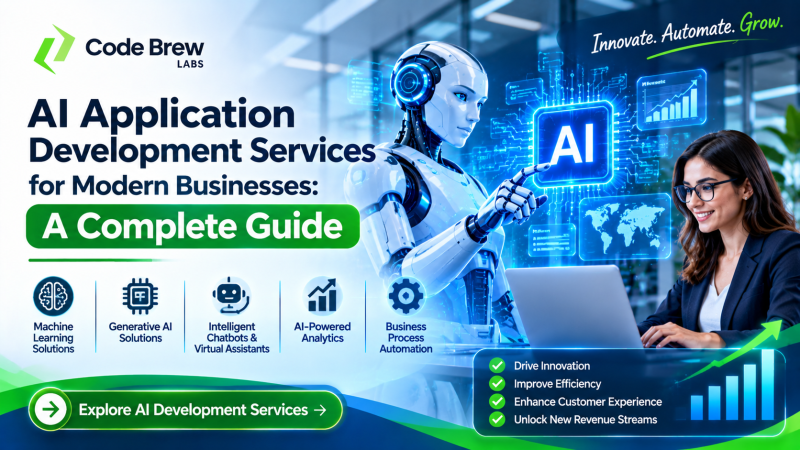
AI Application Development Services for Modern Businesses: A Complete Guide
 Ai agent
Artificial intelligence is changing how businesses manage daily operations, interact with customers, analyze information, and make decisions. From automating repetitive tasks to building intelligent digital products, AI is helping companies improve efficiency, reduce operating costs, and respond to changing customer expectations.
Businesses no longer need to rely entirely on manual processes or traditional software systems. AI-powered applications can analyze large datasets, generate content, predict customer behavior, automate workflows, and deliver personalized experiences across different industries.
For companies planning digital transformation, investing in AI application development services can create new opportunities for growth, better decision-making, and long-term operational improvements.
This guide explains AI application development services, their key features, business benefits, development process, costs, and how to choose the right AI development partner.
What Are AI Application Development Services?
AI application development services involve designing, building, integrating, testing, and maintaining software applications powered by artificial intelligence technologies. These applications use machine learning, natural language processing, computer vision, generative AI, and predictive analytics to perform tasks that traditionally require human input or complex manual processing.
AI applications can work with business data, identify patterns, understand user requests, generate responses, automate workflows, and support faster decision-making.
Businesses can invest in AI solutions such as:
- AI-powered chatbots and virtual assistants
- Generative AI applications
- Predictive analytics platforms
- Intelligent recommendation engines
- AI-powered customer support systems
- Document processing and data extraction tools
- Computer vision applications
- AI-based business automation software
- Enterprise AI platforms
- AI-powered mobile and web applications
An experienced AI application development company can help businesses identify the right use cases, select suitable AI models, develop the application architecture, and deploy a solution that fits their operational requirements.
Why Modern Businesses Are Investing in AI Applications
AI adoption is expanding across industries because businesses need faster processes, better data management, improved customer experiences, and greater operational efficiency.
1. Automating Repetitive Business Tasks
Many organizations spend hours managing routine activities such as answering customer queries, processing invoices, reviewing documents, entering data, and generating reports.
AI applications can automate these processes and reduce manual workload. Employees can spend more time on business planning, customer relationships, and other activities that require human judgment.
2. Improving Decision-Making
AI systems can analyze historical information, customer data, sales records, and market trends to identify patterns that may be difficult to detect manually.
Businesses can use these findings to make better decisions regarding inventory, pricing, customer retention, marketing campaigns, and operational planning.
3. Delivering Personalized Customer Experiences
AI-powered recommendation engines can analyze customer preferences, purchase history, browsing behavior, and interactions to recommend products, services, or content.
This can improve customer engagement, support repeat purchases, and help businesses deliver more relevant experiences.
4. Reducing Operational Expenses
Automation can reduce the time spent on repetitive processes, minimize certain human errors, and improve resource allocation.
When implemented with the right business processes, AI can help companies manage higher workloads without increasing operational expenses at the same rate.
Key AI Application Development Services for Businesses
A professional AI development partner can deliver different solutions based on business goals, available data, industry requirements, and technical needs.
Generative AI and LLM Application Development
Generative AI applications can create text, images, summaries, code, reports, and other outputs based on user instructions or business information.
Businesses can build AI assistants, knowledge management tools, content generation platforms, internal support applications, and intelligent search systems using large language models (LLMs).
Common development capabilities include:
- LLM integration
- Retrieval-Augmented Generation (RAG)
- AI-powered knowledge bases
- Custom AI assistants
- Prompt engineering
- Model fine-tuning
- AI content generation
Machine Learning Development
Machine learning applications learn from historical data to make predictions, identify patterns, and classify information.
These solutions are useful for fraud detection, customer churn prediction, demand forecasting, credit risk assessment, product recommendations, and business analytics.
AI Chatbot and Virtual Assistant Development
AI chatbots can answer customer questions, guide users through services, assist with product selection, and handle common support requests.
Modern conversational applications can connect with CRM platforms, databases, payment systems, and internal business tools to deliver relevant responses and complete selected tasks.
AI Workflow Automation
AI-powered automation combines intelligent decision-making with business process automation. These applications can review incoming information, classify requests, extract data, trigger actions, and route tasks to the appropriate teams.
Examples include automated customer onboarding, invoice processing, sales lead qualification, document review, and internal approval workflows.
Computer Vision Development
Computer vision applications analyze images and videos to identify objects, recognize visual patterns, detect defects, and interpret visual information.
Businesses can use these solutions in manufacturing quality control, retail analytics, security systems, healthcare imaging, logistics, and inventory management.
AI Application Development Process
Building a business-ready AI application requires more than selecting an AI model. The development process should account for business requirements, data quality, software architecture, security, testing, deployment, and ongoing performance.
Step 1: Business Requirement Analysis
The development team evaluates business objectives, existing workflows, customer needs, and operational challenges.
This stage helps identify where AI can make a measurable difference and whether AI is the right solution for the problem.
Step 2: AI Strategy and Solution Architecture
Developers define the application's architecture, AI capabilities, data sources, integrations, infrastructure, security controls, and deployment environment.
The architecture should support future growth, reliable performance, and manageable operating costs.
Step 3: Data Collection and Preparation
AI performance depends on the quality of the information used during development and operation.
Teams collect, clean, structure, validate, and prepare relevant datasets. For AI applications that use company documents, this may also involve indexing content, creating embeddings, and setting up retrieval systems.
Step 4: AI Model Selection and Development
The team selects suitable AI models based on the application's requirements. Depending on the project, developers may integrate existing foundation models, train machine learning models, fine-tune models, or combine multiple AI techniques.
Step 5: Application Development and Integration
Developers build the front end, backend services, databases, AI pipelines, APIs, and required integrations.
The application may connect with CRM systems, ERP software, payment platforms, enterprise databases, cloud services, or third-party APIs.
Step 6: Testing and Quality Assurance
AI applications require software testing along with AI-specific evaluation. Teams assess response accuracy, latency, security, usability, reliability, edge cases, and performance under different workloads.
Step 7: Deployment and Monitoring
After testing, the application is deployed to the required cloud, private infrastructure, or enterprise environment.
Monitoring tools track application performance, model quality, usage, costs, and unexpected outputs. Regular updates help maintain the application's performance as business needs change.
AI Application Development Cost: How Much Does It Cost?
The cost of AI application development depends on the application's functionality, technical requirements, data availability, model selection, integrations, infrastructure, security requirements, and development timeline.
A simple AI chatbot may require less investment than an enterprise AI platform with custom models, multiple integrations, complex data pipelines, and advanced security controls.
Estimated AI Application Development Pricing
AI Application Type
Estimated Cost
AI chatbot or virtual assistant $10,000–$30,000
AI-powered business application $25,000–$60,000
Generative AI application with RAG $30,000–$100,000
Machine learning predictive analytics platform $40,000–$120,000
AI workflow automation solution $20,000–$80,000
Computer vision application $40,000–$150,000+
Enterprise AI platform $100,000–$300,000+
These are estimated development ranges, not fixed quotations. Actual pricing may vary depending on project scope, team location, data complexity, infrastructure requirements, and the number of features.
Factors That Influence AI Development Costs
- Application complexity: More features, user roles, and business workflows increase development time.
- Data preparation: Poorly structured or incomplete datasets may require extensive cleaning and processing.
- AI model requirements: Existing APIs, open-source models, fine-tuned models, or custom-trained models have different costs.
- Third-party integrations: Connecting AI applications with existing enterprise systems can add engineering work.
- Security and compliance: Access controls, encryption, audit logs, and industry-specific requirements affect project budgets.
- Cloud infrastructure: Compute resources, storage, model hosting, API usage, and scaling contribute to ongoing expenses.
- Maintenance: Model updates, monitoring, bug fixes, and performance improvements create recurring costs.
Businesses should evaluate the complete cost of ownership rather than focusing only on the initial development budget.
How AI Applications Help Businesses Achieve ROI
AI investments should be connected to measurable business outcomes. Companies need to understand how an AI application will improve performance, reduce expenses, increase revenue, or support business growth.
Some of the key performance indicators businesses can track include:
- Reduction in manual processing time
- Lower customer support expenses
- Improved customer retention rates
- Increased conversion rates
- Reduced operational errors
- Faster response times
- Higher employee productivity
- Improved forecasting accuracy
For example, an AI customer support application can automatically answer frequently asked questions, categorize incoming requests, and direct complex queries to human agents. This can reduce the number of repetitive support tasks while allowing employees to focus on more demanding customer issues.
An AI-powered sales application can analyze customer interactions, identify promising leads, and recommend follow-up actions. This can help sales teams prioritize opportunities and improve their conversion process.
The best AI investments are connected to clear business goals, measurable results, and a plan for evaluating performance after deployment.
How to Choose the Right AI Application Development Company
Selecting the right AI development partner can affect the application's performance, security, scalability, and long-term value. Businesses should assess a development company's technical expertise, project experience, and ability to manage AI solutions beyond the initial launch.
Consider the following factors when evaluating AI development companies:
AI and Software Engineering Expertise
Look for experience in machine learning, generative AI, LLM integration, data engineering, backend development, cloud infrastructure, and application security. The team should be able to explain why a particular technology fits your business requirements.
Industry Experience
A company with experience in your industry may understand its operational challenges, customer expectations, and data requirements. Review previous projects that relate to your business model.
Data Security and Privacy
AI applications may process sensitive business information, customer records, or financial data. Ask about encryption, access permissions, data retention, secure API connections, and deployment options.
Scalability and Performance
The application should support increasing user numbers, larger datasets, and additional features without requiring major architectural changes.
Post-Launch Support
AI applications need ongoing monitoring, updates, performance testing, and cost management. Choose a partner that can support the software throughout its lifecycle.
Why Choose Code Brew Labs for AI Application Development?
Code Brew Labs — AI Development Partner
Code Brew Labs helps businesses turn AI opportunities into production-ready software built around real operational needs. With 13+ years of product and software development experience, the company works with startups, enterprises, and established organizations to develop intelligent digital solutions.
As an AI application development company, Code Brew Labs focuses on business objectives, technical architecture, data readiness, security, and long-term performance.
Its AI development capabilities include:
- Generative AI and LLM application development
- Custom AI software development
- AI-powered mobile and web applications
- Predictive analytics and machine learning
- Intelligent workflow automation
- AI chatbot and virtual assistant development
- AI integrations with existing business software
- Enterprise AI solutions
- AI system monitoring and optimization
From planning and architecture to deployment and ongoing improvements, Code Brew Labs helps businesses develop AI applications that support real operational requirements and long-term growth.
Whether a business wants to automate customer support, build an intelligent platform, improve forecasting, or integrate AI into an existing product, the right development strategy can turn that objective into a functional business solution.
Conclusion
AI application development is becoming a practical investment for businesses seeking to improve productivity, automate operations, personalize customer experiences, and make better decisions. The right AI solution can address specific business problems while supporting future expansion.
Successful AI implementation requires a clear business strategy, reliable data, suitable AI models, secure software architecture, proper testing, and ongoing performance monitoring.
Partnering with an experienced AI development company such as Code Brew Labs can help businesses move beyond AI experimentation and build intelligent applications that support measurable business outcomes, operational efficiency, and long-term growth.
Frequently Asked Questions
1. What are AI application development services?
AI application development services involve building software that uses artificial intelligence to automate tasks, analyze information, generate content, make predictions, and support business decisions.
2. How much does AI application development cost?
AI application development can cost approximately $10,000 for a basic AI chatbot and exceed $300,000 for advanced enterprise platforms. Pricing depends on features, data requirements, integrations, model selection, infrastructure, and security.
3. How long does it take to build an AI application?
A basic AI application may take 4–8 weeks. A more advanced solution may require 3–6 months, while large enterprise AI systems can take 6–12 months or longer, depending on complexity and deployment requirements.
4. Which technologies are used to develop AI applications?
AI developers may use Python, TensorFlow, PyTorch, OpenAI models, cloud AI services, vector databases, LangChain, API integrations, and various data engineering tools. Technology selection depends on the application's requirements.
5. Can AI be integrated into an existing business application?
Yes. AI capabilities can be integrated into existing mobile apps, websites, CRM platforms, ERP systems, enterprise software, and customer support tools through APIs, model services, and data integrations.
Source:
Click for the: Full Story
You might like






You Might Like this