Close Menu
 World
World
 Biography
 Health
 Education
 Business
 Lifestyle
 Sports
 Technology
 Animals
 History
 Food
Food
 Religious
 Startups
 Movies
 Politics
 Fashion
 Covid
Covid
 Diet
Diet
 Fitness
 Marketing
 Travel
 Science
 Reviews
 Social media
 Stories
 Facts
Facts
 Art
Art
 Entertainment
vanessa jaminson

Business
AI Data Collection for Healthcare: Everything Healthcare Teams Need to Know
 vanessa jaminson
Healthcare organizations across the United States are generating more patient data than ever before. From electronic health records (EHRs) and wearable devices to diagnostic imaging and telehealth platforms, data is at the center of modern patient care. However, collecting, organizing, and utilizing this information efficiently remains a challenge.
This is where AI Data Collection for Healthcare is transforming the industry. Artificial intelligence enables healthcare providers to gather, process, and analyze vast amounts of structured and unstructured data faster and more accurately than traditional methods.
In this guide, we'll explore how AI-powered data collection works, its benefits, key applications, challenges, and why it's becoming an essential technology for healthcare organizations across the U.S.
What Is AI Data Collection for Healthcare?
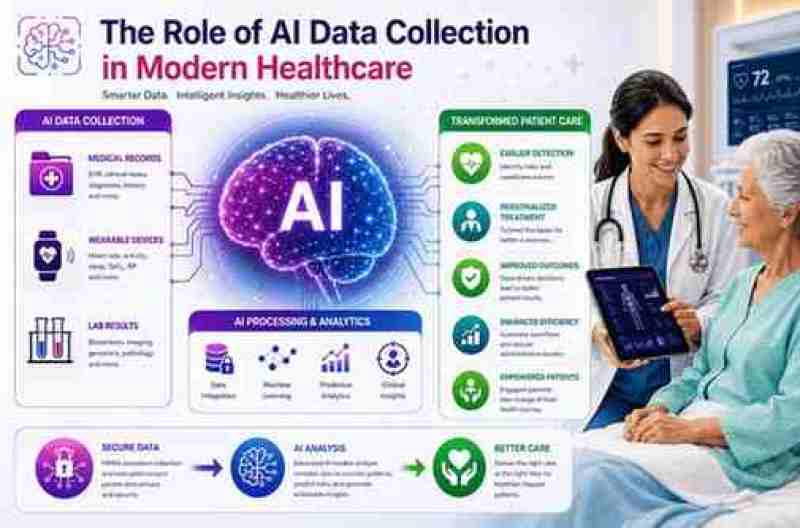
AI Data Collection for Healthcare refers to the use of artificial intelligence technologies to automatically gather, organize, validate, and process healthcare data from multiple sources.
Unlike manual data entry, AI systems can collect information from:
- Electronic Health Records (EHRs)
- Medical imaging systems
- Wearable health devices
- Laboratory reports
- Insurance claims
- Telemedicine platforms
- Clinical notes
- Patient surveys and mobile health apps
Machine learning and natural language processing (NLP) allow AI to extract meaningful information from both structured databases and unstructured documents, significantly reducing manual workload.
Why AI Data Collection Matters in Modern Healthcare
Healthcare professionals spend a significant portion of their day managing documentation rather than treating patients. AI automates repetitive administrative tasks, allowing clinicians to focus on delivering quality care.
Key benefits include:
- Faster access to patient information
- Reduced manual documentation
- Improved clinical decision-making
- Better patient outcomes
- Enhanced operational efficiency
- Lower administrative costs
- Improved data accuracy
By minimizing human error and streamlining workflows, AI helps healthcare organizations improve both productivity and patient satisfaction.
How AI Data Collection Works
AI-powered healthcare data collection follows several intelligent steps:
1. Data Acquisition
AI gathers data from multiple healthcare systems, including EHRs, IoT devices, wearable sensors, imaging systems, pharmacy databases, and laboratory platforms.
2. Data Processing
Using machine learning algorithms, AI cleans, organizes, and standardizes incoming information while identifying duplicate or incomplete records.
3. Natural Language Processing (NLP)
Many healthcare records exist as physician notes or clinical documents. NLP converts these unstructured records into searchable, structured data.
4. Data Validation
AI automatically checks for inconsistencies, missing values, and incorrect entries before integrating data into healthcare systems.
5. Continuous Learning
Modern AI systems improve over time by learning from historical healthcare data, enabling increasingly accurate data collection and analysis.
Benefits of AI Data Collection for Healthcare Organizations
Healthcare providers across the U.S. are rapidly adopting AI because of the measurable improvements it brings to clinical and administrative operations.
Improved Patient Care
Accurate and timely patient data allows physicians to make informed treatment decisions, reducing diagnostic delays and improving health outcomes.
Faster Clinical Workflows
AI automates routine documentation, enabling clinicians to spend more time with patients instead of completing paperwork.
Better Predictive Analytics
AI identifies patterns in patient data to predict disease progression, hospital readmissions, and potential health risks before they become critical.
Enhanced Data Accuracy
Automated validation reduces human errors, improving the quality and reliability of healthcare records.
Cost Savings
By reducing manual labor, duplicate testing, and administrative overhead, healthcare organizations can significantly lower operational costs.
Real-World Applications of AI Data Collection in Healthcare
AI-powered data collection supports numerous healthcare use cases.
Electronic Health Records (EHR) Optimization
AI extracts relevant patient information from multiple systems and updates medical records automatically.
Remote Patient Monitoring
Wearable devices continuously collect health metrics such as heart rate, blood pressure, glucose levels, and oxygen saturation, enabling proactive care management.
Clinical Research
Researchers use AI to collect and analyze large datasets for clinical trials, accelerating drug discovery and medical innovation.
Medical Imaging
AI gathers imaging data and assists radiologists by identifying abnormalities more efficiently.
Population Health Management
Healthcare organizations analyze large patient populations to identify trends, manage chronic diseases, and improve preventive care strategies.
Challenges of AI Data Collection in Healthcare
Although AI offers tremendous benefits, successful implementation requires addressing several challenges.
Data Privacy and Security
Healthcare organizations must ensure compliance with HIPAA regulations while protecting sensitive patient information through robust cybersecurity measures.
Data Quality
AI systems are only as effective as the data they receive. Incomplete or inconsistent records can reduce model accuracy.
System Integration
Many healthcare providers operate multiple legacy systems that may require significant integration efforts.
Ethical Considerations
Healthcare organizations must ensure transparency, fairness, and accountability when using AI-driven decision-making tools.
Best Practices for Successful AI Data Collection
To maximize the value of AI Data Collection for Healthcare, organizations should follow these best practices:
- Establish strong data governance policies.
- Ensure HIPAA-compliant data handling and storage.
- Regularly audit AI models for accuracy and bias.
- Invest in secure cloud infrastructure.
- Train healthcare staff on AI-assisted workflows.
- Continuously monitor data quality and system performance.
A strategic implementation approach helps healthcare providers achieve long-term success while maintaining regulatory compliance.
The Future of AI Data Collection for Healthcare
The future of healthcare will be increasingly data-driven. Advances in generative AI, predictive analytics, and intelligent automation will further improve the speed and accuracy of healthcare data collection.
Emerging technologies such as AI-powered virtual assistants, digital twins, real-time patient monitoring, and personalized medicine will depend on high-quality healthcare data collected through intelligent AI systems.
Healthcare organizations that embrace AI today will be better positioned to deliver faster diagnoses, personalized treatment plans, and improved patient experiences in the years ahead.
Conclusion
AI Data Collection for Healthcare is revolutionizing the way healthcare providers collect, manage, and leverage patient information. By automating data acquisition, improving accuracy, and supporting better clinical decisions, AI is helping healthcare organizations deliver more efficient, patient-centered care.
As healthcare continues to evolve, investing in intelligent AI-powered data collection solutions is no longer optional—it is becoming a competitive necessity. Organizations that adopt AI responsibly can improve operational efficiency, reduce costs, enhance patient outcomes, and build a stronger foundation for the future of digital healthcare.
Source:
Click for the: Full Story
You might like