



 Close Menu
 World
World
 Biography
 Health
 Education
 Business
 Lifestyle
 Sports
 Technology
 Animals
 History
 Food
Food
 Religious
 Startups
 Movies
 Politics
 Fashion
 Covid
Covid
 Diet
Diet
 Fitness
 Marketing
 Travel
 Science
 Reviews
 Social media
 Stories
 Facts
Facts
 Art
Art
 Entertainment
Mamta Devi

Business
Assembly Line Machine: Types, Benefits & Applications
 Mamta Devi
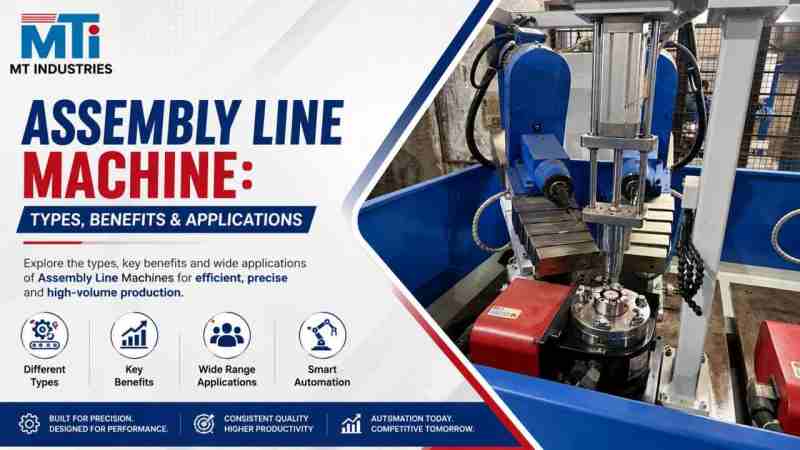
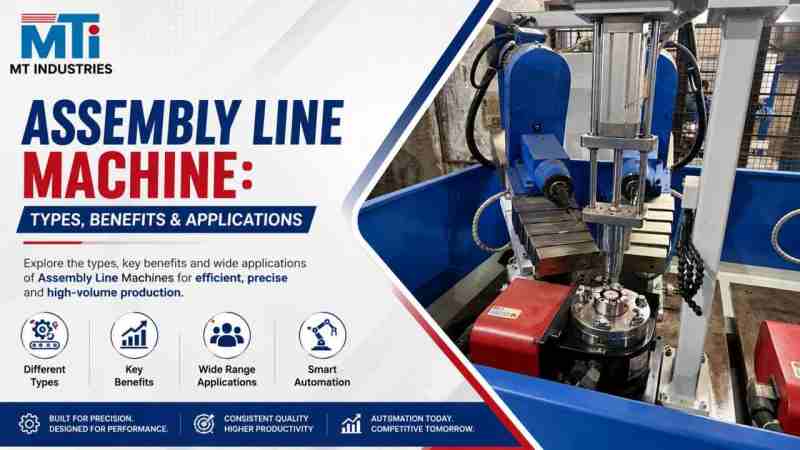
Modern manufacturing depends on producing products faster, more consistently, and with fewer avoidable errors. As production volumes increase, relying entirely on manual assembly can make it difficult to maintain consistent cycle times and quality. This is where an Assembly Line Machine becomes valuable.
An assembly line machine combines mechanical systems, fixtures, tooling, sensors, controls, and automation to perform or support repetitive assembly operations. Depending on the product, the system may handle components such as fasteners, brackets, electrical parts, housings, shafts, or other precision components.
For manufacturers planning to automate production, understanding the different types, benefits, applications, and selection factors is essential. This guide explains how assembly line machines work and what to consider before investing in one.
What Is an Assembly Line Machine?
An Assembly Line Machine is an industrial production system designed to perform a sequence of assembly operations in a controlled and repeatable manner.
Instead of having an operator complete every assembly step manually, different stations can be designed for specific operations. These may include:
- Component loading and positioning
- Drilling or tapping
- Press fitting
- Screw fastening
- Part inspection
- Component insertion
- Welding or joining
- Lubrication
- Marking and identification
- Final quality checking
A complete line can combine several machines and stations into one coordinated production process. The objective is not simply to automate every task but to create a reliable workflow that delivers the required output and quality.
How Does an Assembly Line Machine Work?
The working principle depends on the product and production requirements, but most automated assembly lines follow a logical sequence.
First, components are supplied to the assembly station manually, through conveyors, feeders, trays, or automated material-handling systems. Fixtures then position the parts accurately.
The machine performs the required operation according to programmed parameters. Sensors can verify part presence, position, or process conditions before the next operation begins.
Once the operation is completed, the component moves to the next station. Inspection systems may check critical dimensions, assembly conditions, or the presence of components.
This creates a controlled production flow where every station has a defined task and cycle time.
Types of Assembly Line Machines
There is no single design that fits every manufacturing process. The appropriate machine depends on product geometry, production volume, assembly complexity, required precision, and available floor space.
1. Manual Assembly Line
A manual line relies heavily on operators, with fixtures, tools, conveyors, and workstations supporting the process. It can be suitable for low-volume production or products that change frequently.
However, manual systems may have greater variation in cycle time and assembly quality.
2. Semi-Automatic Assembly Machine
A semi-automatic system combines operator involvement with automated operations. The operator may load components while the machine performs pressing, fastening, drilling, inspection, or another repetitive task.
This approach can provide a practical balance between automation and flexibility.
3. Fully Automated Assembly Line
A fully automated system uses automated feeding, positioning, processing, inspection, transfer, and control mechanisms. Operators primarily monitor the system, replenish materials, perform maintenance, or handle exceptions.
These systems are generally more suitable for high-volume production where repeatability and cycle-time control are important.
4. Rotary Assembly Machine
A rotary system uses a rotating indexing table with multiple workstations. Different operations can be performed at different positions around the table.
This design is useful when several sequential operations are required and the product remains relatively compact.
5. Linear Assembly Line
A linear assembly system transfers components through stations arranged along a straight path. Each station performs a defined operation before the product moves forward.
Linear systems can be easier to expand or configure for certain manufacturing layouts.
Key Benefits of an Assembly Line Machine
Higher Production Capacity
One of the main reasons manufacturers invest in an Assembly Line Machine is increased production capacity. Repetitive operations can be performed at controlled cycle times, allowing more components to be processed during a shift.
The actual improvement depends on product design, automation level, machine cycle time, and material handling.
Consistent Assembly Quality
Manual assembly can introduce variation caused by operator technique, fatigue, or inconsistent application of force. Automated equipment can control parameters such as position, torque, stroke, speed, and timing.
This improves process consistency and makes quality easier to monitor.
Reduced Cycle Time
An optimized production line eliminates unnecessary movement and combines related operations. A well-designed Automated Assembly System can therefore reduce handling time between operations and maintain a more predictable cycle.
Before automation, manufacturers should measure the existing cycle time to identify where the largest delays occur.
Lower Dependence on Repetitive Manual Work
Automation does not necessarily eliminate operators. Instead, it can move people away from highly repetitive or physically demanding tasks and allow them to focus on material management, inspection, maintenance, and process supervision.
Better Process Control
Modern assembly equipment can incorporate sensors, programmable controls, interlocks, and inspection devices. This provides greater visibility into the production process.
For example, a machine can be designed not to continue until a component is correctly positioned or a fastening operation reaches the required condition.
What Is an Industrial Assembly Machine?
An Industrial Assembly Machine is equipment specifically engineered to assemble components in a manufacturing environment. Unlike general-purpose tools, industrial assembly equipment is normally designed around the product, process, production volume, and quality requirements.
For example, an industrial system may combine custom fixtures, pneumatic or servo mechanisms, sensors, tooling, conveyors, and PLC-based controls.
MT Industries approaches such systems by considering the complete manufacturing operation rather than treating individual machine functions separately. This is particularly important when multiple operations must work within one defined cycle.
Applications of Assembly Line Machines
Assembly Line Machines are used across many manufacturing sectors because assembly requirements exist in almost every industrial product category.
Common applications include:
Automotive Manufacturing
Assembly systems can be used for components, subassemblies, brackets, shafts, housings, and other automotive parts. Operations may include pressing, fastening, drilling, tapping, inspection, and component insertion.
Electrical and Electronics
Electrical products often require controlled insertion, fastening, testing, and component assembly. Automated systems can help maintain repeatability for high-volume production.
Consumer Products
Appliances, hardware products, tools, and other consumer goods can benefit from automated assembly when multiple repetitive operations are involved.
Engineering Components
Manufacturers producing mechanical components can integrate drilling, tapping, pressing, fastening, and inspection into a coordinated production system.
MT Industries develops manufacturing solutions where machine configuration is matched to the actual operation, component geometry, and production requirements.
What Should You Consider Before Buying an Assembly Line Machine?
Choosing automation based only on machine speed can lead to an unsuitable system. Manufacturers should evaluate the entire production process.
1. Production Volume
Determine the required daily, monthly, and annual output. High-volume production generally provides stronger justification for automation.
2. Product Design
Study component dimensions, tolerances, material, assembly sequence, and possible product variations.
3. Required Cycle Time
Calculate the target cycle time based on actual production demand rather than selecting a machine simply because it has a high theoretical speed.
4. Level of Automation
Decide whether manual, semi-automatic, or fully automatic operation is appropriate.
5. Quality Requirements
Identify critical dimensions and assembly characteristics that need process monitoring or inspection.
6. Future Production Needs
Consider whether the product, volume, or assembly process may change. A flexible system can be more valuable than a highly specialized machine if future requirements are uncertain.
7. Maintenance and Support
Automation should be evaluated over its complete operating life. Accessibility, spare parts, troubleshooting, preventive maintenance, and technical support all affect long-term productivity.
MT Industries also emphasizes the importance of matching machine design with practical maintenance and production requirements instead of focusing solely on initial specifications.
Assembly Line Machine vs. Manual Assembly
The right choice depends on production requirements.
Factor
Manual Assembly
Assembly Line Machine
Production volume
Low to medium
Medium to high
Cycle time
Can vary
More controlled
Repeatability
Operator dependent
High
Initial investment
Lower
Higher
Flexibility
Usually high
Depends on design
Process monitoring
Limited
Can be integrated
Repetitive workload
Higher
Lower
For low-volume products with frequent design changes, manual or semi-automatic assembly may remain practical. For stable, high-volume production, automation can offer stronger advantages.
Why Customized Assembly Automation Matters
Every product has a different assembly sequence. A standard machine may not always provide the required combination of operations, tooling, and handling.
A customized Automated Assembly System can be designed around the actual product and process. This may include custom fixtures, part-present sensors, automatic feeding, transfer mechanisms, multi-operation tooling, and inspection functions.
The goal should be to remove genuine production bottlenecks while maintaining safety, quality, accessibility, and maintainability.
For manufacturers evaluating automation, MT Industries recommends beginning with a detailed process study. Understanding the current cycle time, manual operations, rejection points, material flow, and production target provides a much stronger foundation for machine selection.
Frequently Asked Questions
1. What is the main purpose of an Assembly Line Machine?
The primary purpose is to perform or coordinate repetitive assembly operations with greater consistency, controlled cycle times, and improved production efficiency.
2. Is an Assembly Line Machine suitable for small production volumes?
It can be, but full automation may not always be economical for low-volume production. Semi-automatic or flexible systems can be more appropriate when product changes are frequent.
3. What is the difference between an Industrial Assembly Machine and an Automated Assembly System?
An Industrial Assembly Machine generally refers to equipment designed for a specific assembly operation or group of operations. An Automated Assembly System can include multiple machines, stations, material-handling mechanisms, controls, and inspection functions working together.
4. How can an Assembly Line Machine reduce production costs?
It can reduce costs by improving cycle-time consistency, reducing repetitive manual work, minimizing process variation, and increasing production output. The actual savings depend on machine utilization, labor requirements, maintenance, and production volume.
5. How do I choose the right Assembly Line Machine?
Start with the product, required production volume, target cycle time, assembly sequence, quality requirements, component handling method, automation level, and future production needs. A machine should be selected based on the complete process rather than speed alone.
Conclusion
An Assembly Line Machine can transform repetitive manufacturing operations by creating a more controlled, consistent, and measurable production process. From semi-automatic workstations to fully automated production lines, the right solution depends on the product, volume, cycle-time target, quality requirements, and level of flexibility required.
The most effective automation is not necessarily the most complex system. It is the system that solves the actual production problem while remaining reliable, maintainable, and commercially practical.
For manufacturers considering automation, MT Industries focuses on understanding the production process first and then developing equipment around the required operations. Whether the requirement involves an Industrial Assembly Machine, a customized workstation, or a complete Automated Assembly System, careful process analysis is the starting point for achieving dependable production results.
With the right machine architecture and process design, assembly automation can support higher productivity, consistent quality, and more predictable manufacturing performance.
For More Information Click Here:- https://mtindustries.in/service-assembly
Source:
Click for the: Full Story
You might like






You Might Like this