Close Menu
 World
 Biography
 Health
 Education
 Business
 Lifestyle
 Sports
 Technology
 Animals
 History
 Food
 Religious
 Startups
 Movies
 Politics
 Fashion
 Covid
 Diet
 Fitness
 Marketing
 Travel
 Science
 Reviews
 Social media
 Stories
 Facts
 Art
 Entertainment
75Way Technologies

Technology
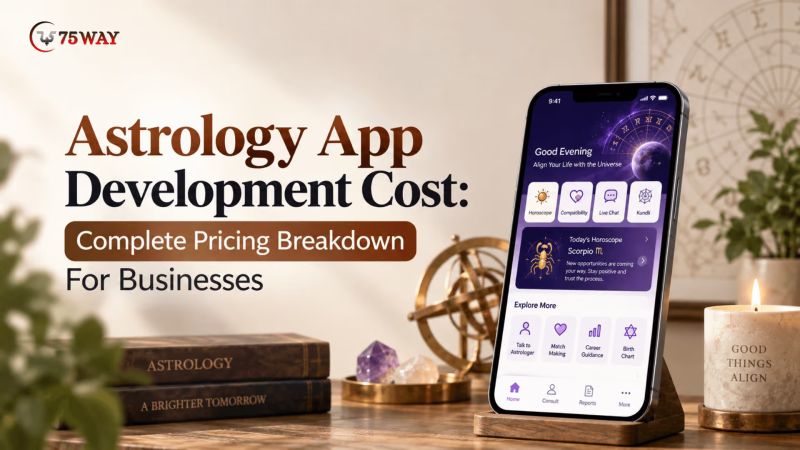
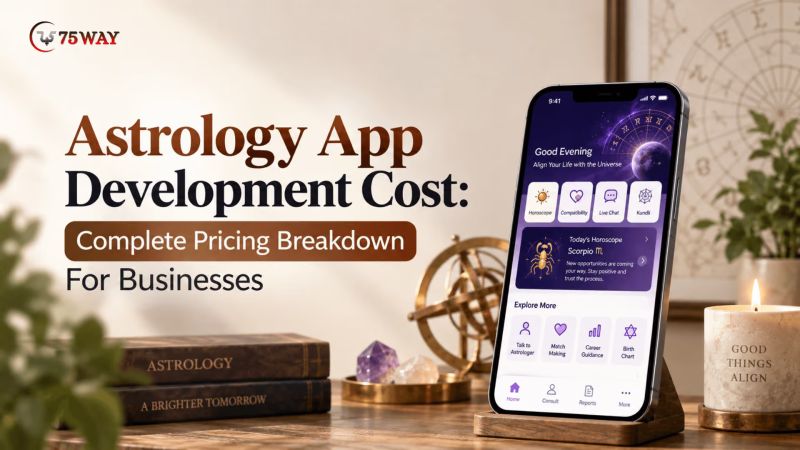
Astrology App Development Cost: Complete Pricing Breakdown for Businesses
 75Way Technologies
Astrology app development cost typically ranges from $5,000 to $300,000+, depending on the product model, features, platforms, integrations, AI capabilities, and scalability requirements.
A basic horoscope app can stay near the lower end, while an astrology marketplace with live consultations, subscriptions, payments, AI personalization, and advanced birth-chart capabilities can require a substantially larger investment.
For founders, the important question is not simply how much it costs to build an astrology app. It is what type of astrology business you are creating, which features must be available at launch, and which expenses will continue after development.
This guide breaks down astrology app development pricing by product type, features, development stages, technology choices, ongoing expenses, and business model to help you plan a realistic budget before hiring a development team.
Astrology App Market Growth and Business Opportunities in the USA
Growing consumer interest in astrology, horoscopes, and related digital services creates opportunities for businesses developing personalized content platforms, subscription applications, and consultation marketplaces.
According to a Pew Research Center survey, 30% of U.S. adults consult astrology, tarot cards, or fortune tellers at least once a year. The survey covered 9,593 U.S. adults in October 2024. It is important to note that this figure combines three activities rather than measuring astrology app usage alone.
One market forecast from MarkNtel Advisors estimates that the global astrology app market will grow from $8.28 billion in 2026 to $13.48 billion by 2032, representing an estimated CAGR of 8.44%. You can review the astrology app market forecast for its methodology and projections.
For businesses, the opportunity is not limited to daily horoscopes. Personalized birth charts, compatibility reports, astrologer consultations, subscription content, and AI-assisted experiences can create different ways to attract and monetize users.
How Much Does It Cost to Build an Astrology App?
The average cost to build an astrology app can range from $5,000 to $300,000+. The actual investment depends on the product's scope, complexity, and required capabilities.
App categoryEstimated development costEstimated timelineBasic astrology app$5,000–$30,0002–3 monthsMid-level astrology app$30,000–$80,0003–5 monthsAdvanced astrology app$70,000–$150,000+4–7 monthsEnterprise astrology marketplace$150,000–$300,000+6–12+ months
1. Basic Astrology App: $5,000–$30,000
A basic application includes essential features such as user profiles, zodiac content, daily horoscopes, birth information, notifications, and simple personalization. It is suitable for startups validating an initial product idea.
2. Mid-Level Astrology App: $30,000–$80,000
A mid-level application can include birth charts, compatibility reports, personalized readings, subscriptions, and basic AI capabilities. It requires more sophisticated backend functionality and integrations.
3. Advanced Astrology App: $70,000–$150,000+
An advanced platform may include astrologer profiles, appointment booking, chat, voice or video consultations, payments, wallets, commissions, and user reviews.
4. Enterprise Astrology Marketplace: $150,000–$300,000+
An enterprise platform can support multiple astrologers, large user volumes, advanced AI, complex integrations, detailed analytics, and scalable infrastructure.
The biggest mistake is selecting a budget based only on the app category. The business model, feature architecture, and expected user volume have a much greater influence on the final development cost.
Cost to Create a Custom Astrology App Based on Development Stages
An astrology app's development budget builds progressively as the product moves from an initial concept toward a launch-ready application. Each stage contributes to the overall investment.
The following estimates are indicative and can vary according to project complexity, development location, technology stack, integrations, and team composition.
Stage 1: Discovery and Planning Cost
Planning defines the application's features, user journeys, technical requirements, and development scope before coding begins. A structured discovery process can reduce rework and help establish a realistic budget.
ActivityEstimated costRequirement analysis$300–$750Feature planning$240–$600Technical planning$240–$750Project roadmap$120–$400
Stage 2: UI/UX Design Cost
Design influences how users navigate the application, explore astrology content, view birth charts, and access personalized services. The cost depends on screen complexity, visual elements, and the overall user experience.
ActivityEstimated costWireframes$180–$500Visual design$320–$700User journey flow$240–$500Prototype design$240–$500Design system$160–$400
Stage 3: Frontend Development Cost
Frontend development covers the user-facing experience, including navigation, responsive layouts, animations, authentication screens, and interactive astrology features.
ActivityEstimated costScreen development$600–$1,250Responsiveness$320–$600UI interactions$320–$600User authentication$320–$600Astrology content interface$400–$750
Stage 4: Backend Development Cost
Backend systems manage user information, databases, servers, authentication, APIs, and the application's core business logic. More complex calculations, real-time processing, and high user volumes can increase development effort.
ActivityEstimated costServer setup$320–$600Database handling$400–$750API development$400–$750User authentication$320–$600Data processing$400–$750
Stage 5: Third-Party Integration Cost
Integrations add capabilities such as payments, communication, notifications, astrology calculations, and analytics. The number and complexity of external services influence the total cost.
IntegrationEstimated costPayment systems$320–$600Astrology APIs$320–$750Messaging tools$240–$500Push notifications$120–$300Analytics tools$160–$350
Stage 6: AI and Personalization Engine Cost
AI can support personalized readings, recommendations, conversational experiences, and astrology-based insights. Costs depend on model complexity, data processing, API usage, personalization logic, and optimization.
ActivityEstimated costData modeling$400–$800Algorithm setup$500–$1,250AI integration$400–$1,000Personalization$400–$1,000AI optimization$300–$700
Stage 7: Admin Panel Development Cost
An admin panel helps businesses manage users, content, astrologers, subscriptions, reports, and operational data. Advanced analytics, moderation, and automation can increase development effort.
ActivityEstimated costDashboard design$200–$400User management$240–$500Content control$240–$500Analytics dashboard$200–$500Role management$120–$350
Stage 8: Security and Data Protection Cost
Astrology apps may store birth details, personal profiles, payment information, consultation records, and private conversations. Security requirements should be considered during architecture and development.
ActivityEstimated costSecure authentication$200–$400Data encryption$200–$500Access controls$160–$350Security testing$240–$500
Stage 9: Testing and Deployment Cost
Testing validates application functionality, device compatibility, performance, and security before launch. Deployment also includes preparing the application for distribution through relevant app marketplaces.
ActivityEstimated costFunctional testing$320–$600Compatibility testing$240–$500Performance checks$200–$400Security testing$160–$400App launch setup$200–$600
Stage 10: Maintenance and Updates Cost
Maintenance keeps an astrology application secure, compatible, and functional after launch. It can include bug fixes, feature updates, performance improvements, API changes, and operating-system compatibility work.
ActivityEstimated costBug fixes$200–$500/monthFeature updates$240–$600/monthPerformance tuning$160–$400/monthAPI updates$120–$300/monthOS compatibility$160–$400/month
Note: These stage-level figures are indicative task estimates, not a complete project quotation. Some activities may overlap, and the final budget should account for project management, quality assurance, infrastructure, and other shared expenses.
Custom Astrology App Development Cost by Feature
Individual features can add different levels of design, engineering, integration, testing, and maintenance work. A feature-wise estimate helps founders decide which capabilities should be included in the first release.
Common features that influence development costs include:
- User registration and profiles: Account creation, login, profile management, and birth information.
- Daily horoscopes: Zodiac-based content, scheduled updates, and personalized horoscope feeds.
- Birth chart generation: Birth date, time, and location inputs combined with astrological calculation services.
- Compatibility analysis: Comparison tools that generate relationship reports based on selected astrology parameters.
- Personalized readings: Customized reports based on user profiles, birth charts, and selected preferences.
- Astrologer profiles: Professional biographies, expertise, ratings, availability, and service listings.
- Appointment booking: Scheduling, calendar management, booking confirmation, and reminders.
- Chat and video consultations: Real-time messaging, voice or video communication, and session management.
- Payment and wallet functionality: Payments, credits, refunds, transaction records, and subscription management.
- AI-powered experiences: Conversational assistants, personalized recommendations, and automated content generation.
- Admin dashboard: User management, content control, reporting, moderation, and platform configuration.
A development company should estimate each capability according to its actual requirements rather than assigning a generic price to the phrase "astrology app."
Astrology App Development Cost Based on Business Model
The business model can become one of the biggest drivers of an astrology app's development budget. A subscription platform requires different functionality from a marketplace built around paid consultations or product sales.
1. Horoscope and Content App
Estimated cost: $15,000–$35,000
Estimated time: 2–4 months
This model delivers daily predictions, zodiac information, astrology articles, and personalized content. It suits businesses focused on building an audience through free and premium content.
2. Birth Chart and Personalized Astrology App
Estimated cost: $25,000–$55,000
Estimated time: 3–5 months
This application provides personalized birth charts, planetary positions, compatibility reports, and customized readings. It may require astrology calculation APIs, user profiles, and personalized content generation.
3. AI Astrology App
Estimated cost: $35,000–$80,000
Estimated time: 4–6 months
An AI astrology app can provide personalized interpretations, recommendations, conversational readings, and automated insights. Development costs depend on AI integrations, personalization logic, data processing, and conversational functionality.
4. Astrology Consultation Marketplace
Estimated cost: $70,000–$150,000+
Estimated time: 5–9 months
This model connects users with professional astrologers through profiles, bookings, chat, voice or video calls, payments, ratings, and commissions. It requires separate workflows for customers, astrologers, and administrators.
5. Astrology Subscription App
Estimated cost: $30,000–$65,000
Estimated time: 3–5 months
A subscription application offers premium horoscopes, personalized reports, exclusive readings, and recurring content through paid plans. It requires subscription management, payment integration, access controls, and retention features.
6. Astrology Compatibility App
Estimated cost: $25,000–$50,000
Estimated time: 3–5 months
A compatibility-focused application compares birth information, zodiac signs, planetary positions, or other astrology parameters to generate relationship insights and personalized reports.
7. Astrology Learning App
Estimated cost: $20,000–$45,000
Estimated time: 3–5 months
This model offers courses, lessons, videos, quizzes, downloadable resources, and structured learning paths. Monetization can include paid courses, memberships, and premium educational content.
8. Astrology Marketplace with E-Commerce
Estimated cost: $50,000–$100,000+
Estimated time: 4–7 months
This model combines astrology services with an online marketplace for products such as gemstones, books, spiritual accessories, and personalized reports. Development may require product catalogs, payments, orders, inventory, user accounts, and service-booking functionality.
Businesses planning a product-based marketplace can also explore ecommerce app development solutions when evaluating the commerce architecture and purchasing experience.
Astrology App Development Cost by Region
Development rates vary according to location, developer experience, technical specialization, and agency overhead. The following figures are indicative planning ranges rather than fixed regional averages.
RegionEstimated hourly rateIndicative project costNorth America (USA and Canada)$120–$200$100,000–$180,000+Western Europe$80–$150$70,000–$130,000Australia and New Zealand$90–$150$75,000–$135,000Eastern Europe$40–$80$35,000–$70,000United Arab Emirates$50–$100$45,000–$90,000Latin America$30–$60$25,000–$50,000India and Southeast Asia$25–$60$10,000–$45,000
North American teams generally involve higher hourly rates and operational costs. India and Southeast Asia can offer comparatively lower development rates, although the final cost still depends on expertise, project scope, and required integrations.
When comparing regions, businesses should evaluate communication, project management, technical experience, security practices, and post-launch support—not just hourly rates.
Cost to Hire an Astrology App Developer
The cost of hiring an astrology app developer depends on experience, team composition, location, and project complexity.
Development levelEstimated project costTypical capabilitiesBasic MVP team$5,000–$15,000Daily horoscopes, onboarding, basic birth charts, and essential interfacesMid-level development team$15,000–$40,000Kundli, compatibility, chat, wallets, subscriptions, and payment integrationsAdvanced or enterprise team$50,000–$80,000+AI predictions, personalized readings, video consultations, advanced integrations, and scalable architecture
These are project-level estimates, not guaranteed hiring fees. A complete team may include UI/UX designers, frontend developers, backend developers, QA engineers, and project managers.
How to Calculate Your Astrology App Development Cost
A practical starting point is to estimate the total development hours and multiply them by the developer's hourly rate. Then add design, API, testing, project management, deployment, and post-launch expenses.
Total Development Cost = (Total Development Hours × Hourly Rate) + Additional Costs
For example, suppose your astrology app requires 800 development hours and the development rate is $50 per hour.
- Development: 800 × $50 = $40,000
- Additional expenses for UI/UX, astrology APIs, testing, and deployment: $8,000
- Estimated project cost: $48,000
This calculation provides an initial planning figure. A detailed estimate should be based on a feature list, technical specification, platform requirements, and integration inventory.
Hidden Costs Founders Often Miss While Building a Horoscope App
The initial development quotation may not include every expense required to launch and operate an astrology application. Founders should account for recurring technology, platform, security, and marketing expenses.
1. Astrology API Costs
Third-party astrology APIs may charge according to requests, users, or subscription tiers. Costs can increase as the application generates more birth charts, horoscopes, compatibility reports, and planetary calculations.
Indicative estimate: $500–$5,000+/year
2. Cloud Hosting and Infrastructure
Server, database, storage, bandwidth, and backup expenses continue after launch. Higher traffic and real-time functionality can increase infrastructure requirements.
Indicative estimate: $100–$2,000+/month
3. AI API and Model Usage
AI-generated readings, chat assistants, and personalized recommendations can create recurring usage-based expenses. Costs depend on model selection, request volume, response length, and personalization requirements.
Indicative estimate: $200–$5,000+/month
4. Payment Gateway Charges
Payment providers generally charge transaction fees for subscriptions, reports, consultations, and other purchases. International transactions and payment methods can affect the total processing cost.
Indicative estimate: 2%–5% per transaction, depending on the provider and payment method.
5. SMS, Email, and Notifications
OTP verification, appointment reminders, promotional messages, and email campaigns can create recurring communication expenses.
Indicative estimate: $50–$500+/month
6. Video and Voice Calling
Consultation-based applications may require third-party voice or video infrastructure. Costs depend on call duration, concurrent users, recording requirements, and monthly usage.
Indicative estimate: $100–$2,000+/month
7. App Store Fees
Publishing applications through major marketplaces can involve developer account fees and platform commissions. For example, Apple's Developer Program lists a standard annual membership fee of $99. Review the official Apple Developer Program membership details for current terms.
Budget consideration: Include account fees and any applicable marketplace commissions in your operating plan.
8. Security and Compliance
Protecting birth details, profiles, payment information, and private consultation data may require encryption, access controls, security audits, and penetration testing.
Indicative estimate: $1,000–$10,000+
9. Analytics and Monitoring Tools
Product analytics, crash monitoring, performance tracking, and user behavior tools may involve monthly or usage-based charges.
Indicative estimate: $50–$500+/month
10. Marketing and User Acquisition
Development alone does not bring users to an astrology app. App Store Optimization, content marketing, paid campaigns, influencer partnerships, and referral programs can become significant post-launch expenses.
Indicative estimate: $1,000–$10,000+/month
iOS, Android, or Both: Which Changes the Budget?
The platform strategy directly affects astrology app development cost. Building for both iOS and Android can increase development, testing, maintenance, and deployment requirements. Starting with one platform can help businesses focus their initial investment.
iOS astrology app: An iOS-first launch can suit businesses whose target audience primarily uses Apple devices. The project still needs testing across supported devices and operating-system versions.
Android astrology app: Android development requires consideration of a broader range of device types, screen sizes, and operating-system versions. Testing scope can influence the overall cost.
Both platforms: Supporting iOS and Android expands potential reach but requires additional development and testing resources.
Cross-Platform Development
Frameworks such as Flutter and React Native allow teams to share significant portions of the codebase across platforms.
However, cross-platform development does not automatically make the project half as expensive. Native integrations, real-time features, performance requirements, and platform-specific behavior may still require additional engineering.
The right decision should be based on the target audience, feature requirements, and product roadmap rather than development cost alone.
How to Reduce Astrology App Development Cost Without Cutting Core Value
A focused astrology app can control development expenses by prioritizing essential functionality, using proven technologies, and avoiding unnecessary complexity in the first release.
- Start with an MVP: Launch with essential features such as user profiles, horoscopes, birth details, notifications, and basic personalization. Validate demand before investing in advanced functionality.
- Prioritize high-value features: Identify capabilities directly connected to user engagement and revenue, such as personalized readings, subscriptions, or consultations.
- Use reliable APIs: Integrate established astrology, payment, communication, and analytics APIs instead of building every component from scratch.
- Choose cross-platform development: Consider frameworks that allow code sharing across iOS and Android to reduce duplicated engineering work.
- Use reusable UI components: Design systems and reusable interface elements can shorten design and development time.
- Build AI gradually: Start with focused AI capabilities, such as personalized recommendations or automated content generation, and expand after validating user demand.
- Plan for scalability: Use flexible architecture that can accommodate more users and features without overengineering the initial product.
Revenue Models to Generate Profit from an Astrology App
An astrology app can attract thousands of users and still struggle to become profitable without a clear monetization strategy. The business model should turn user engagement into repeatable income while maintaining a useful experience.
1. Premium Subscriptions
Offer monthly or annual plans for advanced horoscopes, personalized insights, compatibility reports, and exclusive content.
Example: 10,000 subscribers paying $10 monthly would generate $100,000 in gross monthly subscription revenue before fees and operating expenses.
2. Astrologer Consultations
Charge users for one-to-one consultations through chat, voice, or video.
Example: 5,000 consultations at an average booking value of $20 would generate $100,000 in gross transaction value before astrologer payouts and fees.
3. Paid Astrology Reports
Users can purchase detailed birth charts, compatibility reports, career readings, or personalized forecasts.
Example: 5,000 reports sold at $10 each would generate $50,000 in gross sales.
4. In-App Purchases
Sell individual readings, premium questions, virtual credits, personalized predictions, or additional features.
Example: 10,000 purchases averaging $5 would generate $50,000 in gross sales.
5. Advertising
Free users can access basic astrology content while advertisers pay to reach relevant audiences. Advertising can provide an additional revenue stream alongside subscriptions and purchases.
6. Astrology Courses
Monetize educational content covering astrology fundamentals, birth-chart interpretation, and advanced techniques.
Example: Selling 1,000 courses at $50 each would generate $50,000 in gross sales.
7. Affiliate Commissions
Earn commissions by referring users to relevant astrology products, books, services, or partner offerings.
Example: $20,000 in referred purchases with a 10% commission would generate $2,000 in affiliate revenue.
Note: These examples are illustrative gross revenue calculations, not profit projections. Actual earnings depend on pricing, conversion rates, retention, user volume, platform fees, payouts, and operating costs.
How to Estimate Your Astrology App Budget Before Development
A clear budget estimate helps prevent unexpected expenses during development. Consider these five steps before beginning the project:
- Define your app scope: List core features, user roles, platforms, integrations, and advanced functionality.
- Estimate development hours: Break the project into design, frontend, backend, integrations, testing, deployment, and maintenance.
- Calculate development costs: Multiply the estimated hours by the developer or agency's hourly rate.
- Add third-party expenses: Include astrology APIs, payment gateways, cloud hosting, AI services, and communication tools.
- Plan post-launch costs: Budget separately for maintenance, bug fixes, feature updates, security, infrastructure, marketing, and platform fees.
If your existing product already includes older applications or disconnected systems, evaluate the modernization requirements alongside new development. Legacy application modernization services can be relevant when upgrading an existing platform is part of the project scope.
How 75way Technologies Helps You Build a Cost-Effective AI Astrology App
75way Technologies helps businesses plan and develop astrology applications around their product requirements, business models, and growth objectives.
From AI-powered horoscope generation and personalized readings to astrology API integrations, secure payments, and scalable architecture, the development approach should focus on functionality that delivers measurable user value.
An MVP-first strategy can help businesses launch essential horoscope and astrology features without investing heavily in advanced functionality from day one. As the user base and business requirements grow, the platform can be expanded with conversational AI, astrologer consultations, multilingual support, advanced personalization, and additional capabilities.
The objective is to build a practical foundation that supports future improvements while keeping the initial scope and investment under control.
Final Thoughts
The cost of an astrology app is determined less by the word "astrology" and more by the product you intend to build. A content-based MVP can remain relatively focused, while AI personalization, professional consultations, payments, real-time communication, marketplace operations, and advanced astrology calculations can move the project into a much larger investment range.
For founders, the most practical approach is to define the business model, target audience, MVP features, astrology engine, platform strategy, monetization approach, and expected scale before requesting a development quotation.
That produces a more realistic budget and makes it easier to decide which capabilities belong in the first release and which can be introduced later.
Planning an astrology app? Share your requirements with 75way Technologies to explore a development estimate based on your actual product scope.
Source:
Click for the: Full Story
You might like