Close Menu
 World
World
 Biography
 Health
 Education
 Business
 Lifestyle
 Sports
 Technology
 Animals
 History
 Food
Food
 Religious
 Startups
 Movies
 Politics
 Fashion
 Covid
Covid
 Diet
Diet
 Fitness
 Marketing
 Travel
 Science
 Reviews
 Social media
 Stories
 Facts
Facts
 Art
Art
 Entertainment
Sakshi Padiyar

Education
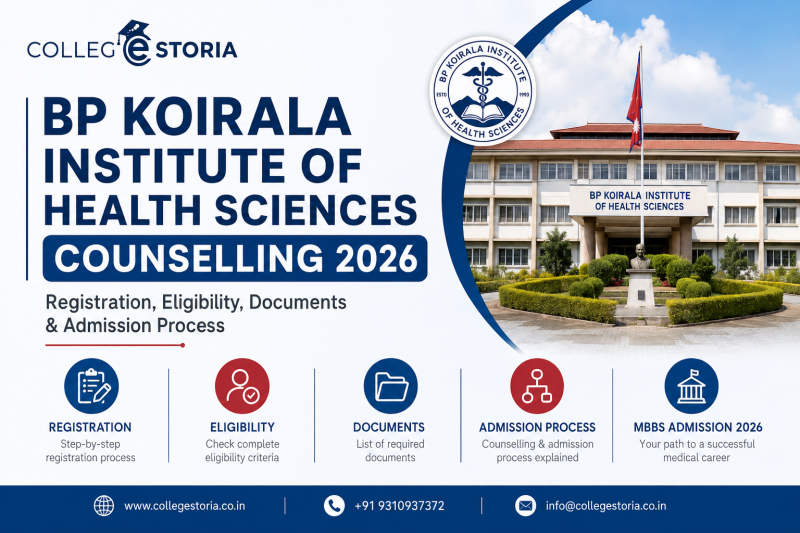
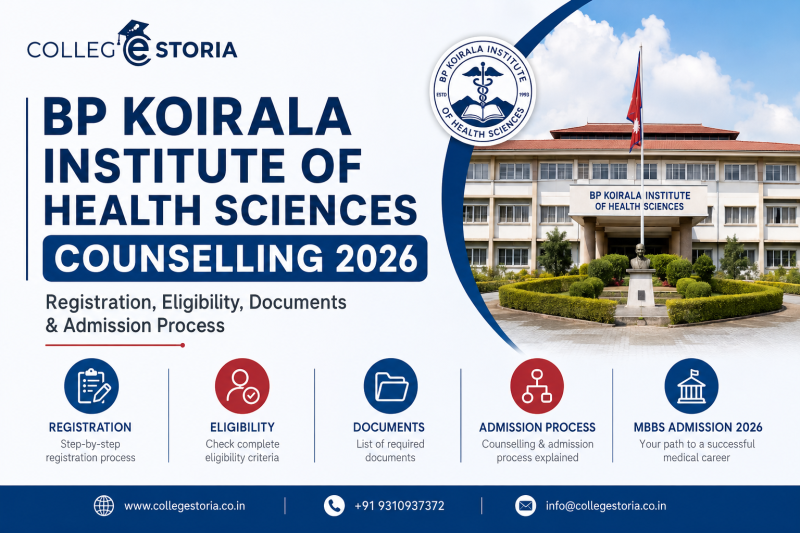
BP Koirala Institute of Health Sciences Counselling 2026: Registration, Eligibility, Documents & Admission Process
 Sakshi Padiyar
If you're an Indian student who has cleared NEET and is now looking seriously at MBBS options abroad, BP Koirala Institute of Health Sciences deserves a spot at the top of your shortlist. Tucked away in Dharan in eastern Nepal, this institute has quietly built a reputation that rivals some of the more heavily marketed destinations, largely because it offers something rare — a government-linked medical education system, genuine clinical exposure, and a counselling process that doesn't drown applicants in paperwork. This guide walks through exactly what the 2026 admission cycle looks like, step by step.
What Is BP Koirala Institute of Health Sciences?
BP Koirala Institute of Health Sciences, commonly referred to as BP Koirala Medical College Dharan or simply BPKIHS, is an autonomous health sciences university established in 1993 and named after former Nepalese Prime Minister Bishweshwar Prasad Koirala. It became a fully autonomous university in 1998 and today operates four constituent colleges: the Faculty of Medicine, the College of Dental Surgery, the College of Nursing, and the School of Public Health and Community Medicine. Its attached teaching hospital runs close to 700 beds, giving MBBS students direct exposure to real patient care from early in their training rather than years later.
In short: BPKIHS is a Nepal-India collaborative institute in Dharan, offering NMC-recognized, WHO-listed MBBS education with direct clinical training built into the curriculum.
Is BPKIHS Recognised in India?
Yes. This is usually the first question Indian parents ask, and rightly so. The MBBS degree from BPKIHS is recognised by the National Medical Commission (NMC) of India, listed in the World Directory of Medical Schools maintained by WHO, and accepted by the Nepal Medical Council. Graduates who wish to practice in India need to clear the FMGE/NExT screening exam after completing their degree — the same requirement that applies to any Indian student graduating from a foreign medical university.
Eligibility Criteria for BPKIHS MBBS Admission 2026
Before you start the counselling registration, make sure you actually meet the entry requirements. Here's what BPKIHS expects from Indian applicants:
- Completion of 10+2 (or equivalent) with Physics, Chemistry, Biology, and English as core subjects.
- A minimum of 50% aggregate marks in PCB for general category candidates, with relaxed criteria for reserved categories.
- A valid NEET-UG scorecard — this is mandatory, not optional. Indian students need to have crossed the qualifying percentile (50th percentile for general category, 40th percentile for SC/ST/OBC, in line with NMC's 2021 regulations).
- Minimum age of 17 years in the year of admission.
Quick answer: To be eligible for MBBS admission in Nepal through BPKIHS, an Indian candidate needs a qualifying NEET-UG score, at least 50% in PCB subjects at the 10+2 level, and to be at least 17 years old in the admission year.
One detail that surprises many families: candidates who have already qualified NEET are not required to sit for any separate BPKIHS entrance exam. The NEET scorecard itself becomes the basis for eligibility screening, which considerably simplifies the process compared to countries where a separate local entrance test is mandatory.
BPKIHS Counselling 2026: Registration Process
The counselling and admission process at BPKIHS is more streamlined than the multi-round system Indian students are used to with domestic NEET counselling. Here's how it typically unfolds:
- Online Application – Candidates fill out the application form on the official BPKIHS portal, uploading scanned copies of their 12th marksheet, NEET-UG scorecard, and passport.
- Document Verification – The admission office cross-checks academic records and NEET eligibility against NMC norms.
- Provisional Offer/Invitation Letter – Once verification is cleared, eligible candidates receive an offer letter confirming their seat.
- Fee Payment – Candidates pay the required tuition and hostel fees to confirm their admission.
- Visa and Travel Formalities – Since Indian nationals do not require a visa to enter Nepal, this step mainly involves student registration formalities rather than a full visa application process, making travel comparatively simple.
- Reporting and Enrollment – Students travel to Dharan, complete in-person document verification, and begin their MBBS journey.
Direct answer: BPKIHS admission for Indian students works on a direct-entry basis — apply online with your NEET scorecard and academic documents, get verified, receive an offer letter, pay fees, and travel to Dharan for enrollment. There are no separate counselling rounds like the ones conducted for Indian government medical colleges.
Documents Required for BPKIHS Admission
Keep both originals and photocopies of the following ready well in advance, since incomplete documentation is the single biggest reason applications get delayed:
- 10th and 12th mark sheets and passing certificates
- NEET-UG scorecard
- Transfer Certificate (TC) from the last institution attended
- Character Certificate
- Migration Certificate (for students from boards other than the local state board)
- Birth Certificate
- Passport (valid, though a visa is not required for Indian nationals)
- Recent passport-size photographs (4–6 copies)
- Medical Fitness Certificate from a recognised medical authority
- Offer/Invitation Letter issued by the university
What Makes BPKIHS a Strong Choice for MBBS Admission in Nepal?
Several practical factors explain why BPKIHS keeps appearing on shortlists for Indian medical aspirants:
- English-medium instruction — no language barrier for Indian students, and no IELTS or TOEFL requirement.
- Affordable structure — tuition is considerably lower than private medical colleges in India, with the full six-year program (tuition, hostel, and food) typically falling in a moderate, predictable range rather than fluctuating wildly year to year.
- Proximity to India — Dharan is easily reachable from cities like Siliguri, Kolkata, and Varanasi, so students can travel home during breaks without the logistics headaches associated with more distant study destinations.
- Cultural familiarity — shared cultural and culinary similarities between India and Nepal make the adjustment period noticeably smoother for most students.
- Substantial clinical exposure — the attached teaching hospital handles a heavy daily patient load across specialities, giving students hands-on experience earlier than many programs offer.
Frequently Asked Questions
1. Is a separate entrance exam required for BPKIHS MBBS admission? No. Indian candidates who have already qualified NEET-UG do not need to appear for any additional entrance test at BPKIHS.
2. What is the medium of instruction at BPKIHS? English is the primary medium of instruction, though students are also introduced to conversational Nepali to assist with patient interaction during clinical postings.
3. Do Indian students need a visa to study at BPKIHS? No. Indian nationals are exempt from visa requirements to enter Nepal, which simplifies the admission and travel process considerably.
4. Can BPKIHS graduates practice medicine in India? Yes, provided they clear the FMGE/NExT screening exam after completing their MBBS degree, which is the standard requirement for all foreign medical graduates seeking to practice in India.
Final Thoughts
The 2026 counselling cycle at BP Koirala Institute of Health Sciences rewards candidates who prepare their documentation early and understand the eligibility bar clearly rather than assuming every NEET-qualified candidate is automatically guaranteed a seat. For Indian families weighing MBBS admission in Nepal against domestic private college fees, BPKIHS stands out as a credible, recognised, and relatively affordable route into a medical career — as long as the paperwork, NEET percentile requirements, and application timelines are handled with the same seriousness as any Indian counselling process.
Source:
Click for the: Full Story
You might like