Close Menu
 World
World
 Biography
 Health
 Education
 Business
 Lifestyle
 Sports
 Technology
 Animals
 History
 Food
Food
 Religious
 Startups
 Movies
 Politics
 Fashion
 Covid
Covid
 Diet
Diet
 Fitness
 Marketing
 Travel
 Science
 Reviews
 Social media
 Stories
 Facts
Facts
 Art
Art
 Entertainment
Sakshi Padiyar

Education
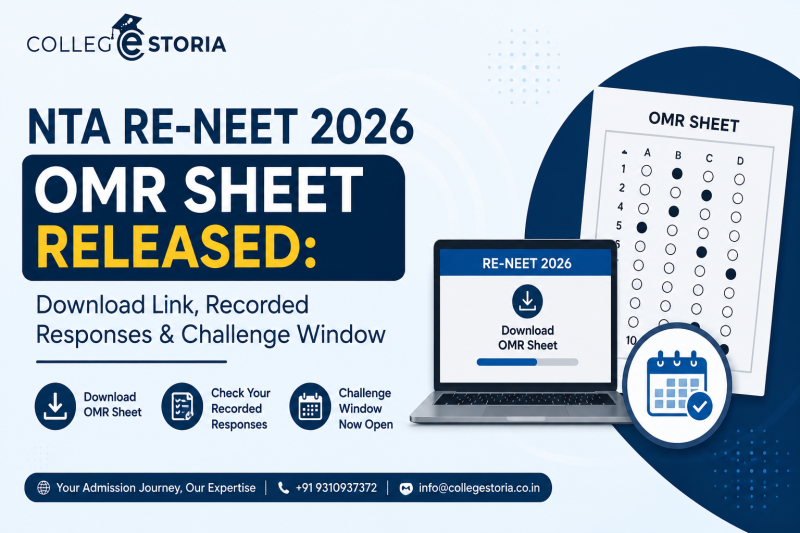
RE-NEET 2026 OMR Sheet Released: Download Link, Recorded Responses & Challenge Window
 Sakshi Padiyar
For thousands of medical aspirants across the country, the wait finally ended on July 13, 2026, when the National Testing Agency uploaded the RE-NEET 2026 OMR Sheet on the official NEET portal. If you sat for the re-conducted NEET UG exam on June 21, 2026, this is the moment to log in, check your recorded responses, and make sure everything the system captured actually matches what you marked on exam day. A single scanning mismatch can shift your rank by a wide margin, so this step deserves your full attention.
What Exactly Is the RE-NEET 2026 OMR Sheet?
Think of the OMR sheet as the digital mirror of your physical answer sheet. During the exam, you shaded bubbles against each question number; after the exam, NTA scans those sheets and converts them into recorded responses that feed directly into your final score. The RE-NEET 2026 OMR Sheet lets you view exactly what the scanner "read" from your paper — and occasionally, what the machine reads isn't what you intended to mark. That's precisely why NTA opens a short window for candidates to raise objections before locking in the final answer key.
This step matters more than most candidates realize. Your entire MBBS admission in India journey — from counselling eligibility to seat allotment — hinges on an accurate score, and that score is only as reliable as the OMR data behind it.
How to Download Your RE-NEET 2026 OMR Sheet
The process is fairly straightforward, but candidates should follow it carefully since the window doesn't stay open indefinitely.
- Visit the official NTA NEET portal at neet.nta.nic.in.
- Look for the link related to recorded responses or the OMR sheet for the NEET UG re-exam 2026.
- Log in using your application number and password (some portals also ask for a security pin or date of birth as an alternative).
- Complete the two-factor OTP verification if prompted.
- Once inside your dashboard, click on "View/Challenge OMR Sheet & Recorded Responses."
- Your scanned sheet along with the system-recorded answers will appear on screen.
- Download and save the PDF — you'll want this copy for your personal records regardless of whether you plan to raise an objection.
Keep in mind that the download and challenge facility is only available for a limited period, so candidates shouldn't delay this step even if they're confident about their responses.
The Challenge Window: What You Need to Know
NTA has opened the objection window for the RE-NEET 2026 OMR Sheet for a short stretch, closing on July 15. During this period, candidates who spot a discrepancy between what they marked and what the system recorded can formally challenge that specific response. The process involves selecting the question in doubt, indicating the option you actually marked, and paying a non-refundable processing fee of ₹200 per challenged response.
It's worth noting there's a difference between challenging your OMR response and challenging the answer key itself. Since the provisional answer key objection window closed earlier — around June 28 — this current window deals strictly with recorded responses, not with disputing whether an answer key option is scientifically correct. Read that distinction carefully before you pay any fee, because selecting the wrong challenge category could mean your objection never gets reviewed by the right team.
If NTA's review finds that a response was genuinely misread by the scanning system, the correction gets reflected before the final result is compiled. Fees for accepted challenges are refunded following NTA's standard process once the review concludes.
Why This Step Shapes Your MBBS Journey
Every year, a small percentage of candidates find that their score shifts — sometimes meaningfully — after checking their OMR sheet against the provisional key. For anyone eyeing MBBS admission in India, even a handful of marks can be the difference between qualifying for a government college seat and missing the cutoff altogether. Given how tightly contested NEET counselling rounds are, it pays to treat this verification stage as seriously as exam day itself.
At the same time, more and more Indian students are exploring MBBS admission in Nepal as a parallel or backup pathway, especially given the rising competition for domestic seats and the relatively accessible fee structures at several recognized Nepalese medical colleges. Whether your NEET score lands you a seat within India or you decide to look at neighbouring countries, verifying your RE-NEET OMR sheet accurately is the first checkpoint in that decision-making process — your actual, corrected score is what any counsellor or admission consultant will ask for first.
What Comes After the OMR Challenge Window Closes
Once the objection period ends, NTA's subject-matter panel reviews every valid challenge. Any confirmed correction gets folded into the final answer key, which is expected shortly after. The final NEET UG 2026 result — and with it, your official percentile and all-India rank — will be prepared only after this verification and correction cycle wraps up. Historically, NTA has moved fairly quickly once the OMR window closes, so candidates should keep an eye on the portal in the days that follow rather than assuming there's a long gap before results.
Planning: Where College Storia Fits In
Once your RE-NEET 2026 result is out, the real decision-making begins — shortlisting colleges, understanding counselling rounds, comparing government versus private seat costs, and, for many students, weighing options between domestic colleges and international MBBS destinations. This is where a platform like College Storia becomes genuinely useful. Instead of piecing together scattered forum posts and outdated PDFs, students can get organized, up-to-date guidance on college choices, admission cutoffs, and counselling procedures for both MBBS admission in India and MBBS admission in Nepal, all in one place.
Final Word
The release of the RE-NEET 2026 OMR Sheet is a small administrative step on paper, but for the candidate sitting behind the screen, it's a moment that can quietly determine the next several years of their career. Download your sheet, cross-check every response against what you remember marking, and if something looks off, don't hesitate to raise the challenge within the window. Getting this right now means one less thing to worry about when the final result — and your MBBS admission plans — start taking shape.
Source:
Click for the: Full Story
You might like