



 Close Menu
 World
World
 Biography
 Health
 Education
 Business
 Lifestyle
 Sports
 Technology
 Animals
 History
 Food
Food
 Religious
 Startups
 Movies
 Politics
 Fashion
 Covid
Covid
 Diet
Diet
 Fitness
 Marketing
 Travel
 Science
 Reviews
 Social media
 Stories
 Facts
Facts
 Art
Art
 Entertainment
yana james

Health
CycloBoon and Gym Workouts: Managing Muscle Pain, Spasms, and Tightness
 yana james
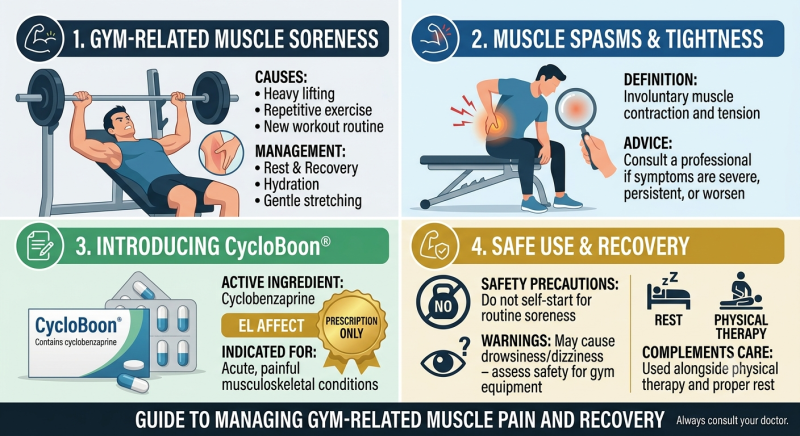
Regular gym workouts can support strength, flexibility, and overall fitness, but intense training may sometimes lead to muscle pain, muscle spasms, muscle tightness, and muscle stiffness. Heavy lifting, repetitive exercises, sudden increases in workout intensity, and inadequate recovery can place additional stress on the muscles and surrounding soft tissues.
CycloBoon contains cyclobenzaprine, a prescription muscle relaxant used for certain acute musculoskeletal conditions involving painful muscle spasms. It may be prescribed as part of a treatment plan alongside rest and other measures. However, CycloBoon is not intended to treat ordinary post-workout soreness, and its use should be based on advice from a healthcare professional.
What Causes Muscle Pain After Gym Workouts?
Gym-related muscle pain can develop when muscles are exposed to physical demands that are greater than they are accustomed to. This can happen after starting a new workout program, increasing weights, adding more repetitions, or returning to exercise after a break.
Common causes include:
- Heavy weightlifting
- High-intensity workouts
- New or unfamiliar exercises
- Overtraining
- Repetitive movements
- Poor exercise technique
- Inadequate recovery
- Muscle strain
Mild soreness after exercise may be associated with delayed-onset muscle soreness (DOMS). However, sudden or severe pain may have a different cause and should not automatically be considered normal workout soreness.
Understanding Muscle Spasms and Muscle Tightness
A muscle spasm is an involuntary contraction or tightening of a muscle. It can occur during exercise or afterward and may cause sudden discomfort.
Muscle tightness can feel like the affected muscle is tense, restricted, or difficult to relax. Gym-goers may notice tightness in areas such as the back, shoulders, legs, or neck.
When muscle spasms occur as part of an acute musculoskeletal condition, a healthcare professional may consider a prescription muscle relaxant such as cyclobenzaprine.
What Is CycloBoon?
CycloBoon is a brand containing cyclobenzaprine, a centrally acting skeletal muscle relaxant. Cyclobenzaprine is prescribed for certain acute, painful musculoskeletal conditions and is generally used together with rest and physical therapy or other supportive measures.
CycloBoon may be relevant when muscle spasms and associated discomfort are part of a diagnosed acute musculoskeletal condition. It should not be viewed as a routine medicine for normal gym soreness.
CycloBoon and Gym-Related Muscle Pain
People who experience significant musculoskeletal pain, muscle spasm pain, or muscle tightness after an injury may be evaluated by a healthcare professional to determine whether prescription treatment is appropriate.
CycloBoon may be prescribed when muscle spasms are contributing to an acute musculoskeletal condition. The appropriate treatment depends on the underlying cause, severity of symptoms, medical history, and other medicines being taken.
If your muscles are simply sore after a challenging workout, taking CycloBoon without medical advice is not appropriate.
CycloBoon and Muscle Stiffness
Muscle stiffness pain can occur after strenuous exercise, particularly when a person performs unfamiliar movements or trains intensely.
CycloBoon may be prescribed for certain acute musculoskeletal conditions where painful muscle spasms contribute to discomfort. However, ordinary post-workout stiffness usually calls for appropriate recovery rather than prescription muscle relaxant therapy.
Gentle movement, adequate recovery, hydration, and appropriate exercise progression may help with mild workout-related stiffness.
CycloBoon and Exercise Safety
Cyclobenzaprine may cause side effects such as drowsiness, dizziness, and fatigue. These effects are particularly important for people who exercise or operate gym equipment.
If CycloBoon has been prescribed to you, do not assume that it is safe to continue heavy lifting or high-intensity exercise while taking it. Ask your healthcare professional when you can safely return to your normal workout routine.
Avoid activities requiring full alertness or coordination if the medicine makes you drowsy or dizzy.
Should You Take CycloBoon Before a Workout?
CycloBoon should not be taken specifically to allow you to exercise through significant pain unless your healthcare professional has instructed you to do so.
Pain can indicate that a muscle or soft tissue structure needs recovery or evaluation. Masking significant pain and continuing heavy exercise could potentially worsen an underlying problem.
Always follow the prescribed dose and instructions provided by your healthcare professional.
Muscle Pain, Soft Tissue Pain, and Gym Injuries
Soft tissue pain may involve muscles, tendons, ligaments, or other connective tissues. It can occur following overuse, repetitive exercise, poor technique, or an acute injury.
Gym-related injuries may involve:
- Shoulder muscles
- Lower back muscles
- Hamstrings
- Quadriceps
- Calves
- Chest muscles
- Arms
- Neck muscles
If pain is sudden, severe, or associated with swelling, bruising, weakness, or restricted movement, stop the exercise and seek appropriate medical advice.
Managing Acute Musculoskeletal Pain
Acute musculoskeletal pain should be evaluated based on its underlying cause. Depending on the condition, treatment may include rest, activity modification, physical therapy, rehabilitation, and medication when medically appropriate.
For certain acute musculoskeletal conditions associated with painful muscle spasms, a healthcare professional may prescribe a muscle relaxant such as cyclobenzaprine.
CycloBoon should be used only as directed by a qualified healthcare professional and should not be self-started for routine gym soreness.
CycloBoon and Post-Workout Recovery
Recovery remains important even when prescription treatment is being used for a specific musculoskeletal condition.
Helpful recovery habits can include:
- Getting adequate rest
- Gradually returning to exercise
- Staying hydrated
- Using appropriate stretching and mobility exercises
- Following a structured rehabilitation plan when recommended
- Avoiding exercises that worsen pain
- Increasing workout intensity gradually
Medication should complement an appropriate treatment and recovery plan rather than replace healthy exercise habits.
How to Prevent Gym-Related Muscle Pain and Spasms
Although workout soreness cannot always be avoided, several habits can help reduce unnecessary muscle stress:
- Warm up before exercise
- Use proper lifting technique
- Increase weights gradually
- Avoid sudden increases in workout volume
- Allow adequate recovery between intense sessions
- Stay hydrated
- Maintain balanced nutrition
- Include rest days
- Avoid training through severe pain
- Follow professional advice after an injury
When Should You Seek Medical Advice?
Not every case of muscle pain, muscle stiffness, or muscle tightness requires medication. However, medical evaluation may be appropriate if symptoms are severe, persistent, worsening, or interfering with normal movement.
Seek professional advice for symptoms such as:
- Sharp or severe pain
- Significant swelling
- Extensive bruising
- Severe weakness
- Repeated muscle spasms
- Difficulty moving the affected area
- Pain following a significant injury
- Symptoms that do not improve with appropriate recovery
Frequently Asked Questions
Is CycloBoon suitable for normal gym soreness?
CycloBoon is not intended as a routine treatment for normal post-workout soreness. It contains cyclobenzaprine and may be prescribed for certain acute musculoskeletal conditions involving painful muscle spasms.
Can CycloBoon be used for muscle spasms?
Cyclobenzaprine, the active ingredient in CycloBoon, may be prescribed for certain acute musculoskeletal conditions associated with muscle spasms. A healthcare professional should determine whether it is appropriate.
Can I exercise while taking CycloBoon?
Cyclobenzaprine may cause drowsiness, dizziness, or fatigue. Speak with your healthcare professional about whether and when exercise is safe while taking CycloBoon.
What can cause muscle tightness after the gym?
Muscle tightness may result from intense exercise, unfamiliar movements, repetitive training, inadequate recovery, or muscle strain.
When is gym muscle pain a concern?
Severe, sharp, persistent, or worsening pain, especially when accompanied by swelling, weakness, bruising, or restricted movement, should be evaluated by a healthcare professional.
Final Thoughts
CycloBoon and gym workouts should be considered separately when it comes to normal exercise soreness versus medically significant muscle spasms. While routine gym activity can cause muscle pain, muscle stiffness, muscle tension, and muscle tightness, CycloBoon is a prescription muscle relaxant intended for specific acute musculoskeletal conditions.
If muscle spasms or acute musculoskeletal pain develop after an injury or intense physical activity, consult a healthcare professional to determine the appropriate treatment. Do not use CycloBoon simply to push through workout pain, and always follow prescribed instructions regarding medication and exercise.
Source:
Click for the: Full Story
You might like






You Might Like this