Close Menu
 World
World
 Biography
 Health
 Education
 Business
 Lifestyle
 Sports
 Technology
 Animals
 History
 Food
Food
 Religious
 Startups
 Movies
 Politics
 Fashion
 Covid
Covid
 Diet
Diet
 Fitness
 Marketing
 Travel
 Science
 Reviews
 Social media
 Stories
 Facts
Facts
 Art
Art
 Entertainment
Marketing Saad

Technology
ERP Integration Services: 7 Benefits for Growing Businesses
 Marketing Saad
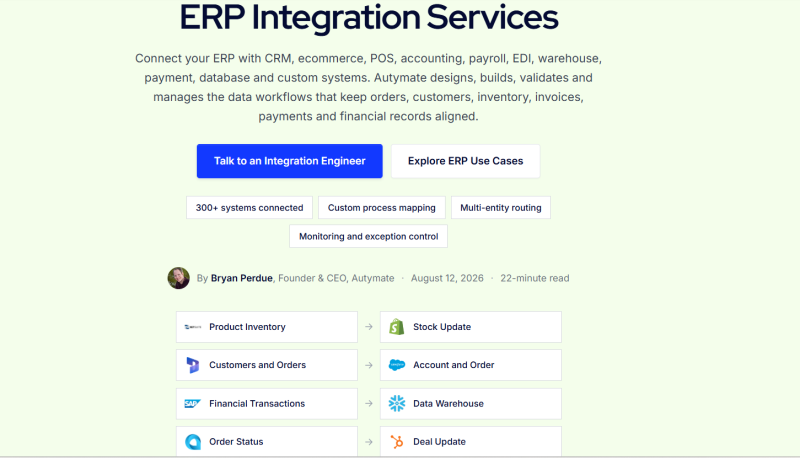
Sales teams may work in a CRM, ecommerce orders may come from an online store, payments may be processed elsewhere, warehouses may use dedicated inventory systems, and finance may depend on accounting applications alongside an ERP.
Each system can work well independently. The challenge begins when information needs to move between them.
Employees start downloading reports, importing spreadsheets, entering the same information more than once, and checking whether records in one application match another. As the business grows, these manual processes become harder to maintain.
ERP integration services address this problem by connecting an enterprise resource planning system with the applications, databases, partners, and workflows surrounding it.
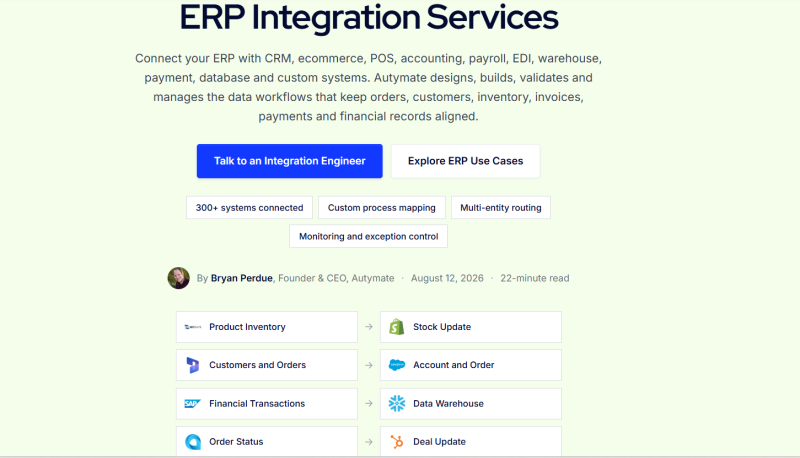
A well-designed ERP integration does more than copy fields. It preserves the meaning of customers, products, orders, inventory, invoices, payments, locations, and financial information as those records move between different systems. Autymate's ERP architecture is designed around connecting ERP environments with CRM, ecommerce, POS, accounting, payroll, EDI, databases, warehouses, payment, and custom systems.
For a growing organization, that creates several important benefits.
1. Reduce Manual Data Entry Between Systems
One of the first problems ERP integration can solve is repeated data entry.
Consider a sales process that begins in a CRM. Once a deal closes, someone may need to create the customer and order again in the ERP. Later, finance may need the same information in another system.
Every manual handoff adds work.
It also creates another opportunity for customer names, product codes, quantities, prices, dates, or other values to be entered incorrectly.
With ERP integration, approved events can trigger structured data movement between systems. Instead of an employee re-entering the information, the workflow can transform and route it according to predefined business rules.
This does not mean every field should be synchronized automatically. The integration should move the information required by the next business process while maintaining clear ownership of the original data.
The result is less repetitive administrative work and a more consistent operational workflow.
2. Improve Data Accuracy and Consistency
Growth increases the number of systems, transactions, employees, and locations contributing data.
Without clear integration rules, different applications can gradually contain different versions of the same information.
A product may have one identifier in ecommerce and another in the ERP. A customer may exist several times. A department might classify transactions differently from another business unit.
ERP integration services can introduce structured mapping and validation before data reaches the destination.
Fields, identifiers, accounts, locations, customers, products, transaction types, and other dimensions can be mapped according to the company's requirements. Validation can then check whether required information exists and whether the record is safe to process.
Autymate's integration approach includes mapping, transformation, validation, routing, duplicate prevention, and monitoring rather than relying on direct field copying alone.
For growing organizations, this consistency becomes increasingly valuable because correcting data after it has spread across several systems is much harder than validating it before transfer.
3. Connect Sales, Ecommerce, Inventory, and Finance
One of the biggest advantages of ERP integration is that it can connect processes that span multiple departments.
A customer order is a good example.
The order may start in ecommerce or CRM, but fulfilling it can involve the ERP, inventory, warehouse operations, payments, shipping, invoicing, and accounting.
If each system operates independently, employees may need to manually update the next system as the order progresses.
Integration creates a more connected process.
An approved order can enter the ERP with the correct customer and product information. Inventory or fulfillment activity can update the appropriate downstream process. Financial information can then support invoicing, payment, or accounting requirements.
ERP integration is broader than accounting integration because ERP workflows can include orders, inventory, procurement, fulfillment, customers, vendors, projects, and financial processes.
For growing businesses, this helps technology support the complete operational process rather than forcing employees to connect departments manually.
4. Make Multi-Location and Multi-Entity Growth Easier
A process that works for one company or location can become difficult when the organization expands.
Each additional entity may introduce its own credentials, subsidiaries, locations, departments, currencies, accounts, or operational settings.
Rebuilding the integration independently for every new entity creates unnecessary complexity.
A better approach is to create reusable integration logic while preserving entity-specific configuration.
For example, common product mappings, transaction types, validation requirements, and business rules may be standardized across the organization. At the same time, company IDs, accounts, departments, locations, currencies, and credentials can remain configurable for each entity.
Autymate's ERP architecture follows this model, using reusable templates, explicit entity routing, configurable company-specific settings, expected-data monitoring, and repeatable onboarding.
This is particularly valuable for franchises, multi-location brands, subsidiaries, and businesses expanding through acquisitions.
Growing faster than your integrations can keep up?
Autymate can help connect ERP, CRM, ecommerce, POS, accounting, databases, and other operational systems through workflows designed around your actual data and business rules.
Talk to an Integration Expert about your ERP workflow.
5. Improve Visibility Into Integration Failures
Automating data movement does not eliminate the possibility of errors.
An API can become unavailable. Credentials can expire. A product might appear without a mapping. A record may contain an invalid value. A destination system can reject a transaction.
The difference between a basic connection and a managed integration is what happens next.
A dependable workflow should make problems visible.
Monitoring can identify failed records, missing expected data, processing delays, duplicate attempts, credential issues, mapping changes, API limits, and reconciliation problems.
This matters because a technically successful integration call does not necessarily mean the correct business result exists inside the ERP.
For example, an order could reach the destination but be associated with the wrong entity, product, or financial dimension.
The final result should therefore be validated at the business level, not only at the API level.
Growing organizations need this visibility because manually reviewing every integration transaction becomes unrealistic as volume increases.
6. Create More Scalable Business Processes
Growth often exposes weaknesses in processes that were originally designed for a smaller organization.
A team may successfully manage hundreds of records with spreadsheets and manual imports. At tens of thousands of records, the same process can become expensive and difficult to control.
ERP integration creates a foundation for handling greater transaction volume without increasing manual work at the same rate.
But scalability is not only about volume.
The integration architecture also needs to handle new systems, entities, products, channels, and workflow rules.
A reusable integration layer can centralize transformations, validation, routing, credentials, monitoring, and onboarding templates. As the technology environment expands, the business can extend this framework instead of creating a collection of unrelated point-to-point connections.
That can make future ERP projects easier to manage because the organization already has an established approach to connecting systems.
7. Adapt Integrations as the Business Changes
ERP integration is not necessarily a one-time implementation.
Businesses change.
New sales channels appear. Products are reorganized. Companies acquire new locations. ERP configurations change. APIs evolve. Accounting structures are updated.
An integration that works today may need adjustments later.
This is why ongoing ownership matters.
A managed integration approach can include monitoring, troubleshooting, mapping updates, controlled reprocessing, and expansion as the business adds new requirements.
Autymate's implementation methodology includes defining the intended business outcome, confirming available access, mapping data, building controls, testing realistic scenarios, verifying the destination result, and then managing failures and changes after launch.
For a growing company, this means integration becomes part of the operational infrastructure rather than an isolated technical project.
When Should a Business Consider ERP Integration Services?
Not every connection requires a custom integration.
If two applications already have a native connector that supports the required records, mappings, volume, controls, and monitoring, the simplest existing option may be sufficient.
More specialized ERP integration services become valuable when workflows involve complex transformations, several systems, proprietary applications, multiple entities, unusual business rules, high transaction volumes, EDI or file-based processes, or stronger monitoring requirements.
Autymate's ERP guidance recommends choosing the least complex architecture that adequately controls the process, data, scale, security, and ownership requirements. Native connectors, configurable automation, custom APIs, EDI or managed file transfers, databases, and managed integration frameworks can all be appropriate depending on the workflow.
The objective is not to build the most technically complex integration.
It is to create a reliable business process.
Build an ERP Environment That Can Grow With Your Business
ERP software can bring finance, inventory, purchasing, orders, and operations together, but its value is limited when the rest of the organization's systems remain disconnected.
ERP integration services help close that gap.
They can reduce repetitive data entry, improve consistency, connect cross-department workflows, support multi-location expansion, provide better integration visibility, handle increasing transaction volume, and adapt as the business changes.
For growing organizations, those benefits can turn the ERP from another isolated application into a more connected part of the technology ecosystem.
Autymate designs and manages ERP integration workflows around the systems, data structures, mappings, validation requirements, entities, and business rules involved in the actual process.
Source:
Click for the: Full Story
You might like