Close Menu
 World
 Biography
 Health
 Education
 Business
 Lifestyle
 Sports
 Technology
 Animals
 History
 Food
 Religious
 Startups
 Movies
 Politics
 Fashion
 Covid
 Diet
 Fitness
 Marketing
 Travel
 Science
 Reviews
 Social media
 Stories
 Facts
 Art
 Entertainment
samiksha

Business
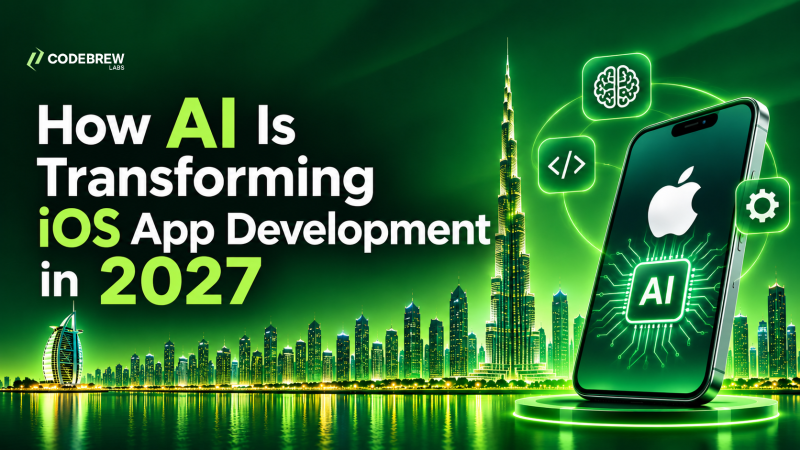
How AI Is Transforming iOS App Development in 2027?
 samiksha
Artificial intelligence is transforming mobile app design and usage by enabling personalized recommendations and intelligent virtual assistants. This integration has become essential for iOS app development as businesses aim to enhance customer connections and digital services.
By 2027, Apple's focus on on-device intelligence and machine learning is creating new opportunities for developers. iOS applications can offer personalized interactions, automate tasks, and better respond to user needs.
For businesses in the UAE and other growing markets, these developments create opportunities to build smarter applications. Working with an experienced iOS app development company can help organizations identify the right AI technologies and integrate them into their mobile products.
Let's explore how AI is transforming iOS app development and what businesses should know about these changes.
1. Personalized User Experiences Through AI
One of the biggest contributions of AI to iOS app development is personalization. Users expect applications to understand their interests and provide relevant suggestions instead of showing the same content to everyone.
AI algorithms can analyze user preferences, browsing patterns, previous purchases, and interactions to deliver personalized recommendations.
For example, an eCommerce application can suggest products based on shopping activity. A music application can recommend playlists based on listening habits, while a travel application can suggest destinations according to previous searches.
These personalized features help businesses make applications more relevant to individual users and encourage them to return.
2. Smarter Customer Support With AI Chatbots
Customer support is an important part of every business application. However, handling large numbers of customer questions manually can take time and resources.
AI-powered chatbots help businesses provide faster responses to common questions. They can assist users with order tracking, appointment scheduling, product information, account-related queries, and service requests.
Modern AI assistants can also understand natural language, making conversations feel more convenient than traditional rule-based chatbots.
For example, a UAE-based retail business can integrate an AI chatbot into its iOS application to help customers find products, check delivery information, and understand return policies.
Businesses can use human support teams for more complicated requests while AI assistants handle routine interactions.
3. On-Device AI Is Improving Application Intelligence
On-device AI is becoming an important development area for Apple applications. Instead of sending every request to an external server, certain AI tasks can be processed directly on supported devices.
Apple's machine learning technologies, including Core ML and its growing Apple Intelligence capabilities, provide developers with opportunities to build intelligent features into applications.
Some possible applications include:
- Smart text suggestions and writing assistance.
- Image recognition and classification.
- Voice processing and transcription.
- Personalized recommendations.
- Intelligent search functionality.
- Context-aware application features.
On-device processing can also reduce the need to transfer certain information to external servers. However, developers must consider device compatibility, model size, processing requirements, and privacy when implementing these features.
4. AI-Powered Search Is Making Navigation Easier
Traditional application search usually depends on exact keywords. Users need to enter specific product names or phrases to find what they want.
AI is making search functionality more flexible through natural language processing and semantic search.
For example, instead of searching for a particular product name, a customer might enter "comfortable shoes for daily office use." An AI-powered search system can understand the intent and display relevant results.
This approach can be useful for eCommerce platforms, property applications, travel services, and content-based mobile applications.
By making information easier to find, AI-powered search can improve navigation and reduce the effort users need to complete everyday tasks.
5. AI Is Supporting Faster App Development
AI is not only changing application features but also improving the development process itself.
Developers can use AI-assisted tools to generate code suggestions, identify errors, create test cases, explain technical problems, and improve development workflows.
These tools can help development teams complete repetitive tasks more efficiently. They also provide support during debugging and documentation.
However, AI-generated code still requires developer review. Security, performance, compatibility, and application quality must be checked before implementation.
An experienced iOS development team can combine AI-assisted workflows with technical knowledge to maintain code quality throughout the project.
6. Better Application Security Through AI
Mobile applications often manage sensitive information, including personal details, payment records, and business data. Protecting this information is essential for building customer trust.
AI can support application security by identifying unusual patterns and helping detect potentially suspicious activities.
For example, a fintech application can use intelligent monitoring systems to identify unusual transaction behavior. An account management application can flag unexpected login patterns for further verification.
AI can also assist security teams in analyzing application activity and identifying possible vulnerabilities.
However, AI should work alongside established security practices such as encryption, secure authentication, access controls, and regular security testing.
7. AI Is Improving Voice-Based Interactions
Voice technology is making mobile applications more convenient, particularly for users who prefer speaking instead of typing.
AI-powered voice features can help users search for information, navigate application sections, create reminders, and interact with digital assistants.
For example, a travel application could allow users to search for flights using voice commands. A healthcare application might support voice-based appointment requests, while a productivity application could convert spoken instructions into tasks.
Apple provides developers with technologies such as Speech and Siri-related integrations to support voice-based functionality.
As natural language processing continues to improve, voice interactions can become a more useful part of everyday mobile application development.
8. Predictive Analytics Is Helping Businesses Make Better Decisions
AI-powered predictive analytics allows applications to identify patterns in existing data and estimate possible future outcomes.
Businesses can use these insights to understand customer behavior, identify purchasing trends, and improve their services.
For example, a retail application can analyze shopping activity to identify products customers may be interested in. A logistics application can use historical information to support delivery planning, while a subscription-based platform can identify patterns associated with customer cancellations.
These insights help businesses make more informed decisions and plan their next steps.
When combined with appropriate analytics systems, AI-powered iOS applications can become useful sources of business information.
AI Is Creating New Opportunities Across Industries
Different industries are finding practical ways to use AI in their iOS applications. The technology can support customer-facing services as well as internal business operations.
Some important examples include:
- Healthcare: AI-assisted symptom information, appointment management, medical image analysis, and patient communication.
- Fintech: Fraud detection, spending insights, transaction monitoring, and personalized financial information.
- eCommerce: Product recommendations, intelligent search, customer support, and shopping assistance.
- Real Estate: Property recommendations, image-based searches, virtual property assistance, and lead management.
- Education: Personalized learning suggestions, AI tutoring, language support, and automated assessments.
- Travel and Hospitality: Smart travel recommendations, booking assistance, itinerary planning, and multilingual support.
These applications show how AI can address specific industry requirements rather than simply adding technology for the sake of it.
AI Is Supporting More Accessible Applications
Accessibility is another area where AI can make a difference. Businesses want their applications to be easy to use for people with different needs and preferences.
AI-supported technologies can assist with speech recognition, text processing, image descriptions, and language translation.
For example, an application can provide speech-to-text functionality for users who prefer speaking. Image recognition can help describe visual content, while translation features can support users who communicate in different languages.
These capabilities can make mobile applications more inclusive and improve access to digital services.
What Should Businesses Consider When Integrating AI Into iOS Apps?
Although AI offers several opportunities, successful implementation requires careful planning. Businesses should identify which problems they want AI to solve before selecting technologies.
Here are some important considerations:
- Define business objectives: Identify whether AI is needed for personalization, automation, search, customer support, or analytics.
- Choose suitable AI technologies: Select technologies based on application requirements, device compatibility, and performance needs.
- Protect user information: Follow appropriate privacy practices and avoid collecting unnecessary personal data.
- Focus on usability: AI features should make the application easier to use rather than create additional complexity.
- Test AI functionality: Evaluate accuracy, performance, security, and reliability before launching features.
- Plan for future updates: AI models and application requirements can change, so regular maintenance and improvements are important.
Working with an experienced development team can help businesses make these decisions and avoid unnecessary technical complexity.
Conclusion
AI is transforming iOS app development in 2027 by making applications more intelligent, personalized, secure, and convenient. From AI-powered chatbots and predictive analytics to on-device intelligence and smarter search, these technologies are creating new opportunities for businesses across different industries.
However, successful AI integration depends on choosing features that solve real problems and provide value to users. Businesses need the right development strategy, suitable technologies, and a clear understanding of their customers' expectations.
Code Brew Labs, a Dubai-headquartered technology company established in 2013, brings over 13 years of industry experience and a team of 250+ technology experts to mobile app development, custom software, and AI solutions. Its capabilities help businesses explore intelligent application features and build digital products aligned with their goals.
As AI continues to evolve, businesses that adopt useful AI capabilities in their iOS applications will be better positioned to improve customer interactions, streamline operations, and compete in the changing digital marketplace.
Source:
Click for the: Full Story
You might like